
Heart ‘blueprint’ reveals origins of defects and insights into fetal development
29.10.2025 11:13:11 CET | KTH Royal Institute of Technology | Press Release
New research has produced a “blueprint” revealing how the human heart is built during prenatal development. It offers insights that could lead to improved prenatal care and new treatments for heart defects, such as holes between heart chambers or deformities of the heart valves.
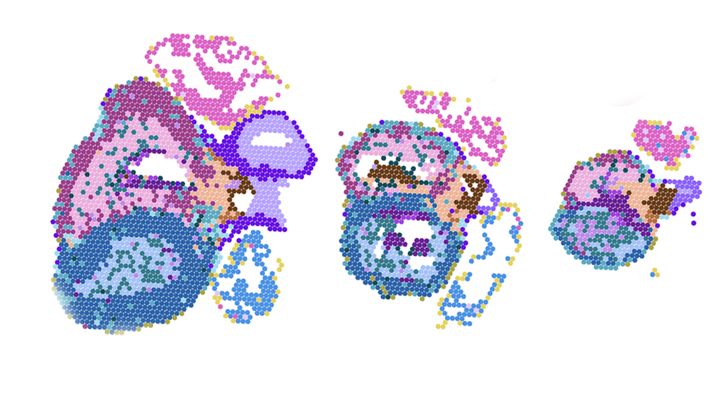
Publishing in Nature Genetics, a research team led by the department of Gene Technology at KTH Royal Institute of Technology published a detailed map of the developing human heart, showing how different groups of cells are arranged and how they interact in fetal heart development.
“Congenital heart diseases, and several acquired ones, originate during early development, which highlights the importance of this period in defining a healthy heart,” says Enikő Lázár, co-lead author of the study.
“This map provides a kind of blueprint, showing how key parts of the heart—like the pacemaker system, heart valves, and the wall between the upper chambers—form and function,” Lázár says.
Among the findings was the discovery of a previously unknown group of cells that produce adrenaline. Lázár says these cells are likely unique to humans and may help the heart respond to low oxygen levels during development or birth. This may explain how the fetal heart adapts to stress and indicates a possible origin of rare heart tumors called pheochromocytomas, the researchers reported.
KTH Professor Joakim Lundeberg, who led the research team, says the work was carried out with cutting-edge technology invented at KTH that allows researchers to study the activity of all genes in human tissue.
This method of spatial transcriptomics enables visualization and analysis of the full range of messenger RNA, or mRNA, molecules expressed by an organism, says Raphaël Mauron, co-lead author of the study. “With careful bioinformatic analysis, we can learn details of heart development that were not possible even a few years ago,” Raphaël Mauron says.
Drawing on the Developmental Tissue Bank of Karolinska Institutet, the map identifies more than 70 distinct cell types, revealing a surprising variety among certain support cells and tracking how nerve connections begin to form.
Other key insights reported:
- The cells forming heart valves and the atrial septum are more diverse, which offers clues to how the heart’s internal structures form and why certain congenital heart defects—like valve malformations or holes between chambers—occur.
- The fetal heart has an unexpected variety of supporting cells, or mesenchymal cells, which provide a kind of scaffolding to help shape the heart’s structure and may even be involved in diseases like valve defects or arrhythmias.
- A precise map of the wiring of cells that form the heart’s natural pacemaker and conduction system, including the sinoatrial node, which sets the heartbeat, and Purkinje fibers, which spread the signal.
- The map also traces how nerve cells and their support cells grow into the heart and connect with pacemaker cells, revealing that different types of their signals—like noradrenaline and acetylcholine—start influencing the heart early on.
The findings are available through an interactive online tool, offering a valuable resource for understanding heart development and its links to genetic heart conditions.
The study was conducted by researchers from KTH Royal Institute of Technology, Karolinska Institutet, and Stockholm University through the joint research center Science for Life Laboratory (SciLifeLab), as part of the Human Developmental Cell Atlas initiative funded by the Erling Persson Foundation and Knut and Alice Wallenberg Foundation.
Spatiotemporal Gene Expression and Cellular Dynamics of the Developing Human Heart, Nature Genetics, DOI: 10.1038/s41588-025-02352-6
Contacts:
Joakim Lundeberg, KTH Royal Institute of Technology
E-mail: joalun@kth.se, joakim.lundeberg@scilifelab.se
Enikő Lázár, KTH Royal Institute of Technology
E-mail: eniko.lazar@scilifelab.se
Images
Subscribe to releases from KTH Royal Institute of Technology
Subscribe to all the latest releases from KTH Royal Institute of Technology by registering your e-mail address below. You can unsubscribe at any time.
Latest releases from KTH Royal Institute of Technology
With climate-resilient crops in mind, study tackles flaw in photosynthesis22.10.2026 13:56:58 CEST | Press Release
Rising temperatures and increasing drought are shortening crop growing seasons in many parts of the world. Now scientists in Sweden report new advances toward engineering more efficient photosynthesis, work that could eventually contribute to efforts to adapt crops for climate change.
Now multiple optical devices' stabilizing properties can be identified with a single reprogrammable chip14.10.2026 13:03:08 CEST | Press Release
In optical fibers, chips and other light-guiding devices, minor defects can scatter photons and disrupt their path. A new study demonstrates a way to reveal properties which, in certain systems, help light wave behavior withstand such flaws. The method could help speed up the search for new kinds of electronics and optical technologies, and contribute to more reliable quantum devices.
Researchers identify aggressive molecular features in low-risk prostate cancer7.10.2026 13:41:39 CEST | Press Release
A new study revealed molecular features linked to more aggressive prostate cancer in a subset of patients who had been classified as low risk, highlighting biological differences that may not be apparent from clinical measures alone. The results could lead to new therapeutic strategies.
Why do spruce take decades to reproduce? A genetic study offers new clues14.9.2026 17:41:41 CEST | Press Release
New techniques have enabled researchers in Sweden to begin decoding how one of Northern Europe's most important coniferous tree species switches from growing branches to producing cones – their seed-bearing reproductive organs.
KTH builds Swedish expertise in nitrocellulose2.9.2026 12:54:32 CEST | Press Release
Sweden wants to reduce its dependence on foreign suppliers for nitrocellulose, a raw material central to the production of conventional propellants. KTH is now launching a new competence centre to build up expertise across the entire chain – from forest-based raw materials and manufacturing to safe storage.
In our pressroom you can read all our latest releases, find our press contacts, images, documents and other relevant information about us.
Visit our pressroom