
Lysosomes in focus: New study reveals how cells keep them intact
9.1.2026 10:00:00 CET | Umeå University | Press Release
When the cell’s recycling stations, the lysosomes, start leaking, it can become dangerous. Toxic waste risks spreading and damaging the cell. Now, researchers at Umeå University have revealed the molecular sensors that detect tiny holes in lysosomal membranes so they can be quickly repaired – a process crucial for preventing inflammation, cell death, and diseases such as Alzheimer’s.
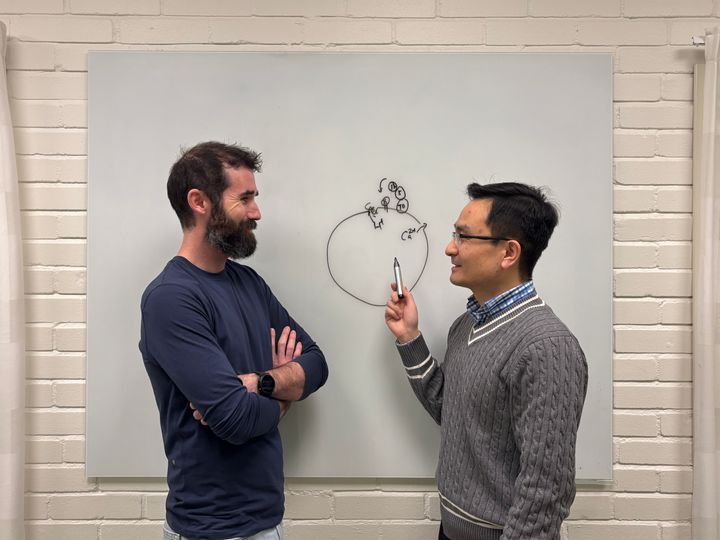
Lysosomes are the cell’s recycling stations, handling cellular waste and converting it into building blocks that can be reused. Lysosomal membranes are frequently exposed to stress from pathogens, proteins, and metabolic byproducts. Damage can lead to leakage of toxic contents into the cytoplasm, which in turn may cause inflammation and cell death. Until now, the mechanism by which cells detect these membrane injuries has remained unknown.
In a recently published study, professor Yaowen Wu and his research group at the Department of Chemistry at Umeå University, identified the signalling pathway that is activated in response to lysosomal damage. This discovery laid the foundation for understanding how the cell senses membrane injuries.
Sensors identified
In the new study, the researchers take it a step further and have discovered two autophagy protein complexes that serve as the long-sought sensors of lysosomal damage.
“They respond and quickly move to the damaged membranes when protons or calcium leak out, initiating the repair system that seals the hole. We observed that without these two key proteins, the cell fails to repair the damage, causing the lysosome to rupture,” says Yaowen Wu, lead author of the study.
Combination of techniques
The team used a combination of live-cell imaging, genetic knockout models, advanced microscopy, and functional repair assays to map the sequence of events following controlled lysosomal damage.
The results apply to several different types of cells and show the same underlying mechanism.
Next step in research
“The discovery provides a new understanding and opens the door to new treatment strategies for diseases where lysosomal damage plays a central role. In future studies, we will investigate links to neurodegeneration, infections, and inflammation,” says Yaowen Wu.
Dale Corkery, staff scientist and first author, adds:
“It is vital that lysosomal contents stay where they belong. If we understand why leaks sometimes go undetected, we can also understand why cells die in neurodegenerative diseases.”
The study is published in the scientific journal EMBO Journal.
About the scientific article
Corkery DP, Wijayatunga D, Feron BKL, Herzog LK, Knyazeva A, and Wu YW: The ATG8 E3-like ligases sense lysosomal damage and initiate ESCRT-mediated membrane repair. EMBO J. 2026. doi: 10.1038/s44318-025-00672-1.
Contacts
Yaowen WuProfessorDepartment of Chemistry
Tel:+46 90-786 55 31yaowen.wu@umu.seDale CorkeryStaff scientistDepartment of Chemistry
dale.corkery@umu.seSara-Lena BrännströmCommunications officerFaculty of Science & Technology
Tel:+46 90 786 72 24sara-lena.brannstrom@umu.seGeneral Press InquiriesPress Officer
Tel:+46 90 786 50 89press@umu.seImages

About us
Umeå University is a comprehensive university and one of Sweden’s largest higher education institutions with around 38,000 students and 4,600 staff. We have a diverse range of high-quality educational programmes and research within all disciplinary domains and the arts. The University offers world-class educational and research environments and helps expand knowledge of global significance. This is where the groundbreaking discovery was made of the CRISPR-Cas9 gene-editing tool, which was awarded the Nobel Prize in Chemistry. At Umeå University, everything is just around the corner. Our tightly knit campus makes it easy to meet, collaborate and share knowledge, something that encourages a dynamic and open culture.
Subscribe to releases from Umeå University
Subscribe to all the latest releases from Umeå University by registering your e-mail address below. You can unsubscribe at any time.
Latest releases from Umeå University
Recreating heatwaves in the lab to help older people stay well at home5.11.2026 12:00:00 CET | Press Release
A climate chamber, virtual environments and technology that monitors the body and brain. Using these resources, researchers at Umeå University will identify ways to protect older adults’ mental well-being during heatwaves at home in northern Sweden.
Bildmuseet: New book on AI, art and agency4.11.2026 08:00:00 CET | Press Release
The use of AI raises fundamental questions about who or what has agency. What happens when decision-making power shifts away from the individual? What does it mean for artists, for society, for the planet and for the future of humanity? A new publication from Bildmuseet at Umeå University explores these urgent questions.
New findings on drug treatment for Compulsive Sexual Behaviour Disorder8.10.2026 07:45:00 CEST | Press Release
Medication used to treat addiction is no more effective than antidepressants in treating Compulsive Sexual Behaviour Disorder (CSBD). This is shown in a new study from Umeå University and Karolinska Institutet. However, the medications differ in terms of side effects and the way symptoms improve over time.
First country to turn around type 2 diabetes trend7.10.2026 14:13:59 CEST | Press Release
Mauritius is the first country in the world to have successfully reduced the prevalence of type 2 diabetes after decades of rising rates, according to a new study involving researchers from Umeå University. The decline has been observed across all population groups and among both women and men.
3D printers can make advanced research more accessible5.10.2026 08:00:00 CEST | Press Release
Developing new research equipment is often expensive and time-consuming. In his doctoral thesis, Daniel Nilsson at Umeå University demonstrates how standard 3D printers can be used to rapidly manufacture advanced scientific instruments directly in the laboratory.
In our pressroom you can read all our latest releases, find our press contacts, images, documents and other relevant information about us.
Visit our pressroom