
For the sake of democracy, Europe must get its governance act together, urges new report
9.9.2026 13:27:50 CEST | news aktuell GmbH | Press Release
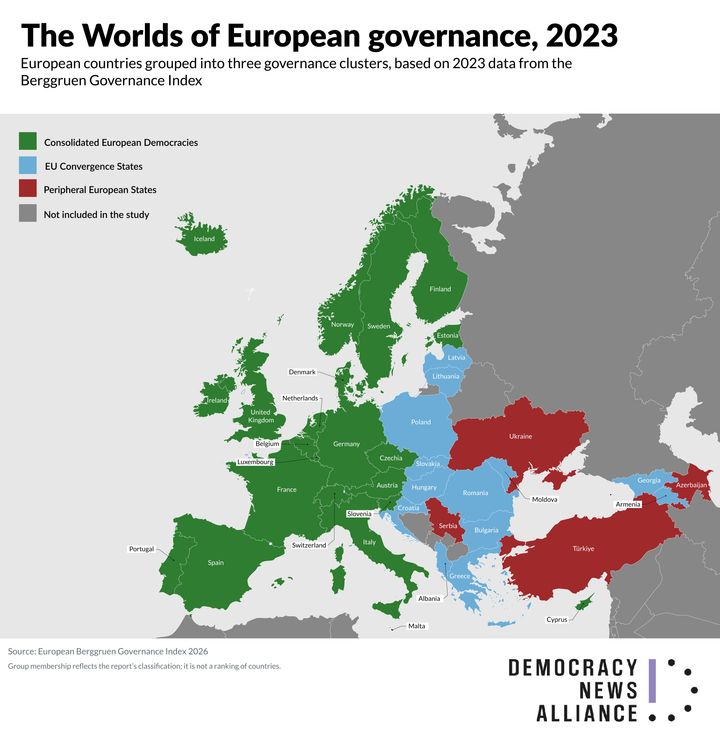
Los Angeles/DNA - Although Europe’s place among the world’s democracies remains at the top of the heap, the latest research from governance experts warns that the continent is slipping from its lofty perch as the runaway global leader.
According to the report - based on the European Berggruen Governance Index (EBGI), which analyses states’ governance performance according to the quality of democracy, government, and lives of citizens - European states’ years-long dominance is stagnating. Over time, this could undermine democratic accountability and raise questions about the region’s long-term stability.
The findings of the report, titled “Sustaining and Expanding Europe’s High Governance Performance”, show that complacency, what researchers refer to as the “silent killer of governance”, is a cause for concern that must be addressed by a renewed focus on bolstering democracy and engaging citizens.
The report was produced by researchers at the University of California Los Angeles (UCLA), the Los Angeles-based Berggruen Institute, and Berlin’s Hertie School.
Europe still leads the way
At first glance, Europe remains the envy of democracies around the world. Overall, Europe dominates the global index’s category of “Consolidated Democratic States” with 15 European countries ranked among the top 20. When it comes to the quality of government, the European average is a whopping 56 percent higher than the non-European average, while quality of democracy enjoys a 40 percent lead.
With such high scores, Europe appears well placed for the future. In fact, the 39 European countries surveyed scored almost 78 per cent in the overall assessment of governance, whilst the non-European countries lagged behind at 54 per cent. Though a closer look at Europe from 2000 to 2023 tells a more nuanced story, one that researchers say needs greater attention.
A tale of three factors
Around the world, quality of life has improved almost everywhere, with the provision of public goods increasing in all 39 European states. However, those gains were not matched by Europe’s institutions, which have seen state capacity stall and democratic accountability decline since 2010, according to the report.
Although the report shows that this trend of better lives and worsening democratic structures is a global issue, in Europe the problem is more pronounced.
The report found that democratic accountability, or quality of democracy, has come to a global standstill, with many countries, including those in Europe, on the decline. At the same time, even as the quality of government has held steady throughout the world, the fortunes of citizens have improved. In Europe, the increased quality of life mirrors that of non-European countries, but the quality of governance has stalled.
Europe’s shifting landscape
To gain a better understanding of Europe’s governance fortunes, the report sorted countries into three clusters, or “worlds”. The first cluster identified those with strong institutions and high governance performance. The second cluster groups post-communist EU members, along with aspiring and candidate states. The third cluster is composed of Europe’s weakest performers of democratic accountability.
Through examining the “worlds” between 2000 and 2023, researchers found what they refer to as a “convergence from below”, an upward shift that saw 12 countries move into a higher governance cluster, a discernible improvement. These countries are Albania, Armenia, Cyprus, Czechia, Estonia, Georgia, Italy, Malta, Moldova, Portugal, Romania, and Slovenia. But the move was largely the result of better public services, not a stronger democracy, which the report says does not bode well for the future.
The clusters were ranked according to economic, social, technological, and climate factors. Research shows that the top cluster is best placed to deal with future challenges in the decades to come. While the findings show that quality of life alone cannot ensure the democratic accountability and state capacity provided by robust institutions, the report details how the allure of EU membership does result in reforms among accession countries that help fuel governance progress.
Estonia as an example of a success story
Among the success stories, the report highlights Estonia, which was able to combine EU accession, fiscal discipline, low corruption, and extensive digital government, all key governance indicators, to move into the top cluster of countries.
By comparison, Greece was an example of what the report called a “distinctly European pathway of decline”, whose weakened state capacity and democratic accountability have been undermined by economic crisis and external conditionality brought on by loans, austerity measures, and forced reforms.
The report also outlines how the increase in the provision of public goods is not always domestically driven. Countries in Central and Eastern Europe and the Balkans have partially relied on funding from Brussels, while other parts of Europe have amassed debt to improve quality of life, which can lead to limited growth among poorer countries.
Strengthening the weakest links
The authors make it clear that while Europe has succeeded at boosting the quality of life through better provision of public goods, it has struggled to maintain democratic accountability and sustain a high level of state capacity needed to navigate the decades ahead.
To begin addressing the governance gap that exists between Europe’s core and peripheral countries, in addition to administrative reform and democratic renewal, the report recommends that building a stronger democracy depends on social accountability, an area largely beyond EU influence.
Specifically, researchers point to attacks on freedom of the press and a shrinking civil society as greater threats to democratic accountability than “rigged elections or captured courts”. In their view, media pluralism and civic space need to be treated as “governance infrastructure” to not only help “reinvigorate democracy and make citizens feel that they are represented”, but also to prevent the “silent killer” of complacency from taking hold.
The full report, “European Berggruen Governance Index - Sustaining and Expanding Europe’s High Governance Performance” can be viewed and downloaded from the website of the UCLA's Luskin School.
-------------------------
This text and the accompanying material (photos and graphics) are an offer from the Democracy News Alliance, a close co-operation between Agence France-Presse (AFP, France), Agenzia Nazionale Stampa Associata (ANSA, Italy), The Canadian Press (CP, Canada), Deutsche Presse-Agentur (dpa, Germany) and PA Media (PA, UK). All recipients can use this material without the need for a separate subscription agreement with one or more of the participating agencies. This includes the recipient's right to publish the material in own products.
The DNA content is an independent journalistic service that operates separately from the other services of the participating agencies. It is produced by editorial units that are not involved in the production of the agencies' main news services. Nevertheless, the editorial standards of the agencies and their assurance of completely independent, impartial and unbiased reporting also apply here.
Contacts
Christian RöwekampDemocracy News Alliance
roewekamp.christian@dpa.comImages
Subscribe to releases from news aktuell GmbH
Subscribe to all the latest releases from news aktuell GmbH by registering your e-mail address below. You can unsubscribe at any time.
Latest releases from news aktuell GmbH
DRF Aviation Services launches on October 1, 20261.10.2026 11:28:06 CEST | Press Release
DRF Luftrettung and DRF Maintenance are joining forces: the newly established DRF Aviation Services combines the two companies’ technical expertise built on more than 50 years of experience in helicopter maintenance, modifications and services. As a “one-stop shop”, DRF Aviation Services provides the full range of services from a single source. Helicopter operators benefit from high levels of reliability and innovative capability.
RM Equity Partners (RMEP) completes generational handover – partners take full ownership1.10.2026 09:30:11 CEST | Press Release
Ruggell (LI), 1 October 2026 – RM Equity Partners (RMEP), the international investment firm focused on asset-light digital businesses, today announces the completion of its generational handover. As of 1 October 2026, the management company is fully owned by the three partners Eugen Benedikt Russ, Chris Wittlinger and Nicola Szekely and the wider team, who will make all new investments independently. With this step, the succession within the founding family is concluded: RMEP operates as a fully independent investment firm with no ownership, management or personnel ties to the Russmedia group. RMEP has grown into one of the most active investors in digital marketplaces, software and consumer platforms in Europe: Assets under management of more than €500 million Annual investment capacity of more than €100 million 50+ portfolio investments, with 95% of revenue generated outside Austria Independent evergreen structure – the partners invest their own capital (principal investing, no exter
Global Sales of Professional Service Robots Surge 24%30.9.2026 12:05:00 CEST | Press Release
7,000 Humanoids emerge as new market 117,000 Transport and logistics’ robots lead as top application
German pharmacies offering new services: Statistical Yearbook 2026 out now30.9.2026 10:29:22 CEST | Press Release
Berlin / Germany, 30 September 2026 – ABDA – Federal Union of German Associations of Pharmacists has published its Statistical Yearbook “German Pharmacies: Figures, Data, Facts 2026”. The 132-page publication provides a comprehensive overview of the most important facts and statistics of the pharmacy market as well as information on the latest trends in the pharmaceutical and healthcare sectors in Germany and beyond.
MED-EL Launches World’s First Commercially Available Totally Invisible Cochlear Implant29.9.2026 14:00:00 CEST | Press Release
World's first and only commercially available cochlear implant with all components implanted beneath the skin Continuous hearing day and night Hearing performance designed to be the same as established cochlear implant solutions September 29, 2026 – (Innsbruck, Austria): MED-EL, a global leader in hearing implant technology, today announced the launch of TICI UNICO, the world's first and only commercially available totally invisible cochlear implant. Designed for people with severe-to-profound hearing loss, TICI UNICO enables continuous hearing 24 hours a day while remaining completely beneath the skin. It has received CE Mark approval and is being introduced in European markets.
In our pressroom you can read all our latest releases, find our press contacts, images, documents and other relevant information about us.
Visit our pressroom