Simple tool shows life expectancy after dementia diagnosis
Researchers at Karolinska Institutet and from the Netherlands have developed a simple tool that shows the survival probability of a person with dementia disease over three years. This, they hope, will facilitate dialogue with the most seriously affected and help doctors and others plan the necessary care. The study is published today in the scientific journal Neurology.
Dementia diseases are currently incurable. There are, however, many kinds of dementia, which develop differently from person to person. Some people can live for many years with their disease, while others have a disease that progresses more aggressively. This means that doctors need a simple tool to indicate the severity of the disease at the point of diagnosis. This can help in planning care and help these patients understand how their disease is likely to develop.
For their study, the researchers monitored patients over the age of 65 who were diagnosed with dementia and registered in the Swedish Dementia Registry between 2007 and 2015. The study included over 50,000 individuals, who were monitored via various health-data registries up to 2016, by which time 20,000 of them had died, on average after a median time of 4.8 years after diagnosis. The researchers examined the effect on post-diagnosis life-expectancy of a number of easily identifiable factors, producing two clear, schematic tables.
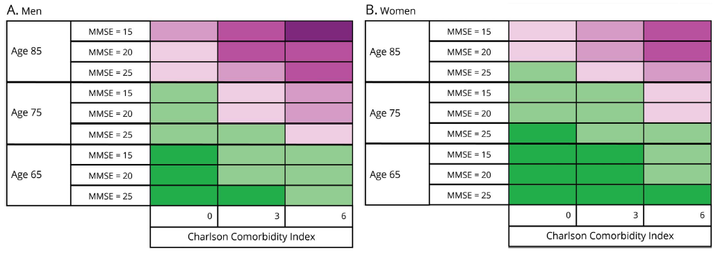
The first one is for primary care physicians that produces a prognosis based on sex, age, cognitive ability (measured using the MMSE, Mini-Mental State Examination) and comorbidity (measured using the Charlson Comorbidity Index).
Graphics: Tables illustrate three-year survival probabilities for people with dementia diseases diagnosed in primary care. Dark green indicates a low risk of death while dark purple indicates a high risk of mortality within three years.
The second table is for specialist clinics, such as memory clinics, that also factors in the specific subtype of dementia (Alzheimer’s disease, for instance, is often less aggressive). Equipped with these parameters, doctors can place an individual case in the schematic table to show how likely it is that the patient will die within three years of diagnosis.
The tool is intended for use by people who care for or treat dementia patients in primary care or at specialist clinics. One aim is to give doctors and care providers a better understanding of which patients are in urgent need of a care plan and who may benefit from additional monitoring. Another goal is to help doctors and other care providers to engage in a dialogue with their patients about their disease and the risk of death.
The study’s corresponding author Sara Garcia-Ptacek, a neurologist at Stockholm South General Hospital, says that many patients ask about how their disease will progress, and that a tool like this can be useful to help answer those questions.
“It can also be used in conversations about future care with patients who don’t raise the issue themselves,” says Garcia-Ptacek, who is also a researcher at the Department of Neurobiology, Care Sciences and Society (NVS) at Karolinska Institutet. “In those cases, a tool like this can be an incentive to start such a conversation, which should be held before there are too many cognitive obstacles. This conversation could be about where someone would prefer to live, at home or in other accommodation, or anything else that needs planning.”
The study was conducted with researchers from Radboud University Medical Center in the Netherlands and was financed with grants from the Swedish Research Council, the Swedish Research Council for Health, Working Life and Welfare (Forte), the Swedish Society for Medical Research, the Swedish Order of St John, Region Stockholm (ALF), the Foundation for Geriatric Diseases at Karolinska Institutet, the Loo and Hans Osterman Foundation for Medical Research, Radboud University Medical Center in the Netherlands and Alzheimer Nederland.
Publication: “Survival time tool to guide care planning in people with dementia”, Miriam L Haaksma, Maria Eriksdotter, Debora Rizzuto, Jeannie-Marie S Leoutsakos, Marcel GM Olde Rikkert, René JF Melis and Sara Garcia-Ptacek, Dec. 16, 2019, online issue of Neurology®, the medical journal of the American Academy of Neurology, doi: 10.1212/WNL.0000000000008745
For more information, contact:Sara Garcia-Ptacek, researcher and neurologistDepartment of Neurobiology, Care Sciences and Society (NVS) at Karolinska InstitutetPhone: +46 (0)76-0292394Email: Sara.Garcia-Ptacek@ki.se
Contacts
Contact the Press Office and download photo: ki.se/pressroom
Images
Karolinska Institutet (http://ki.se/english) is one of the world’s leading medical universities. Our vision is to advance knowledge about life and strive towards better health for all. Karolinska Institutet accounts for the single largest share of all academic medical research conducted in Sweden and offers the country’s broadest range of education in medicine and health sciences. The Nobel Assembly at Karolinska Institutet selects the Nobel laureates in Physiology or Medicine.
Subscribe to releases from Karolinska Institutet - English
Subscribe to all the latest releases from Karolinska Institutet - English by registering your e-mail address below. You can unsubscribe at any time.
Latest releases from Karolinska Institutet - English
Using social media may impair children’s attention8.12.2025 06:01:00 CET | Press Release
Children who spend a significant amount of time on social media tend to experience a gradual decline in their ability to concentrate. This is according to a comprehensive study from Karolinska Institutet, published in Pediatrics Open Science, where researchers followed more than 8,000 children from around age 10 through age 14.
POTS common in patients with long COVID3.10.2025 11:33:37 CEST | Press Release
A new study from Karolinska Institutet in Sweden shows that an unusual heart rhythm disorder, POTS, is particularly common in people with long COVID. The majority of those affected are middle-aged women. The study is published in the scientific journal Circulation: Arrhythmia and Electrophysiology.
Simple test can predict risk of severe liver disease29.9.2025 09:00:00 CEST | Press Release
A new study from Karolinska Institutet, published in the scientific journal The BMJ, shows how a simple blood analysis can predict the risk of developing severe liver disease. The method may already start to be applied in primary care to enable the earlier detection of cirrhosis and cancer of the liver.
Press invitation: Announcement of the Nobel Prize in Physiology or Medicine 202523.9.2025 13:00:00 CEST | Press Invitation
The Nobel Prize in Physiology or Medicine 2025 will be announced on Monday October 6 at 11.30 am CEST (at the earliest).
How mutations in bodily tissues affect ageing20.8.2025 11:00:00 CEST | Pressmeddelande
Two new studies from Karolinska Institutet in Sweden have investigated how mutations that occur in muscles and blood vessels over time can affect ageing. The studies, which are published in Nature Aging, show that such mutations can reduce muscle strength and accelerate blood vessel ageing. The results can be of significance to the treatment of age-related diseases.
In our pressroom you can read all our latest releases, find our press contacts, images, documents and other relevant information about us.
Visit our pressroom