
New Swedish Initiative to Integrate Research and Healthcare
4.4.2025 11:37:56 CEST | KTH Royal Institute of Technology | Press Release
A groundbreaking national initiative, Precision Omics Initiative Sweden (PROMISE), aims to connect research with healthcare and establish Sweden as a world leader in data-driven precision medicine.
The vision was recently published in the scientific journal Nature Medicine.
PROMISE has been developed by leading researchers and clinicians from universities and university hospitals across Sweden. Recent technological advancements in large-scale molecular analysis have the potential to transform both research and healthcare.
“We want to make use of this major new opportunity. But this requires larger amounts of data than what we currently have in Sweden," says Tuuli Lappalainen, Professor of Genomics at KTH Royal Institute of Technology and Director of the National Genomics Infrastructure at SciLifeLab.
Data-driven research to boost both research and healthcare
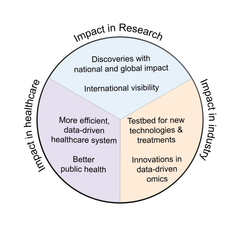
Large-scale molecular analysis offers vast opportunities in improved diagnosis and personalizing care and treatment, which is a field known as precision medicine. "We envision that PROMISE will create new clinically relevant research results that can be reported back to benefit patients. This kind of integration of research and healthcare would also be quite unique in the world,” says Anders Kämpe, physician and researcher at Karolinska Institutet and Karolinska University Hospital.
Leveraging Swedish strengths to seize the international forefront
Sweden already possesses all the necessary building blocks to conduct groundbreaking biomedical research. The country has a publicly funded healthcare system and a population that has high trust in research and is open to new technologies. Sweden is also one of the few countries where every individual can be identified using a unique personal identity number, which can be linked to extensive longitudinal registries and comprehensive electronic medical records.
Additionally, Sweden has world-leading technology platforms and analytical capacity through SciLifeLab and the Data-Driven Life Science Program. Genomic Medicine Sweden has also positioned Sweden at the forefront of the clinical implementation of precision medicine.
Collaboration between research, healthcare and industry
However, this potential is far from fully utilized. PROMISE aims to leverage these existing capabilities to build bigger and deeper data sets that are needed for internationally leading research and healthcare.
“A key step is to build a large population-based research cohort of hundreds of thousands of individuals with longitudinal molecular and genomic data linked to disease and registry data. We also see great potential for scientific breakthroughs in detailed molecular characterization of cancer and rare diseases, where we can increase the research use of the omics data already produced within Swedish healthcare,” says Richard Rosenquist Brandell, Senior Physician and Professor of Clinical Genetics at Karolinska Institutet and Director of Genomic Medicine Sweden.
“We also want to work closely with industry to boost the development of new technologies and treatments. For example, data and patient groups in PROMISE could offer highly attractive opportunities for better clinical trials,” Lappalainen says.
The three pillars of PROMISE
The initiative aims to build biomedical data of unique size and scale via three activities:
- Generating and integrating large-scale molecular profiling data, also known as omics, from Swedish research cohorts.
- Maximizing the use of omics data generated within Swedish healthcare for research purposes.
- Establishing a national database to facilitate access and integration of research and healthcare data.
Contacts
Tuuli LappalainenKTH Royal Institute of Technology
Tel:+46-721940550tuuli.lappalainen@scilifelab.seImages



Subscribe to releases from KTH Royal Institute of Technology
Subscribe to all the latest releases from KTH Royal Institute of Technology by registering your e-mail address below. You can unsubscribe at any time.
Latest releases from KTH Royal Institute of Technology
Cause of common heart valve defect revealed in genetic study28.4.2026 11:18:02 CEST | Press Release
New clues from genetic research may help explain what causes the most common heart defect present at birth. Researchers in Sweden have identified rare DNA changes during fetal development that can lead to a condition known as bicuspid aortic valve (BAV).
Study offers new way to stop global potato pathogen once linked to Ireland’s Great Famine23.4.2026 11:46:21 CEST | Press Release
Scientists in Sweden have taken an important step toward fighting potato late blight, a plant disease that once triggered an historic famine in Ireland and now threatens to spread globally due to climate change.
Study reveals unseen changes in motor control after spinal cord injury14.4.2026 12:09:09 CEST | Press Release
Even when people with incomplete spinal cord injuries can walk, everyday functions like standing, balancing or producing steady force may remain difficult. A new study shows why.
Study offers single explanation for two major symptoms of schizophrenia19.3.2026 11:00:02 CET | Press Release
Scientists have long known that dopamine helps the brain learn from rewards, but a new computational model shows how for people with schizophrenia this learning system can break down and simultaneously produce two very different symptoms — delusions and a loss of motivation.
Wheat bran research shows fiber- and protein-rich food gels can be entirely plant-based18.3.2026 12:56:57 CET | Press Release
Scientists in Sweden have for the first time created a fully wheat-based gel made entirely from wheat bran fiber and wheat gluten protein—an advance that could turn one of the grain industry’s least valued by products into a nutritious, sustainable ingredient in food products.
In our pressroom you can read all our latest releases, find our press contacts, images, documents and other relevant information about us.
Visit our pressroom