
AI helps decode horses' body language for better veterinary care
9.4.2025 12:20:55 CEST | KTH Royal Institute of Technology | Press Release
Researchers are using AI to bridge the communication gap between horse and human. Combining 3D motion capture and machine learning, a new modeling system would equip veterinarians with a powerful visual tool for interpreting equine body language—the key to detecting physical and even behavioral problems.
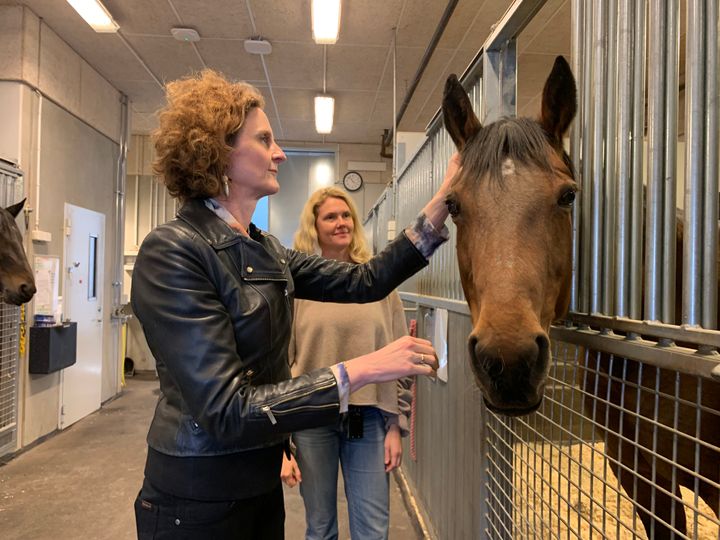
Based on new research from KTH Royal Institute of Technology and Swedish University of Agricultural Science (SLU), the platform can reconstruct the exact 3D motion of horses from videos, using an AI-based parametric model of the horse’s pose and shape. The model is precise enough to enable a veterinarian, for example, to spot telling changes which could otherwise be overlooked or misinterpreted in an examination, such as in a horse’s posture or their body weight.
The system—titled DESSIE—employs disentangled learning, which separates different important factors in an image and helps the AI avoid confusion with background details or lighting conditions, says Hedvig Kjellström, a Professor in computer vision and machine learning at KTH.
“DESSIE marks the first example of disentangled learning in non-human 3D motion models,” Kjellström says.
Elin Hernlund, Associate Professor in biomechanics at SLU and equine orthopedics clinician, says DESSIE would enable greater accuracy in observation and interpretation of horses’ movements and, as a result, earlier and more precise intervention than today. In a sense, it enables getting critical information “straight from the horse’s mouth.”
“Horses are powerful but fragile and they tell us how they are feeling by their body language,” Hernlund says. “By watching their gate we can see, for example, if they are offloading pain,” she says.
“We say we created a digital voice to help these animals break through the barrier of communication between animals and humans. To tell us what they are feeling,” Hernlund says. “It’s the smartest and highest resolution way to extract digital information from the horse’s body—even their faces, which can tell us a great deal.”
The research team are further training DESSIE with images of a wider variety of horse breeds and sizes, which would enable them to link genetics to phenotypes and gain a better understanding of the core biological structure of animals.
“To achieve this, we're asking breeders to send images of their breeds to capture as much variation as possible," Hernlund says.
Images
Subscribe to releases from KTH Royal Institute of Technology
Subscribe to all the latest releases from KTH Royal Institute of Technology by registering your e-mail address below. You can unsubscribe at any time.
Latest releases from KTH Royal Institute of Technology
With climate-resilient crops in mind, study tackles flaw in photosynthesis22.10.2026 13:56:58 CEST | Press Release
Rising temperatures and increasing drought are shortening crop growing seasons in many parts of the world. Now scientists in Sweden report new advances toward engineering more efficient photosynthesis, work that could eventually contribute to efforts to adapt crops for climate change.
Now multiple optical devices' stabilizing properties can be identified with a single reprogrammable chip14.10.2026 13:03:08 CEST | Press Release
In optical fibers, chips and other light-guiding devices, minor defects can scatter photons and disrupt their path. A new study demonstrates a way to reveal properties which, in certain systems, help light wave behavior withstand such flaws. The method could help speed up the search for new kinds of electronics and optical technologies, and contribute to more reliable quantum devices.
Researchers identify aggressive molecular features in low-risk prostate cancer7.10.2026 13:41:39 CEST | Press Release
A new study revealed molecular features linked to more aggressive prostate cancer in a subset of patients who had been classified as low risk, highlighting biological differences that may not be apparent from clinical measures alone. The results could lead to new therapeutic strategies.
Why do spruce take decades to reproduce? A genetic study offers new clues14.9.2026 17:41:41 CEST | Press Release
New techniques have enabled researchers in Sweden to begin decoding how one of Northern Europe's most important coniferous tree species switches from growing branches to producing cones – their seed-bearing reproductive organs.
KTH builds Swedish expertise in nitrocellulose2.9.2026 12:54:32 CEST | Press Release
Sweden wants to reduce its dependence on foreign suppliers for nitrocellulose, a raw material central to the production of conventional propellants. KTH is now launching a new competence centre to build up expertise across the entire chain – from forest-based raw materials and manufacturing to safe storage.
In our pressroom you can read all our latest releases, find our press contacts, images, documents and other relevant information about us.
Visit our pressroom