
Becoming Ovartaci
3.9.2025 09:41:24 CEST | Kunstmuseum Brandts | Press Release
Overlooked and acclaimed, outsider and insider, man and woman, on the periphery and at the centre of art history. The artist Ovartaci occupies a space where conflicting aspects intersect, fuelling an enduring fascination with her fate and art alike.
Becoming Ovartaci opens September 20 th, 2025 at Kunstmuseum Brandts in Odense, Denmark

In art, Ovartaci the artist and Ovartaci the human being was able to find a safe space amidst an unusually harsh fate. All her life, she fought for understanding, respect and change.
Even in Ovartaci’s own day, internationally acclaimed artists such as Asger Jorn and Jean Dubuffet, both of whom are featured in the exhibition, were fascinated by her artistic abilities and effortless access to the wellspring of creativity. Even so, true appreciation of the sheer quality of her works and their significant place in art history has come only recently, within the past few years.
Now, Kunstmuseum Brandts tells the poignant story of Ovartaci and her connection to the Cobra movement. The exhibition presents the artist’s work in comprehensive detail, featuring nearly 100 paintings, sculptures, drawings and poems supplemented by documentary film footage, photographs and archival material.
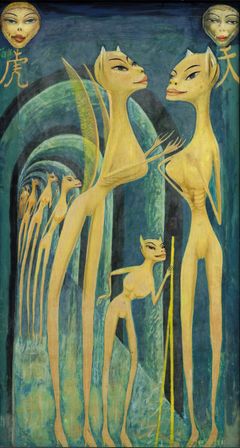
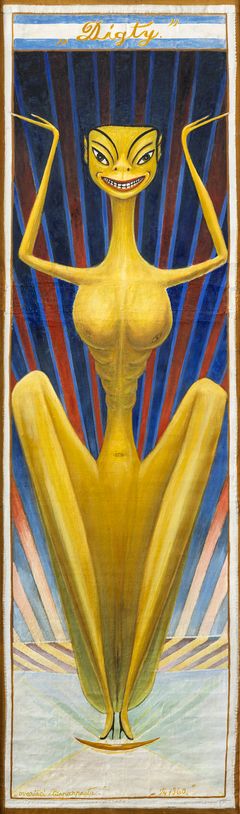
As an involuntarily committed psychiatric patient – primarily at the hospital in Risskov, Aarhus – for fifty-six years of her life, Ovartaci’s surrealist, winged, or soaring figures became her soulmates, acting as tokens of her dreams of freedom and transformation.
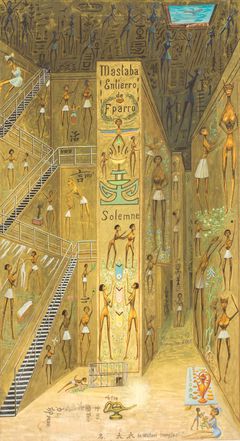
Ovartaci’s works open up portals to strange, alternative worlds populated by hybrid creatures that radiate zest for life, longing and a sense of community. Often, these beings appear on both the front and back of a given work, partly because access to canvases and materials was limited, but primarily because Ovartaci wanted to fully capture and bind the beings on the canvas as a safeguard against any sudden attacks and surprises from them.
When Ovartaci died in 1985, aged 91, she was still hospitalised and free only in her imagination and art. But in recent years, Ovartaci has finally achieved great, well-deserved attention and acclaim, both in her native Denmark and internationally. In 2022 she was represented in the main exhibition of the Venice Biennale, and later this year a major exhibition will open at the New Museum in New York, where her work will be exhibited alongside key international artists of the twentieth century such as Salvador Dalí, Kiki Kogelnik and Francis Bacon, as well as some of the biggest stars on the contemporary art scene today such as Pierre Huyghe, Wangechi Mutu and Tau Lewis.
The Asger Jorn and Cobra connection
Ovartaci’s effortless access to the healing powers of art and the imagination has captivated many artists over time, from Asger Jorn and Jean Dubuffet to Tal R and Katrine Ærtebjerg.
Throughout her life, Ovartaci was attended by several doctors who recognised that she was a special patient, granting her privileges such as a private room, access to materials, and permission to go out on bicycle rides. During the periods when Ovartaci was allowed to be a creative artist, she needed no medication.
In 1952, chief physician Arild Leth Petersen invited Ovartaci to a dinner party at his home alongside Danish artist Asger Jorn, who at the time was hospitalised after a nervous breakdown and physically ill from tuberculosis. Jorn was so captivated by Ovartaci that he invited her to France with the intention of garnering international recognition for her. However, Ovartaci was indifferent to the idea of breaking through on the international art scene and declined the offer.
Later, Asger Jorn sent two of Ovartaci’s works to the artist Jean Dubuffet. Missing since 1964, these works were recently rediscovered in Lausanne in connection with the curation of this exhibition. Their disappearance was due to being registered under one of Ovartaci’s other aliases, Gonzales. One of the works will now be on public display in Denmark for the very first time.
A self-taught artist, Ovartaci can in many ways be said to belong to the artistic genre known as art brut, a term used for the ‘raw’ art of unschooled artists. At the same time, she found her own surrealist mode of expression, an aesthetic that gave her work a kinship with the visual idiom of the Cobra movement represented by Asger Jorn and others.
“When observing these works first-hand, audiences will clearly see what fascinated Jorn and Dubuffet: the artistic sensibility, the liberating power of creativity, and the sense of how much we stand to gain if we set each other free. At the heart of Ovartaci’s life’s work we find a yearning to be loved and accepted. Unconditionally. Not in spite of, but because of who we are”, says Chief Curator at Kunstmuseum Brandts, Naja Rasmussen, who curated the exhibition.
An outsider in her own time
Ovartaci was born a boy, Louis Marcussen, in the Jutland town of Ebeltoft in 1894. The young Louis Marcussen ran counter to many of the prevailing norms and expectations of the time at an early stage, displaying a keen interest in other cultures, in communing with nature, winter swimming, yoga, Buddhism and literature. Later in life, Ovartaci requested gender-affirming surgery to become a woman.
After primary school, Ovartaci trained and worked as a house painter before travelling to Argentina in 1923. Upon returning to Ebeltoft after six years abroad, she was admitted to the Psychiatric Hospital in Risskov and diagnosed with schizophrenia. From then on followed a life as a psychiatric patient. It was during these years that she took the name ‘Ovartaci’, a variant spelling of the made-up Danish word ‘overtosse’, meaning ‘head lunatic’.
When the healthcare system in which she lived and died denied her access to gender-affirming surgery, Ovartaci performed an amputation on herself in 1954. The staff found her in time to save her life, and in 1957 her transition was partially granted. She was, however, still denied the right to wear dresses or to wear her hair long.
“Ovartaci’s life would probably have taken a very different course today given the completely different outlook on mental illness in our day and age. Time and time again, we have seen how art can have a healing effect on the mind and give people with mental illness a voice and all-important means of self-expression. At the same time, Ovartaci’s fraught fate and illness were instrumental in imbuing Ovartaci’s works with the distinctive character and power that is now receiving such great acclaim”, says Director of Kunstmuseum Brandts, Stine Høholt.
----------------------------------------------------------------------------------------------------------------
The exhibition is accompanied by a research-based catalogue published in collaboration with Kunsten Museum of Modern Art in Aalborg, where the exhibition will subsequently be shown.
The catalogue presents texts by chief curator Naja Rasmussen, artist Noah Umur Kanber, authors Sebastian Nathan and Gry Dalgas, art historian Elias Ståhl, associate professor and museum curator Jens Tang Kristensen, museum director Mia Lejsted, as well as curator Cecilia Alemani, who was behind the main exhibition The Milk of Dreams at the Venice Biennale in 2022, where Ovartaci was among the artists featured.
Becoming Ovartaci was first shown at the Cobra Museum in Amsterdam in spring 2023. In collaboration with Kunsten Museum of Modern Art in Aalborg, the Cobra Museum in Amsterdam, and Museum Ovartaci, Kunstmuseum Brandts is now presenting the exhibition to a Danish audience.
Ovartaci in brief
Born Louis Marcussen in Ebeltoft in 1894. Died 1985. Became a trained house painter in 1913.
Emigrated to Argentina in 1923 and lived in South America for six years.
Shortly after returning to Denmark, Louis Marcussen was involuntarily committed to the psychiatric ward in Risskov and diagnosed with schizophrenia. She then spent a total of fifty-six years as a psychiatric patient. Here she named herself Ovartaci – a pun meaning ‘head lunatic’ in Danish.
Ovartaci was born male and lived as a man for most of her life. Choosing to respect her long-standing wish to become a woman, we write about the artist as a woman – but you will also often find Ovartaci described and discussed as a man.
Ovartaci’s breakthrough
Ovartaci’s art has previously been exhibited on Danish soil at Louisiana in 1979 and at Ribe Kunstmuseum in 1990. In 2017, Kunsthal Charlottenborg presented the exhibition Ovartaci & the Art of Madness, giving the artist her major breakthrough in Denmark.
When Ovartaci was selected for the main exhibition, The Milk of Dreams, at the Venice Biennale in 2022, she and her art achieved broad international recognition. In 2023, Museum Ovartaci reopened with a permanent exhibition in 2023 in the former school of journalism in Skejby, Aarhus.
Contacts
Kristian Dyg-JespersenOutreach and PR Coordinator
Tel:+45 27 53 70 25kristian.dyg@brandts.dkSusanne MorePR employee
Tel:+45 26 28 20 69susanne.more@brandts.dkImages



About Kunstmuseum Brandts
Kunstmuseum Brandts is situated in Odense, one of the oldest cities in Denmark and birthplace of author Hans Christian Andersen, universally renowned for his fairy tales. Within walking distance from Kunstmuseum Brandts you will find the innovative Hans Christian Andersen Museum, drawn by the Japanese architect, Kengo Kuma.
Subscribe to releases from Kunstmuseum Brandts
Subscribe to all the latest releases from Kunstmuseum Brandts by registering your e-mail address below. You can unsubscribe at any time.
Latest releases from Kunstmuseum Brandts
In our pressroom you can read all our latest releases, find our press contacts, images, documents and other relevant information about us.
Visit our pressroom