
Heart ‘blueprint’ reveals origins of defects and insights into fetal development
29.10.2025 11:13:11 CET | KTH Royal Institute of Technology | Press Release
New research has produced a “blueprint” revealing how the human heart is built during prenatal development. It offers insights that could lead to improved prenatal care and new treatments for heart defects, such as holes between heart chambers or deformities of the heart valves.
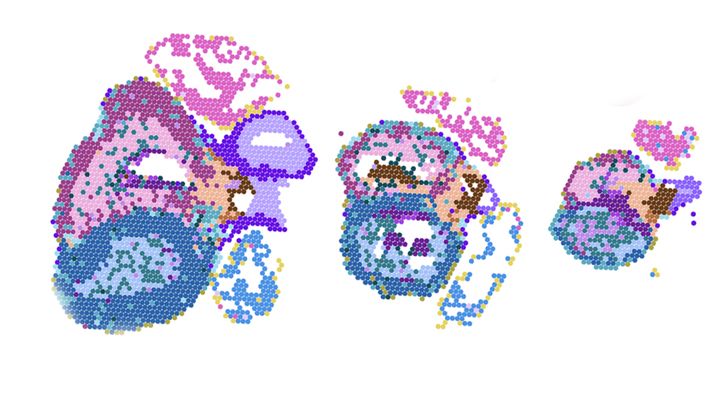
Publishing in Nature Genetics, a research team led by the department of Gene Technology at KTH Royal Institute of Technology published a detailed map of the developing human heart, showing how different groups of cells are arranged and how they interact in fetal heart development.
“Congenital heart diseases, and several acquired ones, originate during early development, which highlights the importance of this period in defining a healthy heart,” says Enikő Lázár, co-lead author of the study.
“This map provides a kind of blueprint, showing how key parts of the heart—like the pacemaker system, heart valves, and the wall between the upper chambers—form and function,” Lázár says.
Among the findings was the discovery of a previously unknown group of cells that produce adrenaline. Lázár says these cells are likely unique to humans and may help the heart respond to low oxygen levels during development or birth. This may explain how the fetal heart adapts to stress and indicates a possible origin of rare heart tumors called pheochromocytomas, the researchers reported.
KTH Professor Joakim Lundeberg, who led the research team, says the work was carried out with cutting-edge technology invented at KTH that allows researchers to study the activity of all genes in human tissue.
This method of spatial transcriptomics enables visualization and analysis of the full range of messenger RNA, or mRNA, molecules expressed by an organism, says Raphaël Mauron, co-lead author of the study. “With careful bioinformatic analysis, we can learn details of heart development that were not possible even a few years ago,” Raphaël Mauron says.
Drawing on the Developmental Tissue Bank of Karolinska Institutet, the map identifies more than 70 distinct cell types, revealing a surprising variety among certain support cells and tracking how nerve connections begin to form.
Other key insights reported:
- The cells forming heart valves and the atrial septum are more diverse, which offers clues to how the heart’s internal structures form and why certain congenital heart defects—like valve malformations or holes between chambers—occur.
- The fetal heart has an unexpected variety of supporting cells, or mesenchymal cells, which provide a kind of scaffolding to help shape the heart’s structure and may even be involved in diseases like valve defects or arrhythmias.
- A precise map of the wiring of cells that form the heart’s natural pacemaker and conduction system, including the sinoatrial node, which sets the heartbeat, and Purkinje fibers, which spread the signal.
- The map also traces how nerve cells and their support cells grow into the heart and connect with pacemaker cells, revealing that different types of their signals—like noradrenaline and acetylcholine—start influencing the heart early on.
The findings are available through an interactive online tool, offering a valuable resource for understanding heart development and its links to genetic heart conditions.
The study was conducted by researchers from KTH Royal Institute of Technology, Karolinska Institutet, and Stockholm University through the joint research center Science for Life Laboratory (SciLifeLab), as part of the Human Developmental Cell Atlas initiative funded by the Erling Persson Foundation and Knut and Alice Wallenberg Foundation.
Spatiotemporal Gene Expression and Cellular Dynamics of the Developing Human Heart, Nature Genetics, DOI: 10.1038/s41588-025-02352-6
Contacts:
Joakim Lundeberg, KTH Royal Institute of Technology
E-mail: joalun@kth.se, joakim.lundeberg@scilifelab.se
Enikő Lázár, KTH Royal Institute of Technology
E-mail: eniko.lazar@scilifelab.se
Images


Subscribe to releases from KTH Royal Institute of Technology
Subscribe to all the latest releases from KTH Royal Institute of Technology by registering your e-mail address below. You can unsubscribe at any time.
Latest releases from KTH Royal Institute of Technology
Method to extract Baltic phosphorus may ease Europe's reliance on fertilizer imports18.2.2026 14:28:50 CET | Press Release
The Baltic Sea is one of the world's most oxygen-depleted major bodies of water. The reason is excessive concentrations of phosphorus, an element essential for life—and an important ingredient in fertilizer. New research shows a way to possibly convert this problem into a resource that reduces Europe's dependency on phosphate mining while revitalizing the Baltic ecosystem.
Data from a Swedish rail switch may reduce train delays in cold climates11.2.2026 15:08:36 CET | Press Release
Rail commuters in cold climates like Sweden’s are all too familiar with winter train delays and cancellations. The culprit is usually rail switches that freeze up or clog with snow even though they’re heated. A new study offers a more affordable and sustainable solution to keep these crucial, track-moving components in working order.
Researchers removed all plastic from a family's home, and here's what they found5.2.2026 12:12:32 CET | Press Release
What would happen if all the plastic in your home disappeared overnight? A Swedish family found out by volunteering for one month of near-total plastic withdrawal, in an experiment conducted by researchers at KTH Royal Institute of Technology.
New research enables safe reuse of concrete29.1.2026 10:06:38 CET | Press Release
Recent research in Sweden and Finland shows how used concrete’s lifespan can be extended another 50 to 100 years when incorporated into new construction.
Study explains why new kinds of steel needed to build lead cooled reactors11.12.2025 14:23:59 CET | Press Release
Safer operation, better fuel efficiency and lower waste mark lead-cooled nuclear power as a potentially dramatic shift from the water-cooled nuclear stations the world has relied on since the mid 20th century. A recent Swedish study casts new light on how to avoid corrosion in the steel used to build these next-generation nuclear facilities.
In our pressroom you can read all our latest releases, find our press contacts, images, documents and other relevant information about us.
Visit our pressroom