
Reshaping gold leads to new electronic and optical properties
2.2.2026 08:10:00 CET | Umeå University | Press Release
By changing the physical structure of gold at the nanoscale, researchers can drastically change how the material interacts with light – and, as a result, its electronic and optical properties. This is shown by a study from Umeå University published in Nature Communications.
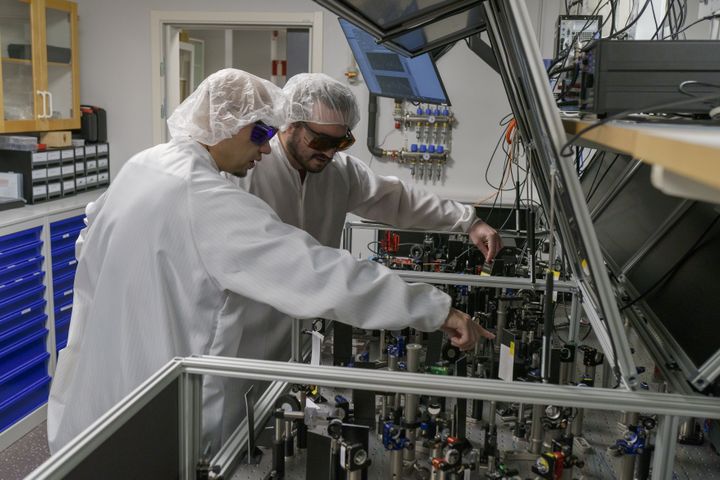
Gold plays a crucial role in modern advanced technology thanks to its unique properties. New research now demonstrates that changing the material's physical structure – its morphology – can fundamentally enhance both its electronic behaviour and its ability to interact with light.
“This might make it possible to improve the efficiency of chemical reactions such as those used in hydrogen production or carbon capture,” says Tlek Tapani, one of the leading researchers behind the study and doctoral student at the Department of Physics.
The researchers worked with nanoporous gold, a so-called metamaterial produced in a laboratory. Thanks to its sponge-like structure, nanoporous gold has even better properties for technical applications than ordinary solid gold.
Absorbs more light energy
In this study, the researchers observed that a thin film of nanoporous gold interacts with light in ways that solid gold cannot. By exposing the "gold sponge" to ultrashort laser pulses, they found that the porous structure allows the material to absorb more light energy over a wider spectrum.
As a result, the electrons become considerably more energetic. The electronic temperature was estimated to reach about 3200 K (~2900 °C) in the nanoporous film, compared with just 800 K (~500 °C) in the unstructured gold film used as a reference, under the same conditions. It also takes longer for the "hot" electrons to cool down and return to their initial state at room temperature.
“Such elevated electronic temperatures enable light induced transitions that would otherwise be nearly impossible,” says Nicolò Maccaferri, leader of the Ultrafast Nanoscience Unit at the Department of Physics and senior author of the article. “Interestingly, using advanced electron microscopy and X-ray photoelectron spectroscopy experiments (XPS) here at Umeå University, we were able to confirm that these unique behaviours are driven solely by the material's physical shape and not by changes to the electronic structure of gold itself.”
Can be extended to other materials
The experiments suggest that nanoporous structure can be used as a new design parameter to engineer materials used in advanced technologies. By systematically varying the filling factor (the ratio of gold to air in the “sponge"), researchers can tune the electronic behaviour of not only gold but also other metals in a controllable way, which could improve the efficiency of chemical reactions.
“Our research shows that by manipulating a material's architecture at the nanoscale, we can use structure itself as a design parameter,” says Nicolò Maccaferri. “These results can be generalised, in principle, to every material, with implications in how we design smart materials for sustainability and technology, with applications spanning from catalysis to energy harvesting, medicine and quantum batteries.”
About the scientific study
Tlek Tapani, Jonas M. Pettersson, Nils Henriksson, Carla M. Brunner, Ann Céline Zimmermann, Erik Zäll, Nils V. Hauff, Lakshmi Das, Anastasiia Sapunova, Gianluca Balestra, Massimo Cuscunà, Aitor De Andrés, Tommaso Giovannini, Denis Garoli & Nicolò Maccaferri. Morphology-modified contributions of electronic transitions to the optical response of plasmonic nanoporous gold metamaterial. Nature Communications 17, 829 (2026). DOI: 10.1038/s41467-026-68506-0
Contacts
Nicolò MaccaferriAssociate ProfessorDepartment of Physics
Tel:+46 90 786 75 95nicolo.maccaferri@umu.seSara-Lena BrännströmCommunications officerFaculty of Science & Technology
Tel:+46 90 786 72 24sara-lena.brannstrom@umu.seImages
Links
About us
Umeå University is a comprehensive university and one of Sweden’s largest higher education institutions with around 38,000 students and 4,600 staff. We have a diverse range of high-quality educational programmes and research within all disciplinary domains and the arts. The University offers world-class educational and research environments and helps expand knowledge of global significance. This is where the groundbreaking discovery was made of the CRISPR-Cas9 gene-editing tool, which was awarded the Nobel Prize in Chemistry. At Umeå University, everything is just around the corner. Our tightly knit campus makes it easy to meet, collaborate and share knowledge, something that encourages a dynamic and open culture.
Subscribe to releases from Umeå University
Subscribe to all the latest releases from Umeå University by registering your e-mail address below. You can unsubscribe at any time.
Latest releases from Umeå University
Bildmuseet opens the MFA exhibition from Umeå Academy of Fine Arts.5.5.2026 10:56:52 CEST | Press Release
Of Love and Care is the title of this year’s Master’s exhibition from Umeå Academy of Fine Arts at Umeå University. It will be unveiled during an Art Friday at Bildmuseet on 22 May, with talks, performances, tours, live music, DJ and bar. A media preview will be held on Wednesday, 20 May at 10:00 (RSVP). The artists will be there to talk about their work.
The protein that helps cancer cells survive treatment7.4.2026 08:00:00 CEST | Press Release
Researchers at Umeå University have contributed new insights into how cancer cells protect themselves from cell death. The study provides a deeper understanding of how key proteins interact within the cell and could, in the long term, support the development of new cancer therapies.
Capsule technology opens new window into individual cells12.3.2026 09:00:00 CET | Press Release
Researchers have developed a capsule-based method that makes it possible to analyse the same cell through multiple experimental steps. The technology overcomes a long-standing limitation in cell research and could open new ways to study disease mechanisms at the single-cell level.
Who holds the power when AI enters our lives?25.2.2026 14:05:00 CET | Press Invitation
In a major new exhibition at Bildmuseet, international artists examine the rapid technological development shaping contemporary life. AI and the Paradox of Agency opens on 13 March, with presentations, performances, film screenings, creative workshops and more, continuing until midnight. Members of the press are invited to book preview visits and interviews on 10 and 11 March.
Swedish Picture Book of the Year / Where’s My Egg?25.2.2026 14:00:00 CET | Press Invitation
Julia Groth’s Var är mitt ägg? has been named the Swedish Picture Book of the Year. On 13 March, in conjunction with the award ceremony at Littfest – Umeå International Literature Festival, Bildmuseet opens an exhibition of the original illustrations from the winning book. Press previews by appointment.
In our pressroom you can read all our latest releases, find our press contacts, images, documents and other relevant information about us.
Visit our pressroom