
Study offers new way to stop global potato pathogen once linked to Ireland’s Great Famine
23.4.2026 11:46:21 CEST | KTH Royal Institute of Technology | Press Release
Scientists in Sweden have taken an important step toward fighting potato late blight, a plant disease that once triggered an historic famine in Ireland and now threatens to spread globally due to climate change.
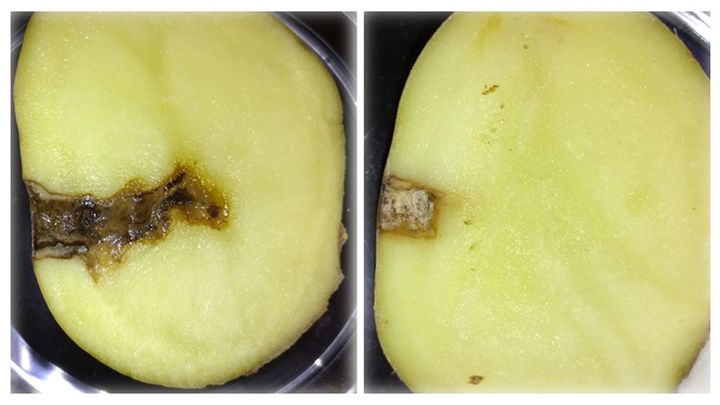
A new study reports the synthesis of a peptide that specifically attacks Phytophthora infestans (P. infestans) to protect potato and tomato crops—without harm to other plants. The work was carried out by researchers at Stockholm’s KTH Royal Institute of Technology, in collaboration with research partners in Italy, India and Australia.
The P. infestans pathogen remains one of the most destructive crop diseases in the world nearly 200 years after setting the stage for what would become known as "The Great Famine" or alternately “The Irish Potato Famine” – a crisis in which Ireland lost one quarter of its population to starvation and emigration.
Late blight continues to cost farmers billions of dollars each year, threatening staple crops such as potatoes and tomatoes. While modern agriculture has prevented a famine on the scale of Ireland’s 19th century calamity, climate change is increasing humidity and rainfall patterns that favor the rapid spread of the disease.
“Regions that once saw late blight only sporadically – from cool highlands to temperate fringes – are now experiencing longer, more intense infection windows as seasons become warmer and wetter, says Vaibhav Srivastava, a glycoscience researcher at KTH. At the same time, more diverse and aggressive P. infestans populations are exploiting these new niches, challenging spray calendars and resistance strategies that were designed for yesterday’s climate.
Their solution exploits the peculiar nature of the pathogen, Srivastava says. This pathogen is often referred to as a “water mold” but belongs to the oomycetes, a group more closely related to algae such as kelp than to fungi.
Oomycete cell walls are mostly made of cellulose and related complex sugars, with little or no chitin. Because of this, many researchers doubted whether the enzyme that makes chitin was important enough to target. The researchers resolve this uncertainty by showing that the enzyme PiChs does in fact produce specific chitin fragments— and that blocking it clearly slows the pathogen’s growth and ability to infect plants.
“CS5 is designed to match and bind to this singular enzyme,” he says.
In lab tests, CS5 blocked the enzyme’s activity and slowed, or stopped, the pathogen’s growth. It also prevented infection in treated potato samples. Srivastava says the peptide poses no threat to anything but P. infestans because the particular chitin synthase enzyme that it binds to is not present in humans or any plant.
“We’ve shown that this pathogen depends on a specific internal process to grow—and that a specially designed peptide can switch it off,” he says. “This gives us a completely new way to fight late blight. It also works alongside existing methods and could help farmers slow the rise of resistance while relying less on chemical sprays.”
Srivastava says CS5 and related compounds could form the basis of environmentally-friendly crop protection tools, either alone or in combination with other targeted treatments. Such approaches could help farmers protect yields while cutting back on broad spectrum fungicides and their wider environmental impact. The study also lays the groundwork for developing comparable peptide based controls against other economically damaging oomycete pathogens.
The study was the result of an international collaboration involvingb the University of Milan, Italy; Flinders University, Australia; and Indraprastha Institute of Information Technology, India.
Contacts
Vaibhav SrivastavaKTH Royal Institute of Technology
vasri@kth.seImages
Subscribe to releases from KTH Royal Institute of Technology
Subscribe to all the latest releases from KTH Royal Institute of Technology by registering your e-mail address below. You can unsubscribe at any time.
Latest releases from KTH Royal Institute of Technology
Why your building is often too hot, or cold — and the simple fix3.6.2026 13:28:26 CEST | Press Release
Not happy with the heating in your office, or your apartment building? A new study shows that complicated “smart building” technology isn’t the only answer for spaces that feel too hot after lunch, or too cold in the morning.
New chip offers way to make use of quantum system ‘imperfections’19.5.2026 14:30:22 CEST | Press Release
Quantum technologies promise powerful new kinds of computers, giving scientists new tools to mimic and explore nature at its tiniest scales. At those levels, everything in nature—from atoms and electrons to light itself—follows the strange rules of quantum mechanics. But the real world is never perfectly clean: signals fade, energy leaks away and systems pick up noise from their surroundings.
How to save computing energy? This study shows a way to engineer materials so magnetic signals can carry information6.5.2026 13:06:14 CEST | Press Release
A recent study shows a new and potentially more energy efficient way for information to be transmitted inside electronic systems, including computers and phones—without relying on electric currents or external magnetic fields.
Cause of common heart valve defect revealed in genetic study28.4.2026 11:18:02 CEST | Press Release
New clues from genetic research may help explain what causes the most common heart defect present at birth. Researchers in Sweden have identified rare DNA changes during fetal development that can lead to a condition known as bicuspid aortic valve (BAV).
Why do incomplete spinal cord injuries cause unstable movements? New study reveals disrupted muscle coordination14.4.2026 12:09:09 CEST | Press Release
Even when people with incomplete spinal cord injuries can walk, everyday functions like standing, balancing or producing steady force may remain difficult. A new study shows why.
In our pressroom you can read all our latest releases, find our press contacts, images, documents and other relevant information about us.
Visit our pressroom