Study at Umeå University shows greatly reduced negative behaviors from sports parents'
14.8.2026 13:04:40 CEST | Youth Sport Research | Press Release
Negative parental behaviour poses a major challenge in children’s and youth sport. Now, a new study conducted at Umeå University shows that a digital parent-education programme substantially reduced negative behaviour towards both club leaders and young referees.
SHL club Frölunda Hockey was one of the participating clubs. Among its parents, negative behaviour towards young referees fell by 40 per cent after just one year.
“We have noticed a major difference in how the parents in our club behave since completing the training,” says Mikael Ström, Development Manager at Frölunda Hockey.
“I’m proud that the Gothenburg Ice Hockey Association is helping to increase understanding of how we can improve the parental climate surrounding children and young people. It is important that young people stay involved in sport for as long as possible, and that we retain more young referees for longer than we do today,” says Henrik Pihlblad, Project Manager at the Gothenburg Ice Hockey Association.
BACKGROUND
Negative parental behaviour is a recurring problem in Swedish children’s and youth sport. Conflicts surrounding matches, hostility towards young referees and pressure placed on children can affect young athletes’ experiences of sport and their willingness to continue participating.
Christian Augustsson’s dissertation on young athletes’ experiences of parental pressure showed as early as 2007 that 31 per cent of the children surveyed had, at some point, found it difficult or very difficult to have their parents present at matches or training sessions. The study also found that 19 per cent of the children experienced high levels of parental pressure. International research published over the past 15 years supports this picture.
Although sports clubs, national sports federations and the Swedish Sports Confederation have worked with educational and informational initiatives for many years, the problem remains. Against this background, the results of a new study conducted at Umeå University are particularly noteworthy.
RESULTS
The study, “Influencing the parental climate in youth sport through digital training”, examined how parental behaviour changed following a digital training initiative delivered on three occasions over a two-year period, with each parent completing the training individually.
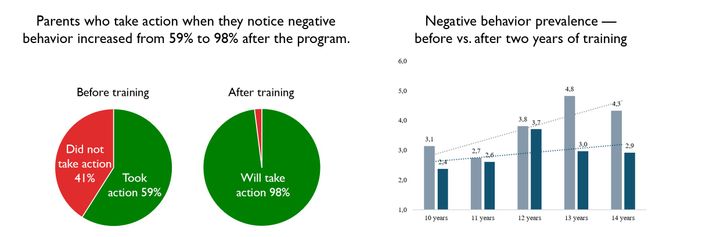
After just one year, statistically significant reductions were observed in negative parental behaviour towards young referees. After two years, similar reductions were found in negative behaviour surrounding the teams and towards club leaders.
In addition, as the chart shows, the relationship between the children’s age and the prevalence of negative behaviour weakened following the training. Before the training, negative behaviour became more prevalent as the children grew older.
This is the first study, nationally or internationally, to demonstrate an improvement in parental behaviour over time following an educational intervention aimed at parents in youth sport. These results were achieved through a relatively limited intervention: a digital training programme that takes approximately 20 minutes to complete.
“The programme uses a different methodology and pedagogical approach from those used in existing educational initiatives, and this likely contributed to the results. The findings raise the question of whether educational interventions need to be as resource- and time-intensive as they often are today,” says Niklas Lovefall, author of the study.
SPORTS CLUBS ALSO NOTICED THE CHANGE
The change was not only evident in the survey results; it was also noticed by the participating sports clubs. In a follow-up evaluation, 12 of the 13 clubs reported that they observed a positive change in parents’ behaviour around the teams and towards young referees. Six of the clubs described the change as large or very large.
“This study shows that we now have a concrete way of addressing negative behaviour among parents in youth sport—not merely by talking about the problem, but by offering training that has been shown to change behaviour for the better,” concludes Niklas Lovefall.
FACTS ABOUT THE STUDY
-
A master’s thesis conducted at Umeå University.
-
The main cross-sectional study included 11,459 parents from 250 sports clubs across 25 different sports. Each parent participated at one measurement point.
-
A separate sample of ice hockey parents was surveyed at three time points over two years, with 711, 955 and 686 parents participating. Individual parents were not followed over time.
-
The training was completed digitally at a time and place chosen by each participant and took approximately 20 minutes.
-
The study analysed changes in the perceived parental climate surrounding club leaders and young referees following the training.
-
Based on the number of participating parents, it is the largest study of its kind worldwide and the first to demonstrate longer-term improvements following an educational intervention aimed at parents in youth sport.
Contacts
Henrik PihlbladGöteborgs Ishockeyförbund
Tel:0707381195henrik.pihlblad@gbgif.seNiklas LovefallSport Values Sverige
Tel:0703550899niklas@sportvalues.seDocuments
Links
OM YOUTH SPORT RESEARCH
Youth Sport Research is an independent knowledge platform that collects and communicates research on how adult behaviour affects children's and young people's experiences of sport. By combining its own, national and international research, the platform wants to contribute to safer, more positive and more sustainable sports environments for children and young people.
https://www.youthsportresearch.org/
ABOUT SPORT VALUES SVERIGE AB
The training analyzed in the study has been developed by Sport Values Sweden, which develops research-based training and digital tools to strengthen the work on core values in children's and youth sports.
https://www.sportvalues.se
Alternative languages
Subscribe to releases from Youth Sport Research
Subscribe to all the latest releases from Youth Sport Research by registering your e-mail address below. You can unsubscribe at any time.
Latest releases from Youth Sport Research
In our pressroom you can read all our latest releases, find our press contacts, images, documents and other relevant information about us.
Visit our pressroom