
For the sake of democracy, Europe must get its governance act together, urges new report
9.9.2026 13:27:50 CEST | news aktuell GmbH | Press Release
Los Angeles/DNA - Although Europe’s place among the world’s democracies remains at the top of the heap, the latest research from governance experts warns that the continent is slipping from its lofty perch as the runaway global leader.
According to the report - based on the European Berggruen Governance Index (EBGI), which analyses states’ governance performance according to the quality of democracy, government, and lives of citizens - European states’ years-long dominance is stagnating. Over time, this could undermine democratic accountability and raise questions about the region’s long-term stability.
The findings of the report, titled “Sustaining and Expanding Europe’s High Governance Performance”, show that complacency, what researchers refer to as the “silent killer of governance”, is a cause for concern that must be addressed by a renewed focus on bolstering democracy and engaging citizens.
The report was produced by researchers at the University of California Los Angeles (UCLA), the Los Angeles-based Berggruen Institute, and Berlin’s Hertie School.
Europe still leads the way
At first glance, Europe remains the envy of democracies around the world. Overall, Europe dominates the global index’s category of “Consolidated Democratic States” with 15 European countries ranked among the top 20. When it comes to the quality of government, the European average is a whopping 56 percent higher than the non-European average, while quality of democracy enjoys a 40 percent lead.
With such high scores, Europe appears well placed for the future. In fact, the 39 European countries surveyed scored almost 78 per cent in the overall assessment of governance, whilst the non-European countries lagged behind at 54 per cent. Though a closer look at Europe from 2000 to 2023 tells a more nuanced story, one that researchers say needs greater attention.
A tale of three factors
Around the world, quality of life has improved almost everywhere, with the provision of public goods increasing in all 39 European states. However, those gains were not matched by Europe’s institutions, which have seen state capacity stall and democratic accountability decline since 2010, according to the report.
Although the report shows that this trend of better lives and worsening democratic structures is a global issue, in Europe the problem is more pronounced.
The report found that democratic accountability, or quality of democracy, has come to a global standstill, with many countries, including those in Europe, on the decline. At the same time, even as the quality of government has held steady throughout the world, the fortunes of citizens have improved. In Europe, the increased quality of life mirrors that of non-European countries, but the quality of governance has stalled.
Europe’s shifting landscape
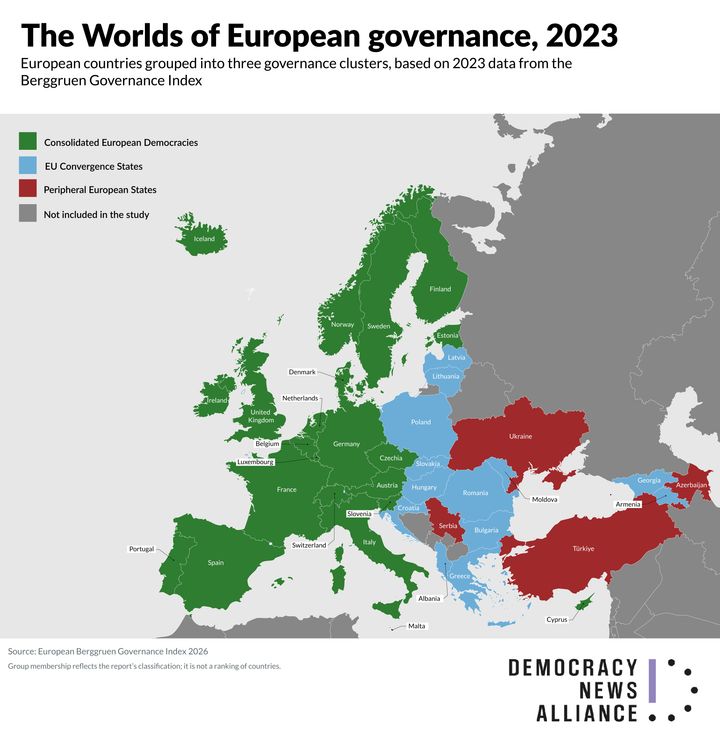
To gain a better understanding of Europe’s governance fortunes, the report sorted countries into three clusters, or “worlds”. The first cluster identified those with strong institutions and high governance performance. The second cluster groups post-communist EU members, along with aspiring and candidate states. The third cluster is composed of Europe’s weakest performers of democratic accountability.
Through examining the “worlds” between 2000 and 2023, researchers found what they refer to as a “convergence from below”, an upward shift that saw 12 countries move into a higher governance cluster, a discernible improvement. These countries are Albania, Armenia, Cyprus, Czechia, Estonia, Georgia, Italy, Malta, Moldova, Portugal, Romania, and Slovenia. But the move was largely the result of better public services, not a stronger democracy, which the report says does not bode well for the future.
The clusters were ranked according to economic, social, technological, and climate factors. Research shows that the top cluster is best placed to deal with future challenges in the decades to come. While the findings show that quality of life alone cannot ensure the democratic accountability and state capacity provided by robust institutions, the report details how the allure of EU membership does result in reforms among accession countries that help fuel governance progress.
Estonia as an example of a success story
Among the success stories, the report highlights Estonia, which was able to combine EU accession, fiscal discipline, low corruption, and extensive digital government, all key governance indicators, to move into the top cluster of countries.
By comparison, Greece was an example of what the report called a “distinctly European pathway of decline”, whose weakened state capacity and democratic accountability have been undermined by economic crisis and external conditionality brought on by loans, austerity measures, and forced reforms.
The report also outlines how the increase in the provision of public goods is not always domestically driven. Countries in Central and Eastern Europe and the Balkans have partially relied on funding from Brussels, while other parts of Europe have amassed debt to improve quality of life, which can lead to limited growth among poorer countries.
Strengthening the weakest links
The authors make it clear that while Europe has succeeded at boosting the quality of life through better provision of public goods, it has struggled to maintain democratic accountability and sustain a high level of state capacity needed to navigate the decades ahead.
To begin addressing the governance gap that exists between Europe’s core and peripheral countries, in addition to administrative reform and democratic renewal, the report recommends that building a stronger democracy depends on social accountability, an area largely beyond EU influence.
Specifically, researchers point to attacks on freedom of the press and a shrinking civil society as greater threats to democratic accountability than “rigged elections or captured courts”. In their view, media pluralism and civic space need to be treated as “governance infrastructure” to not only help “reinvigorate democracy and make citizens feel that they are represented”, but also to prevent the “silent killer” of complacency from taking hold.
The full report, “European Berggruen Governance Index - Sustaining and Expanding Europe’s High Governance Performance” can be viewed and downloaded from the website of the UCLA's Luskin School.
-------------------------
This text and the accompanying material (photos and graphics) are an offer from the Democracy News Alliance, a close co-operation between Agence France-Presse (AFP, France), Agenzia Nazionale Stampa Associata (ANSA, Italy), The Canadian Press (CP, Canada), Deutsche Presse-Agentur (dpa, Germany) and PA Media (PA, UK). All recipients can use this material without the need for a separate subscription agreement with one or more of the participating agencies. This includes the recipient's right to publish the material in own products.
The DNA content is an independent journalistic service that operates separately from the other services of the participating agencies. It is produced by editorial units that are not involved in the production of the agencies' main news services. Nevertheless, the editorial standards of the agencies and their assurance of completely independent, impartial and unbiased reporting also apply here.
Contacts
Christian RöwekampDemocracy News Alliance
roewekamp.christian@dpa.comImages
Subscribe to releases from news aktuell GmbH
Subscribe to all the latest releases from news aktuell GmbH by registering your e-mail address below. You can unsubscribe at any time.
Latest releases from news aktuell GmbH
FEV Consulting recognized by Forbes and Statista as one of the world's best management consulting firms8.9.2026 11:00:00 CEST | Press Release
FEV Consulting has once again been recognized among the world's leading management consulting firms. The company has been included in the World's Best Management Consulting Firms 2026 ranking by Forbes and Statista. The recognition highlights FEV Consulting's international consulting expertise and underscores its successful expansion as a global partner for technology-driven transformation.
A European Gateway to Commercial Space is established in Dübendorf / Zurich Gains Direct Access to the International Space Station and the Starlab Space Station7.9.2026 10:00:00 CEST | Press Release
The Center for Space and Aviation Switzerland and Liechtenstein (CSA) is bringing together a fully integrated pathway at the Switzerland Innovation Park Zurich from laboratory preparation through parabolic flight test and qualification to low Earth orbit. With international partners across Europe and the United States, the hub now provides a practical route to orbital research and development aboard the International Space Station (ISS) - including three initial free competitive experiment slots provided jointly by the Center for Space and Aviation Switzerland and Liechtenstein (CSA) and Starlab Space - and, in the future, to commercial space stations such as Starlab.
Antigravity Announces Newest Innovation at IFA, Expanding Creative Possibilities4.9.2026 09:00:00 CEST | Press Release
Berlin, Germany - Today at IFA, Antigravity, an aerial technology brand incubated by Insta360, announced its latest innovation, the Antigravity Cellular Module, which is designed to give creators greater freedom and reliability in flight. The Cellulare Module enhances A1's transmission reliability by adding a 4G connection. Working alongside the A1’s OmniLink 360 system, the module provides an additional connection when the primary transmission link encounters interference or obstruction. In complex urban environments, it helps maintain a stable video connection while supporting smoother transmission over longer distances. The module can be mounted directly onto the drone and Vision Goggles and features an integrated eSIM for convenient connectivity while traveling. The Antigravity Cellular Module will be available by the end of September 2026. At IFA 2026, Antigravity will give attendees the chance to experience the award-winning Antigravity A1 for themselves. Visitors can head to the
Change of leadership at PMG Presse-Monitor: Natascha Thomas takes over as managing director on 1 January 20274.9.2026 08:03:22 CEST | Press Release
Berlin, 3 September 2026 A change in leadership is planned at PMG Presse-Monitor GmbH & Co. KG at the end of 2026: Managing Director Ingo Kästner will be leaving the company at his own request and retiring after many successful years. Natascha Thomas will take over as his successor, supported by Désirée von Domarus as Commercial Director. Ingo Kästner has played a key role in shaping PMG over many years. Under his leadership, new business areas were developed, digital services were expanded, and the company’s position as a leading provider of media monitoring, press reviews and media analysis in the German-speaking world was significantly strengthened. “The past few years at PMG have been characterised by dedicated colleagues, trusting partnerships and many successful developments,” says Ingo Kästner. “I am delighted to hand over responsibility to Natascha Thomas. She has known the company, the market, and our customers for many years and has the experience needed to successfully lead
10 Years of the Elbphilharmonie Hamburg: Spectacular Concert Hall Celebrates Its Success Story2.9.2026 08:03:55 CEST | Press Release
HAMBURG -The opening of the Elbphilharmonie Hamburg will mark its tenth anniversary on 11 January 2027. At the start of the anniversary season, the spectacular concert hall presented key figures from its success story: annual attendance at classical concerts in Hamburg has tripled since the Elbphilharmonie opened. 7.4 million people have attended around 6,400 concerts and events at the Elbphilharmonie, while 29.5 million have visited the Plaza, the public viewing platform 37 metres above ground. Ten years after opening the Elbphilharmonie has become a landmark of Hamburg and an internationally established concert venue. Its impact extends far beyond the concert hall itself: its architecture, public Plaza and a programme combining musical excellence with a spirit of discovery have transformed the perception of Hamburg as a city of music. What was once a controversial construction project has become a concert hall that inspires the people of Hamburg as much as artists, orchestras and cur
In our pressroom you can read all our latest releases, find our press contacts, images, documents and other relevant information about us.
Visit our pressroom