
3D printers can make advanced research more accessible
5.10.2026 08:00:00 CEST | Umeå University | Press Release
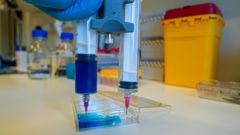
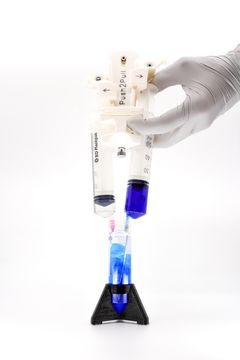
Developing new research equipment is often expensive and time-consuming. In his doctoral thesis, Daniel Nilsson at Umeå University demonstrates how standard 3D printers can be used to rapidly manufacture advanced scientific instruments directly in the laboratory.
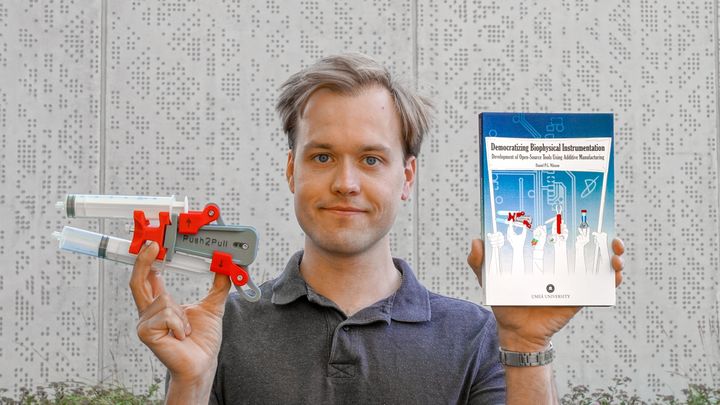
Studying microorganisms requires instruments with extremely high precision. Such instruments are expensive and take a long time to manufacture using traditional methods, which has slowed progress in the field. It has also been difficult for the biologists who use these instruments to participate directly in their development.
Using standard consumer-grade 3D printers, Daniel Nilsson at the Department of Physics has shown that it is possible to independently develop advanced, customised research instruments.
“We have developed a set of instruments that can be manufactured directly in the laboratory by anyone. We hope this will make biological research less expensive and more accessible to a larger number of researchers,” he says.
Instruments for detecting bacteria
Examples of the tools developed by the researchers include instruments for detecting and manipulating harmful bacteria using laser light, as well as tools for cultivating and measuring the properties of biofilms. Biofilms are slimy structures that bacteria can form on surfaces and that cause major problems in areas such as food production and healthcare.
A key idea behind the work is that researchers should be able to build, adapt and further develop equipment based on their own needs, rather than rely on expensive commercial solutions.
“These methods enable a more collaborative and needs-driven approach to development within the research community,” says Daniel Nilsson.
A practical guide
The thesis also includes a practical guide showing how researchers and other interested users can design 3D-printed tools and integrate open-source electronics.
“The same methods can be used both for advanced research instruments and for everyday technological solutions in the laboratory,” says Daniel Nilsson.
About the public defence
On Friday 9 October, Daniel Nilsson of the Department of Physics at Umeå University will defend his doctoral thesis, Democratisation of Biophysical Instrumentation through Open-Source Design and Additive Manufacturing. The public defence will take place at 09:00 in Aula Anatomica (BIO.A.206) in the Biology Building, Umeå University. The faculty opponent is Christine Selhuber-Unkel of Heidelberg University.
About the researcher
Daniel Nilsson is a doctoral student in experimental physics. His research focuses on method and instrument development in biophysics, ranging from studies of single cells to models of biological flows. He has a background as an electrician, holds a Master of Science in Engineering degree in Engineering Physics, and has extensive experience building measurement equipment for researchers.
Contacts
Daniel NilssonResearch AssistantDepartment of Physics
Tel:+46 73 049 85 95daniel.pg.nilsson@umu.seSara-Lena BrännströmCommunications officerFaculty of Science & Technology
Tel:+46 90 786 72 24sara-lena.brannstrom@umu.seGeneral Press InquiriesPress Officer
Tel:+46 90 786 50 89press@umu.seImages
About us
Umeå University is a comprehensive university and one of Sweden’s largest higher education institutions with around 38,000 students and 4,600 staff. We have a diverse range of high-quality educational programmes and research within all disciplinary domains and the arts. The University offers world-class educational and research environments and helps expand knowledge of global significance. This is where the groundbreaking discovery was made of the CRISPR-Cas9 gene-editing tool, which was awarded the Nobel Prize in Chemistry. At Umeå University, everything is just around the corner. Our tightly knit campus makes it easy to meet, collaborate and share knowledge, something that encourages a dynamic and open culture.
Subscribe to releases from Umeå University
Subscribe to all the latest releases from Umeå University by registering your e-mail address below. You can unsubscribe at any time.
Latest releases from Umeå University
Researchers discover major ecological shift in the Gulf of Bothnia2.10.2026 10:00:00 CEST | Press Release
For decades, scientists have regarded phosphorus as the main nutrient limiting biological production in the Gulf of Bothnia. Now, a new study led by researchers at Umeå University shows that a fundamental change is underway. The Bothnian Sea has shifted to nitrogen limitation, while the Bothnian Bay is rapidly moving in the same direction.
Bildmuseet: Anneli Furmark / You Are the Centre of the Earth1.10.2026 15:29:11 CEST | Press Release
Anneli Furmark’s works, graphic novels as well as painting, often explore the ways people relate to one another, to the landscape, and to the place. Her narratives frequently unfold in northern settings, with particular attention to houses and built environments. Bildmuseet presents drawings, comics, paintings and sketchbooks from the past fifteen years. Also on view is a film created especially for the exhibition, in which actors give voice to short stories from Furmark’s graphic novels.
Bildmuseet: Nina Mangalanayagam / Blank Pages1.10.2026 15:25:46 CEST | Press Release
Drawing on photography, film and sound installation, Nina Mangalanayagam explores questions of belonging and composite identities, often with an autobiographical approach. In a compelling, thought-provoking exhibition at Bildmuseet, she presents new works examining Sweden’s colonial past and its relevance today.
Katarina Pierre steps down after 16 years as artistic director of Bildmuseet11.9.2026 13:23:51 CEST | Press Release
With an unfailing eye for artistic quality and a deep belief in the importance of art, Katarina Pierre has developed Bildmuseet into one of Sweden’s leading venues for international contemporary art. After 16 years as artistic director, she is now retiring.
A few minutes of freezing can change the fate of iron in nature27.8.2026 09:00:00 CEST | Press Release
Just a few minutes of freezing and thawing can have a decisive impact on how ferrihydrite, the most reactive iron mineral in cold soils, permafrost and glaciers, transforms, according to researchers at Umeå University in a paper published in the journal Science. As climate warming intensifies freeze-thaw cycles and extends them into new regions, ice is becoming an increasingly important driver of Earth's ecosystems.
In our pressroom you can read all our latest releases, find our press contacts, images, documents and other relevant information about us.
Visit our pressroom