
Researchers hacked a 3D printer to speed up fabrication of bioelectronics
26.2.2024 13:57:21 CET | KTH Royal Institute of Technology | Press Release
The speed of innovation in bioelectronics and critical sensors gets a new boost with the unveiling of a technique for fast-prototyping of devices.
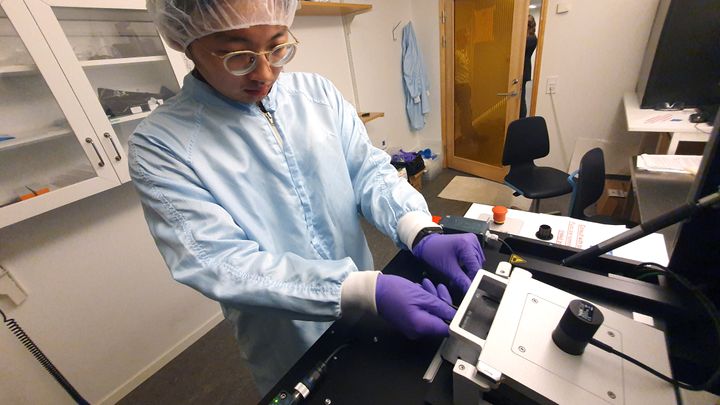
A research team at KTH Royal Institute of Technology and Stockholm University reported a simple way to fabricate electrochemical transistors using a standard Nanoscribe 3D microprinter. Without cleanroom environments, solvents or chemicals, the researchers demonstrated that 3D microprinters can be hacked to laser print and micropattern semiconducting, conducting and insulating polymers.
Anna Herland , professor in Micro- and Nanosystems at KTH , says the printing of these polymers is a key step in prototyping new kinds of electrochemical transistors for medical implants, wearable electronics and biosensors.
The technique could replace time-consuming processes that require an expensive cleanroom environment. Nor would it involve solvents and developer baths that have a negative environmental impact, says the study’s co-author Erica Zeglio , a faculty researcher with Digital Futures , a research center jointly operated by KTH Royal Institute of Technology and Stockholm University.
“Current methods rely on expensive and unsustainable cleanroom practices,” Zeglio says. “The method we proposed here doesn’t.”
Polymers are core components of many bioelectronic and flexible electronic devices. The applications are diverse, including monitoring living tissues and cells and diagnosing diseases in point-of-care testing.
“Fast prototyping of these devices is time consuming and costly.” Herland says. “It hinders the widespread adoption of bioelectronic technologies.”
Using ultrafast laser pulses, the new method creates possibilities for the rapid prototyping and scaling of microscale devices for bioelectronics, says co-author and KTH Professor Frank Niklaus. The method could also be used for the patterning of other soft electronic devices, he says. The team applied the new method to fabricate complementary inverters and enzymatic glucose sensors.
Herland says the method could advance research in bioelectronic devices and significantly shorten the time-to-market.
“This also creates the possibility of replacing some of the current components with cheaper and more sustainable alternatives,” she says.
The researchers published their results in the journal Advanced Science.
Read the research paper
"Cleanroom-Free Direct Laser Micropatterning of Polymers for Organic Electrochemical Transistors in Logic Circuits and Glucose Biosensors", Advanced Science, https://doi.org/10.1002/advs.202307042
Images
Subscribe to releases from KTH Royal Institute of Technology
Subscribe to all the latest releases from KTH Royal Institute of Technology by registering your e-mail address below. You can unsubscribe at any time.
Latest releases from KTH Royal Institute of Technology
Why your building is often too hot, or cold — and the simple fix3.6.2026 13:28:26 CEST | Press Release
Not happy with the heating in your office, or your apartment building? A new study shows that complicated “smart building” technology isn’t the only answer for spaces that feel too hot after lunch, or too cold in the morning.
New chip offers way to make use of quantum system ‘imperfections’19.5.2026 14:30:22 CEST | Press Release
Quantum technologies promise powerful new kinds of computers, giving scientists new tools to mimic and explore nature at its tiniest scales. At those levels, everything in nature—from atoms and electrons to light itself—follows the strange rules of quantum mechanics. But the real world is never perfectly clean: signals fade, energy leaks away and systems pick up noise from their surroundings.
How to save computing energy? This study shows a way to engineer materials so magnetic signals can carry information6.5.2026 13:06:14 CEST | Press Release
A recent study shows a new and potentially more energy efficient way for information to be transmitted inside electronic systems, including computers and phones—without relying on electric currents or external magnetic fields.
Cause of common heart valve defect revealed in genetic study28.4.2026 11:18:02 CEST | Press Release
New clues from genetic research may help explain what causes the most common heart defect present at birth. Researchers in Sweden have identified rare DNA changes during fetal development that can lead to a condition known as bicuspid aortic valve (BAV).
Study offers new way to stop global potato pathogen once linked to Ireland’s Great Famine23.4.2026 11:46:21 CEST | Press Release
Scientists in Sweden have taken an important step toward fighting potato late blight, a plant disease that once triggered an historic famine in Ireland and now threatens to spread globally due to climate change.
In our pressroom you can read all our latest releases, find our press contacts, images, documents and other relevant information about us.
Visit our pressroom