
Alternative to studded winter tires reduces airborne particles by 20 percent
6.2.2025 14:41:07 CET | KTH Royal Institute of Technology | Press Release
On icy roads, studded winter tires can save lives – but they pulverize pavement and fill the air with dangerous, inhalable particles. A new Swedish study shows that both road wear and airborne particles could be reduced by as much as 20 percent if studs were made instead with an alternative hard metal.
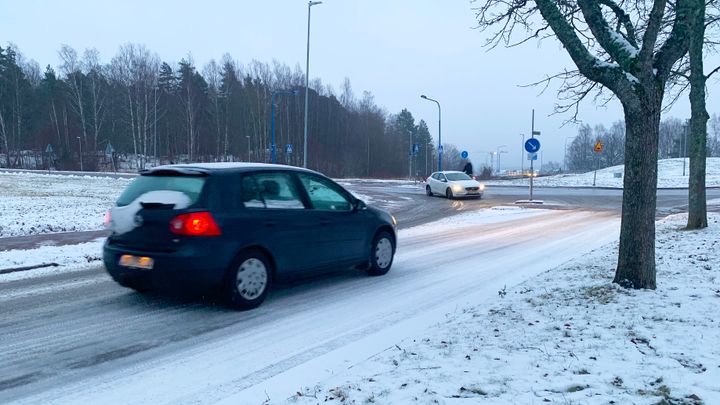
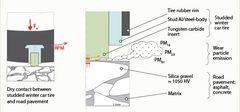
• Two stud materials were evaluated in two dedicated test rigs for road wear and airborne particle emission studies.
• One of the stud materials was a cobalt containing stud and the other one was a cobalt free alternative.
• Lower particle emissions and road wear for the cobalt free stud compared to today’s standard cobalt containing one.
In tests at KTH Royal Institute of Technology in Stockholm, researchers compared asphalt wear-and-tear and particle emissions caused by cobalt-containing studs with studs composed of an alternative, iron-nickel containing hard metal. They found that the iron-nickel stud material could grip ice and packed snow just as well—while causing significantly less damage to the road surface.
“Cobalt is a cheap solution,” says Ulf Olofsson, a professor in the Department of Engineering Design at KTH Royal Institute of Technology. “It’s so hard that it doesn’t wear down, which is why it’s also mass produced for rock drilling tools.”
“But asphalt is soft enough that cobalt-containing studs grind and pulverize it into ultra-fine particles that go deep down into the body when inhaled.”
Studs need to be only 20 to 30 percent harder than asphalt to make driving on ice safer, Olofsson says. “But the studs on the market today are double the hardness of road material and nine times the hardness of glacial ice at -40C.
“That’s overkill,” he says.
Olofsson says the research team is now studying the longevity of alternative stud materials – the next step in finding an alternative to cobalt-containing studs.
Though studies show studded tires save roughly 70 lives each year in Sweden, some cities in the country have banned them on designated roadways due to the health risk posed by airborne asphalt particles. In most U.S. states, use of studded tires is restricted, while several states have banned them altogether. Mostly allowed across Europe, the tires are however banned in several, including Germany, the Netherlands and Poland.
In the EU, non-exhaust vehicle emissions from tire, road and brake wear are equivalent to exhaust emissions in terms of PM10 (particles with aerodynamic diameters smaller than 10 µm), Olofsson says. But in the Nordic countries, non-exhaust PM10 emissions significantly exceed those from exhaust due to the frequent use of studded tires.
It also increases road maintenance costs for the public. He estimates that Swedish road surfaces have a lifespan half as long as the roads in Germany, where a ban on studded tires is in place.
Images
Subscribe to releases from KTH Royal Institute of Technology
Subscribe to all the latest releases from KTH Royal Institute of Technology by registering your e-mail address below. You can unsubscribe at any time.
Latest releases from KTH Royal Institute of Technology
Twisting atom thin materials reveals new way to save computing energy6.5.2026 13:06:14 CEST | Press Release
A recent study shows a new and potentially more energy efficient way for information to be transmitted inside electronic systems, including computers and phones—without relying on electric currents or external magnetic fields.
Cause of common heart valve defect revealed in genetic study28.4.2026 11:18:02 CEST | Press Release
New clues from genetic research may help explain what causes the most common heart defect present at birth. Researchers in Sweden have identified rare DNA changes during fetal development that can lead to a condition known as bicuspid aortic valve (BAV).
Study offers new way to stop global potato pathogen once linked to Ireland’s Great Famine23.4.2026 11:46:21 CEST | Press Release
Scientists in Sweden have taken an important step toward fighting potato late blight, a plant disease that once triggered an historic famine in Ireland and now threatens to spread globally due to climate change.
Study reveals unseen changes in motor control after spinal cord injury14.4.2026 12:09:09 CEST | Press Release
Even when people with incomplete spinal cord injuries can walk, everyday functions like standing, balancing or producing steady force may remain difficult. A new study shows why.
Study offers single explanation for two major symptoms of schizophrenia19.3.2026 11:00:02 CET | Press Release
Scientists have long known that dopamine helps the brain learn from rewards, but a new computational model shows how for people with schizophrenia this learning system can break down and simultaneously produce two very different symptoms — delusions and a loss of motivation.
In our pressroom you can read all our latest releases, find our press contacts, images, documents and other relevant information about us.
Visit our pressroom