
Bildmuseet: Northern dawn chorus in Machine Auguries by Alexandra Daisy Ginsberg
18.12.2024 12:42:34 CET | Umeå University | Press Release
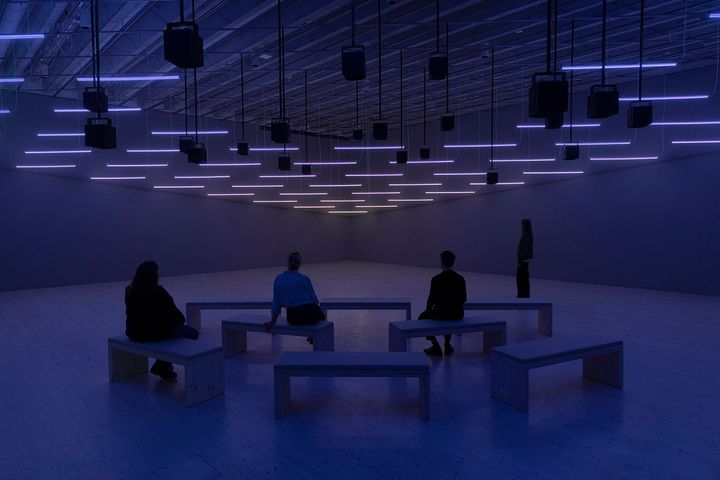
Bildmuseet unveils a new site-specific iteration of Alexandra Daisy Ginsberg’s sound and light installation Machine Auguries, this time set in Umeå in northern Sweden. Premiere on 12 January – Welcome! Presented alongside the previous iterations from London and Toledo, these three artificial dawn choruses from different parts of the world invite the museum visitor to reflect on our relationship with nature.
With AI-generated birdsong heard under an artificial dawn sky, Machine Auguries warns of our infatuation with technology at the expense of nature. Using thousands of field recordings of birds, Alexandra Daisy Ginsberg has trained a pair of neural networks to develop their synthetic birdsong in dialogue. In her immersive artwork, a real dawn chorus is slowly taken over by artificial song. As human actions decimate bird populations, the artist offers a false copy of the dawn.
For the first time, Bildmuseet brings together three choruses of Machine Auguries, each simulating the experience of a particular place and moment. The first was created in London, where – as in many big cities – light and sound pollution are forcing birds to sing earlier, longer, louder or at higher pitches. The second was commissioned for Toledo, Ohio, a city located on the spring migration flyways from South America to the colder northern climes. In January 2025, the new 12-minute site-specific Umeå chorus premieres. Working with local sound recordists, ornithologists, and sound archives, Ginsberg has collated field recordings of bird species iconic to this subarctic ecosystem in northern Sweden.
The spring in Umeå ushers in melting snow and disappearing nights, as the sun begins to skirt closer and closer to the horizon. In the gallery, softly illuminated with the cold blue light of the early dawn, the bubbling sounds of black grouse are interrupted by the first solo of the Eurasian blackbird. As the sun rises over the room, the calls of song thrushes, lapwings, curlews and cranes are replaced by the songs of their AI-generated counterparts. When the chorus falls silent, we can no longer be sure what is real.
Capturing the experience of a place, Machine Auguries is an expanding archive of vanishing local realities. This collection celebrates the uniqueness of ecosystems but reminds us of their interconnectedness, as bird species reappear across places. As these imperfect copies of the dawn are situated inside the gallery, Machine Auguries reminds us of the impossibility of recreating nature and the urgent need to protect it.
Alexandra Daisy Ginsberg (b. 1982) is a multidisciplinary artist based in London, examining humans’ fraught relationship with nature and technology. Her work has been shown worldwide, including at MoMA, New York; the Museum of Contemporary Art, Tokyo; the Centre Pompidou, Paris; and the Royal Academy, London. She has a PhD from the Royal College of Art. In 2023, she won the S+T+ARTS Grand Prize – Artistic Exploration from the European Commission for her interspecies living artwork Pollinator Pathmaker. This is the artist’s first solo presentation in Sweden.
Machine Auguries is the first of two exhibitions, developed with Curator Sarah Cook, at Bildmuseet which explore our future with AI technologies. The exhibition, which runs until April 6, 2025, is produced by Bildmuseet with support from Kempestiftelserna, the Arctic Centre at Umeå University and WASP-HS. Special thanks to the Cornell Lab of Ornithology | Macaulay Library for their support of this artwork.
Sarah Cook is UmArts WASP-HS Guest Professor at Bildmuseet and Umeå School of Architecture, supported by the Wallenberg AI, Autonomous Systems and Software Program – Humanities and Society (WASP-HS). She is Professor of Museum Studies at the University of Glasgow.
EVENTS PROGRAMME
SUN 12 JANUARY 14:00–14:30
Launching of Machine Auguries: Umeå. Speech by Museum director Katarina Pierre, followed by a conversation with evolutionary ecologist Keith Larson, Director, Arctic Centre, Umeå University.
SUN 26 JANUARY 14:00–15:00
Art in the Rise of AI. Artist Daniel Shanken, Postdoc at the Umeå School of Architecture, on how AI poses new challenges and methodological choices for art.
SUN 9 FEBRUARY 14:00–15:00
Fifty Years of Birdlife Evolution in the Umeå region. Ornithologist Christer Olsson on changes in migration patterns, bird populations and new species in Västerbotten.
SUN 23 FEBRUARY 14:00–15:00
Living by the Light. Katharina Wulff, Associate Professor of Chronobiology and Sleep at Umeå University, on how all living things adapt to the shifts in daylight.
CONTACT INFORMATION
Contacts
General Press InquiriesPress Officer
Tel:+46 90 786 50 89press@umu.seImages
About us
Umeå University is a comprehensive university and one of Sweden’s largest higher education institutions with around 38,000 students and 4,600 staff. We have a diverse range of high-quality educational programmes and research within all disciplinary domains and the arts. The University offers world-class educational and research environments and helps expand knowledge of global significance. This is where the groundbreaking discovery was made of the CRISPR-Cas9 gene-editing tool, which was awarded the Nobel Prize in Chemistry. At Umeå University, everything is just around the corner. Our tightly knit campus makes it easy to meet, collaborate and share knowledge, something that encourages a dynamic and open culture.
Subscribe to releases from Umeå University
Subscribe to all the latest releases from Umeå University by registering your e-mail address below. You can unsubscribe at any time.
Latest releases from Umeå University
The protein that helps cancer cells survive treatment7.4.2026 08:00:00 CEST | Press Release
Researchers at Umeå University have contributed new insights into how cancer cells protect themselves from cell death. The study provides a deeper understanding of how key proteins interact within the cell and could, in the long term, support the development of new cancer therapies.
Capsule technology opens new window into individual cells12.3.2026 09:00:00 CET | Press Release
Researchers have developed a capsule-based method that makes it possible to analyse the same cell through multiple experimental steps. The technology overcomes a long-standing limitation in cell research and could open new ways to study disease mechanisms at the single-cell level.
Who holds the power when AI enters our lives?25.2.2026 14:05:00 CET | Press Invitation
In a major new exhibition at Bildmuseet, international artists examine the rapid technological development shaping contemporary life. AI and the Paradox of Agency opens on 13 March, with presentations, performances, film screenings, creative workshops and more, continuing until midnight. Members of the press are invited to book preview visits and interviews on 10 and 11 March.
Swedish Picture Book of the Year / Where’s My Egg?25.2.2026 14:00:00 CET | Press Invitation
Julia Groth’s Var är mitt ägg? has been named the Swedish Picture Book of the Year. On 13 March, in conjunction with the award ceremony at Littfest – Umeå International Literature Festival, Bildmuseet opens an exhibition of the original illustrations from the winning book. Press previews by appointment.
Reshaping gold leads to new electronic and optical properties2.2.2026 08:10:00 CET | Press Release
By changing the physical structure of gold at the nanoscale, researchers can drastically change how the material interacts with light – and, as a result, its electronic and optical properties. This is shown by a study from Umeå University published in Nature Communications.
In our pressroom you can read all our latest releases, find our press contacts, images, documents and other relevant information about us.
Visit our pressroom