
Shared e-scooters help riders beat the clock — until parking rules kick in
15.10.2025 14:22:28 CEST | KTH Royal Institute of Technology | Press Release
Commuters trying to beat the clock account for nearly one third of shared electric scooter trips on a typical workday morning, recent research indicates. But reliance on these vehicles can be dampened when cities don’t provide enough parking near transit hubs, according to a new study.
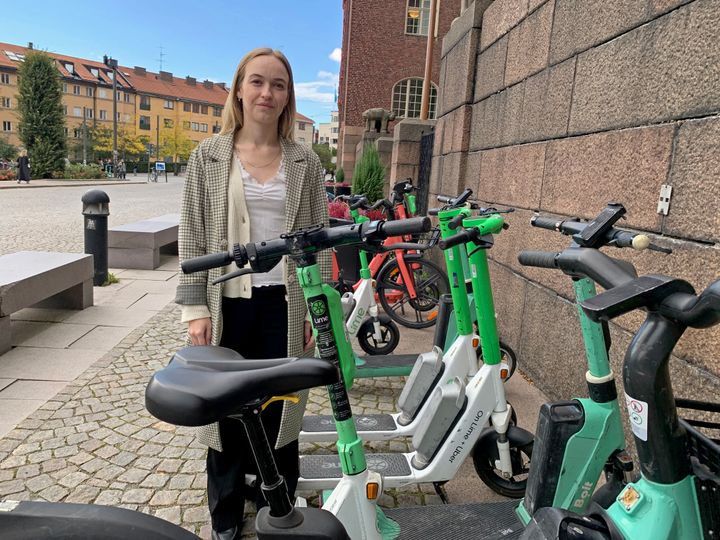
In a recent Swedish study, 60 percent of electric scooter users in two major cities, Stockholm and Malmö, said they used shared electric scooters less frequently after parking regulations were instituted in 2022. The most consistent reason given was the increased distance they have to walk as a result of a national policy requiring riders to park in the newly-designated zones or bike racks.
Boel Berg Wincent, a researcher at Stockholm's KTH Royal Institute of Technology, says the policy’s aim was to reduce sidewalk clutter and improve accessibility. But one unintended outcome was the way it reshaped commuters attitudes about combining e-scooters with mass transit, an example of the growing “micromobility” trend.
In an online survey with more than 1,000 respondents, more than 80 percent of shared e-scooter users in both cities said they had to walk farther to find or to park around bus and train stations. About 40 percent said their travel times had increased since the regulations took effect.
Berg Wincent say these longer distances—and the time required to find parking—appeared to undermine the convenience of shared e-scooters, which are often chosen for their door-to-door utility.
Earlier research by Berg Wincent and her team found a significant portion of shared e-scooter trips begin near public transport hubs but end elsewhere, indicating that e-scooters are often used to complete the “last mile” of a journey—especially when buses or trains are delayed.
A substantial portion of trips appear to involve people hurrying to avoid arriving late for work or class. “About 30 percent of weekday morning trips end in the last 10 to 15 minutes before the hour, that is, the peaks before lectures, exams or work start times,” she says.
As both a backup and a bridge, this dual role of electric scooters suggests they are not merely replacing walking or cycling, but actively complementing public transport systems, the research shows.
The study highlights the need for planning and thoughtful design for e-scooter parking, Berg Wincent says. That is, more density of spaces, and closer to transit hubs. She says that despite the results, the city of Stockholm was on the right track in its intentions. It quickly create parking spaces close to transit hubs in anticipation of the new regulations.
“They were aiming for higher parking density, so this study confirms their strategy was right,” she says.
Contacts
David CallahanInternational Public Information OfficerKTH Royal Institute of Technology
press@kth.seBoel Berg WincentKTH Royal Institute of Technology
Researcher, Transport Planning
Images
Links
Subscribe to releases from KTH Royal Institute of Technology
Subscribe to all the latest releases from KTH Royal Institute of Technology by registering your e-mail address below. You can unsubscribe at any time.
Latest releases from KTH Royal Institute of Technology
KTH builds Swedish expertise in nitrocellulose2.9.2026 12:54:32 CEST | Press Release
Sweden wants to reduce its dependence on foreign suppliers for nitrocellulose, a raw material central to the production of conventional propellants. KTH is now launching a new competence centre to build up expertise across the entire chain – from forest-based raw materials and manufacturing to safe storage.
'Like uprooting tree stumps' – a simpler method to manufacture biosensors27.8.2026 15:42:00 CEST | Press Release
A new manufacturing method could help move the production of nanoscale sensors from specialized fabrication facilities to conventional semiconductor manufacturing plants.
Technique could make flat optic fiber 1,000 times more sensitive than standard fiber13.8.2026 10:57:20 CEST | Press Release
Optical fiber has already transformed the modern world. New research now suggests it could do even more. A new flat fiber fabrication technique produces a high fidelity sensor for a wide range of applications, from batteries to bridges, according to a recently-published study.
Why your building is often too hot, or cold — and the simple fix3.6.2026 13:28:26 CEST | Press Release
Not happy with the heating in your office, or your apartment building? A new study shows that complicated “smart building” technology isn’t the only answer for spaces that feel too hot after lunch, or too cold in the morning.
New chip offers way to make use of quantum system ‘imperfections’19.5.2026 14:30:22 CEST | Press Release
Quantum technologies promise powerful new kinds of computers, giving scientists new tools to mimic and explore nature at its tiniest scales. At those levels, everything in nature—from atoms and electrons to light itself—follows the strange rules of quantum mechanics. But the real world is never perfectly clean: signals fade, energy leaks away and systems pick up noise from their surroundings.
In our pressroom you can read all our latest releases, find our press contacts, images, documents and other relevant information about us.
Visit our pressroom