
Potential treatment may prevent brain damage in premature babies
11.11.2025 11:10:46 CET | KTH Royal Institute of Technology | Press Release
A treatment that could protect premature babies from brain damage showed promise in a recent study in Sweden. Using a first-of-its-kind prenatal brain model created with human cells, researchers observed new details about the effects of cerebral hemorrhages on stem cells during premature birth. And they successfully tested an antidote that reduced the damage.
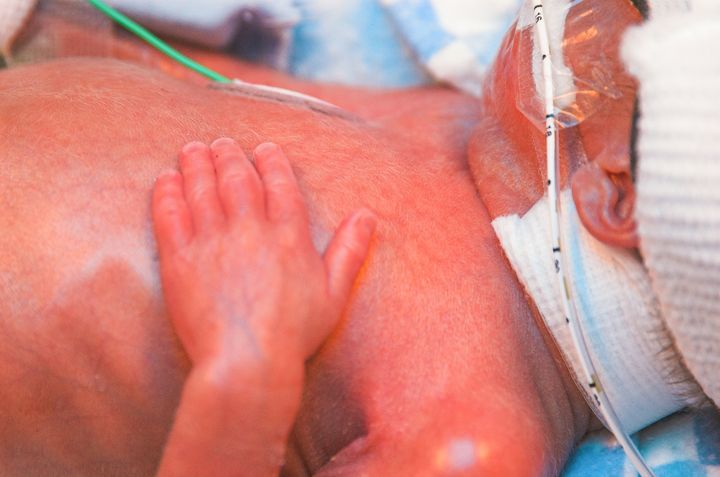
Publishing in Advanced Science, the researchers identified how neural stem cells in preterm infants are damaged as a result of a cerebral hemorrhage. Researchers from KTH Royal Institute of Technology, Karolinska Institutet, and Lund and Malmö Universities collaborated on the study.
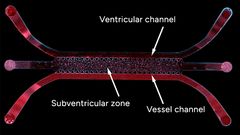
The study shows that as red blood cells seep into the brain’s subventricular zone (SVZ) and break down, levels of the immune response messenger protein interleukin-1 (IL-1) become elevated. These proteins send strong signals that direct neural stem cells to stop acting like stem cells, says Professor Anna Herland, senior lecturer at the AIMES research center at KTH Royal Institute of Technology and Karolinska Institutet.
“Instead of remaining flexible and ready to grow into different types of brain cells, the stem cells start changing too early or stop growing altogether,” Herland says.
Intraventricular hemorrhage (IVH) is a frequent and severe neurologic complication of preterm birth. When red blood cells enter the brain, the plasma proteins and antioxidants that protect them in the bloodstream become overwhelmed by pressure and stress. Blood cells rupture and release inflammation-triggering components such as hemoglobin, which triggers pro-inflammatory proteins associated with immune response, such as interleukin-1.
“Blood and its degradation products cause a strong inflammatory response in brain support cells, glia cells, that are meant to protect and nourish the brain and repair damage,” Herland says.
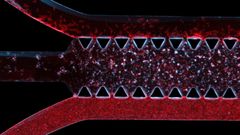
Medical science has previously experimented on animals to research the effects of red blood cell lysate, but the model developed in Sweden breaks new ground. It enables these effects to be studied for the first time in a system that closely mimics mechanisms of the human brain. In collaboration with researchers at Ege University in Turkey and Harvard University in the U.S., the team built its model with living lab-grown human brain cells derived from stem cells, which enables examination of responses in the vulnerable brains of premature babies.
The advanced model provided a unique platform for successfully testing an antidote: an IL1 antagonist, which was shown to suppress levels of interleukin-1, providing partial protection to the stem cells.
The impact of cerebrospinal fluid (CSF) from patients with hemorrhage was studied separately, showing a clear but less intense effect on neural stem cells due to a lower concentration of toxic breakdown products, as well as CSF’s growth factors, nutrients and anti-inflammatory proteins.
“This is one of the most complex in vitro models I have constructed and seen,” Herland says. “That we could recapitulate all these interactions is amazing. That we can then see relevant responses to both simulated conditions and patients’ samples is really important, as there is currently no established treatment for these patients.
Going forward, the team aims to use the platform for studying different levels of injury and scaling up the model. “We hope to screen more treatments that could be even more effective than the one we studied.”
Images
Links
Subscribe to releases from KTH Royal Institute of Technology
Subscribe to all the latest releases from KTH Royal Institute of Technology by registering your e-mail address below. You can unsubscribe at any time.
Latest releases from KTH Royal Institute of Technology
Technique could make flat optic fiber 1,000 times more sensitive than standard fiber13.8.2026 10:57:20 CEST | Press Release
Optical fiber has already transformed the modern world. New research now suggests it could do even more. A new flat fiber fabrication technique produces a high fidelity sensor for a wide range of applications, from batteries to bridges, according to a recently-published study.
Why your building is often too hot, or cold — and the simple fix3.6.2026 13:28:26 CEST | Press Release
Not happy with the heating in your office, or your apartment building? A new study shows that complicated “smart building” technology isn’t the only answer for spaces that feel too hot after lunch, or too cold in the morning.
New chip offers way to make use of quantum system ‘imperfections’19.5.2026 14:30:22 CEST | Press Release
Quantum technologies promise powerful new kinds of computers, giving scientists new tools to mimic and explore nature at its tiniest scales. At those levels, everything in nature—from atoms and electrons to light itself—follows the strange rules of quantum mechanics. But the real world is never perfectly clean: signals fade, energy leaks away and systems pick up noise from their surroundings.
How to save computing energy? This study shows a way to engineer materials so magnetic signals can carry information6.5.2026 13:06:14 CEST | Press Release
A recent study shows a new and potentially more energy efficient way for information to be transmitted inside electronic systems, including computers and phones—without relying on electric currents or external magnetic fields.
Cause of common heart valve defect revealed in genetic study28.4.2026 11:18:02 CEST | Press Release
New clues from genetic research may help explain what causes the most common heart defect present at birth. Researchers in Sweden have identified rare DNA changes during fetal development that can lead to a condition known as bicuspid aortic valve (BAV).
In our pressroom you can read all our latest releases, find our press contacts, images, documents and other relevant information about us.
Visit our pressroom