
Potential treatment may prevent brain damage in premature babies
11.11.2025 11:10:46 CET | KTH Royal Institute of Technology | Press Release
A treatment that could protect premature babies from brain damage showed promise in a recent study in Sweden. Using a first-of-its-kind prenatal brain model created with human cells, researchers observed new details about the effects of cerebral hemorrhages on stem cells during premature birth. And they successfully tested an antidote that reduced the damage.
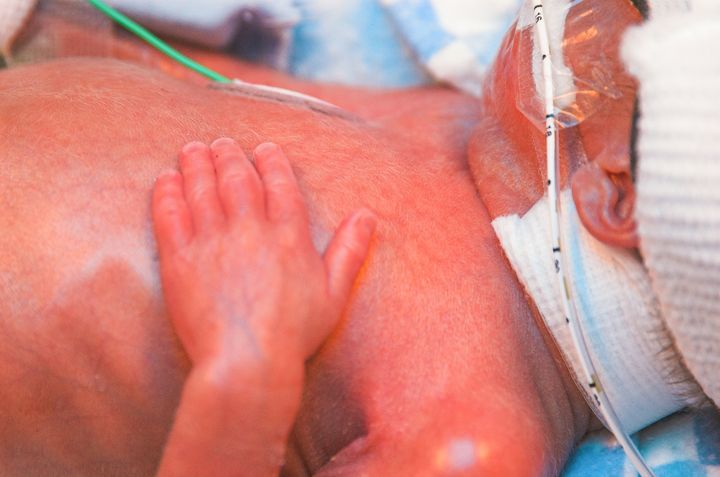
Publishing in Advanced Science, the researchers identified how neural stem cells in preterm infants are damaged as a result of a cerebral hemorrhage. Researchers from KTH Royal Institute of Technology, Karolinska Institutet, and Lund and Malmö Universities collaborated on the study.
The study shows that as red blood cells seep into the brain’s subventricular zone (SVZ) and break down, levels of the immune response messenger protein interleukin-1 (IL-1) become elevated. These proteins send strong signals that direct neural stem cells to stop acting like stem cells, says Professor Anna Herland, senior lecturer at the AIMES research center at KTH Royal Institute of Technology and Karolinska Institutet.
“Instead of remaining flexible and ready to grow into different types of brain cells, the stem cells start changing too early or stop growing altogether,” Herland says.
Intraventricular hemorrhage (IVH) is a frequent and severe neurologic complication of preterm birth. When red blood cells enter the brain, the plasma proteins and antioxidants that protect them in the bloodstream become overwhelmed by pressure and stress. Blood cells rupture and release inflammation-triggering components such as hemoglobin, which triggers pro-inflammatory proteins associated with immune response, such as interleukin-1.
“Blood and its degradation products cause a strong inflammatory response in brain support cells, glia cells, that are meant to protect and nourish the brain and repair damage,” Herland says.
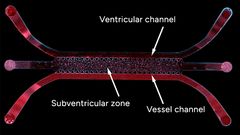
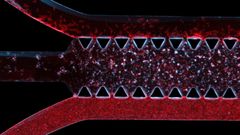
Medical science has previously experimented on animals to research the effects of red blood cell lysate, but the model developed in Sweden breaks new ground. It enables these effects to be studied for the first time in a system that closely mimics mechanisms of the human brain. In collaboration with researchers at Ege University in Turkey and Harvard University in the U.S., the team built its model with living lab-grown human brain cells derived from stem cells, which enables examination of responses in the vulnerable brains of premature babies.
The advanced model provided a unique platform for successfully testing an antidote: an IL1 antagonist, which was shown to suppress levels of interleukin-1, providing partial protection to the stem cells.
The impact of cerebrospinal fluid (CSF) from patients with hemorrhage was studied separately, showing a clear but less intense effect on neural stem cells due to a lower concentration of toxic breakdown products, as well as CSF’s growth factors, nutrients and anti-inflammatory proteins.
“This is one of the most complex in vitro models I have constructed and seen,” Herland says. “That we could recapitulate all these interactions is amazing. That we can then see relevant responses to both simulated conditions and patients’ samples is really important, as there is currently no established treatment for these patients.
Going forward, the team aims to use the platform for studying different levels of injury and scaling up the model. “We hope to screen more treatments that could be even more effective than the one we studied.”
Images
Links
Subscribe to releases from KTH Royal Institute of Technology
Subscribe to all the latest releases from KTH Royal Institute of Technology by registering your e-mail address below. You can unsubscribe at any time.
Latest releases from KTH Royal Institute of Technology
Simulations suggest a breakthrough in understanding how turbulence develops12.3.2026 09:43:46 CET | Press Release
A new study revisits a century-old question about how turbulence starts. The findings could potentially influence not only aircraft engineering but even design of mechanical heart valves, and treatment of heart disease. Computer simulations at Stockholm’s KTH Royal Institute of Technology indicate that very small vortices may create increasingly larger swirls of flow—the opposite of the traditional view of how energy is transferred in turbulence.
Method to extract Baltic phosphorus may ease Europe's reliance on fertilizer imports18.2.2026 14:28:50 CET | Press Release
The Baltic Sea is one of the world's most oxygen-depleted major bodies of water. The reason is excessive concentrations of phosphorus, an element essential for life—and an important ingredient in fertilizer. New research shows a way to possibly convert this problem into a resource that reduces Europe's dependency on phosphate mining while revitalizing the Baltic ecosystem.
Data from a Swedish rail switch may reduce train delays in cold climates11.2.2026 15:08:36 CET | Press Release
Rail commuters in cold climates like Sweden’s are all too familiar with winter train delays and cancellations. The culprit is usually rail switches that freeze up or clog with snow even though they’re heated. A new study offers a more affordable and sustainable solution to keep these crucial, track-moving components in working order.
Researchers removed all plastic from a family's home, and here's what they found5.2.2026 12:12:32 CET | Press Release
What would happen if all the plastic in your home disappeared overnight? A Swedish family found out by volunteering for one month of near-total plastic withdrawal, in an experiment conducted by researchers at KTH Royal Institute of Technology.
New research enables safe reuse of concrete29.1.2026 10:06:38 CET | Press Release
Recent research in Sweden and Finland shows how used concrete’s lifespan can be extended another 50 to 100 years when incorporated into new construction.
In our pressroom you can read all our latest releases, find our press contacts, images, documents and other relevant information about us.
Visit our pressroom