
Simulations suggest a breakthrough in understanding how turbulence develops
12.3.2026 09:43:46 CET | KTH Royal Institute of Technology | Press Release
A new study revisits a century-old question about how turbulence starts. The findings could potentially influence not only aircraft engineering but even design of mechanical heart valves, and treatment of heart disease.
Computer simulations at Stockholm’s KTH Royal Institute of Technology indicate that very small vortices may create increasingly larger swirls of flow—the opposite of the traditional view of how energy is transferred in turbulence.
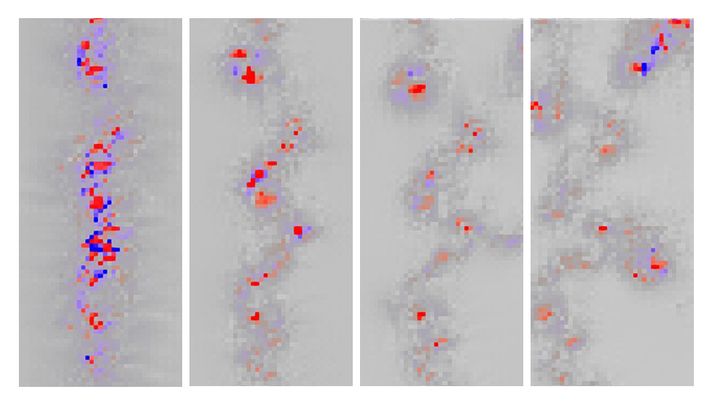
Often seen in nature, from whirlpools to the shape of galaxies, vortices are one of the main flow structures that drive turbulence. The dominant idea over the last 100 years is that large swirling motions in a fluid break apart into smaller and smaller swirls, passing energy down the chain until it finally disappears – a process known as the forward cascade.
Johan Hoffman, professor of numerical analysis at KTH Royal Institute of Technology, says there is no reason to abandon that explanation, but now science has to make room for the possibility of another.
The study was published in Scientific Reports.
Hoffman and co-author Joel Kronborg, a PhD student at KTH, began the simulation with two large, counter‑rotating vortices. These big vortices created a very strong strain field — a region where the fluid is stretched in one direction and squeezed in another. That strain field generated the small vortices.
These small-scale vortices then reorganized themselves into patterns whose combined motion produces flow on larger scales. Hoffman says the team used advanced math to break down the flow into basic parts and to explain why the tiny vortices appeared and how they behaved.
Hoffman says the finding doesn’t rule out that energy is transferred also in the forward direction, from big to small vortices.
“Sometimes both can happen together,” he says.
“In fact, this is also the first step in the new mechanism, where energy is transferred from big vortices to vortices on the finest possible scale, before the transfer of energy is reversed to flow from small to larger scales,” he says.
The result could eventually impact a number of industries and applications where turbulence and vortex dynamics are important, he says.
“The aerodynamic performance of airplanes and vehicles is one such example, with potential gains in safety and fuel efficiency,” Hoffman says.
“Another example from our own research is the design of mechanical heart valves, and planning of clinical interventions to treat heart valve disease.”
Contacts
David CallahanInternational Public Information OfficerKTH Royal Institute of Technology
press@kth.seJohan HoffmanresearcherKTH Royal Institute of Technology
Tel:+46 708 46 45 86jhoffman@kth.seSubscribe to releases from KTH Royal Institute of Technology
Subscribe to all the latest releases from KTH Royal Institute of Technology by registering your e-mail address below. You can unsubscribe at any time.
Latest releases from KTH Royal Institute of Technology
Cause of common heart valve defect revealed in genetic study28.4.2026 11:18:02 CEST | Press Release
New clues from genetic research may help explain what causes the most common heart defect present at birth. Researchers in Sweden have identified rare DNA changes during fetal development that can lead to a condition known as bicuspid aortic valve (BAV).
Study offers new way to stop global potato pathogen once linked to Ireland’s Great Famine23.4.2026 11:46:21 CEST | Press Release
Scientists in Sweden have taken an important step toward fighting potato late blight, a plant disease that once triggered an historic famine in Ireland and now threatens to spread globally due to climate change.
Study reveals unseen changes in motor control after spinal cord injury14.4.2026 12:09:09 CEST | Press Release
Even when people with incomplete spinal cord injuries can walk, everyday functions like standing, balancing or producing steady force may remain difficult. A new study shows why.
Study offers single explanation for two major symptoms of schizophrenia19.3.2026 11:00:02 CET | Press Release
Scientists have long known that dopamine helps the brain learn from rewards, but a new computational model shows how for people with schizophrenia this learning system can break down and simultaneously produce two very different symptoms — delusions and a loss of motivation.
Wheat bran research shows fiber- and protein-rich food gels can be entirely plant-based18.3.2026 12:56:57 CET | Press Release
Scientists in Sweden have for the first time created a fully wheat-based gel made entirely from wheat bran fiber and wheat gluten protein—an advance that could turn one of the grain industry’s least valued by products into a nutritious, sustainable ingredient in food products.
In our pressroom you can read all our latest releases, find our press contacts, images, documents and other relevant information about us.
Visit our pressroom