
Calcium-sensitive switch designed to boost efficacy of cancer drugs
24.11.2025 21:11:53 CET | KTH Royal Institute of Technology | Press Release
Cancer-fighting antibody drugs are designed to penetrate tumor cells and release a lethal payload deep within, but too often they don’t make it that far. A new study shows how this Trojan Horse strategy works better by exploiting calcium differences outside and inside cells.
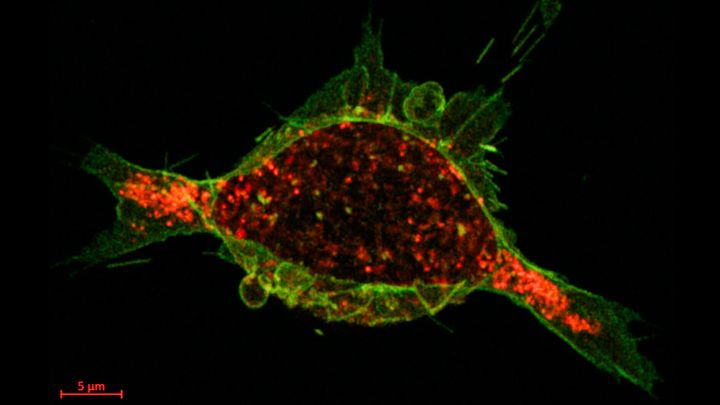
A research team led by Sophia Hober, professor at KTH Royal Institute of Technology, reported the development of a calcium activated delivery system they say could enable more precise treatment, with lower doses and less collateral damage to healthy tissue. In collaboration with Stanford University and Umeå University, the researchers reported their results in PNAS, the journal of the National Academy of Sciences.
The concept takes aim at a common challenge with targeted drugs, which tend to cling too tightly to receptors expressed by tumors. On the positive side, that strong bond blocks receptors’ tumor growth signals. But ADCs (Antibody–Drug Conjugates) are also meant to attack and kill, and too often the protein can become stuck without ever penetrating deeper into the cell’s real intended goal: an acidic compartment called the lysosome. There, in the kill zone, the targeting protein can be broken down, thus unleashing toxin that causes cell death.
To avoid that problem, the researchers developed a calcium-sensitive switch that binds strongly to the cancer cell receptor on the outside of the cell where relatively high calcium concentrations are found, in the blood and the extracellular fluid.
Once bound together, the drug-loaded protein (or calcium-regulated affinity, CaRA) and epidermal growth factor receptor (EGFR) are pulled inside the cell, into compartments with gradually lower levels of calcium. And because their bond is calcium dependent, the receptor and CaRA eventually go their separate ways: the receptor can recycle back to the membrane, while CaRA continues carrying its payload toward the lysosome.
“The calcium switch is built into the drug design,” Hober says. “It senses calcium levels and changes its grip automatically.”
Co-authors Malin Jönsson and Marit Möller, both postdoctoral researchers at KTH, say the study was performed on living human cancer cell lines, using a payload of the cytotoxin, mertansine DM1. In the tests, the concentration of the CaRA EGFR–DM1 conjugate needed to kill 50 percent of high EGFR-expressing cancer cells was extremely low, which Jönsson says indicates very high potency. It had no effect on low EGFR-expressing cells:
“The drug conjugate is highly selective—it only kills cells that overexpress EGFR, leaving healthy or low-EGFR cells unharmed,” Jönsson says. “This shows specific targeting and a strong therapeutic window, which is critical for reducing side effects.”
Contacts
Sophia HoberProfessorKTH Royal Institute of Technology
sophia@kth.seImages
Subscribe to releases from KTH Royal Institute of Technology
Subscribe to all the latest releases from KTH Royal Institute of Technology by registering your e-mail address below. You can unsubscribe at any time.
Latest releases from KTH Royal Institute of Technology
Why do spruce take decades to reproduce? A genetic study offers new clues14.9.2026 17:41:41 CEST | Press Release
New techniques have enabled researchers in Sweden to begin decoding how one of Northern Europe's most important coniferous tree species switches from growing branches to producing cones – their seed-bearing reproductive organs.
KTH builds Swedish expertise in nitrocellulose2.9.2026 12:54:32 CEST | Press Release
Sweden wants to reduce its dependence on foreign suppliers for nitrocellulose, a raw material central to the production of conventional propellants. KTH is now launching a new competence centre to build up expertise across the entire chain – from forest-based raw materials and manufacturing to safe storage.
'Like uprooting tree stumps' – a simpler method to manufacture biosensors27.8.2026 15:42:00 CEST | Press Release
A new manufacturing method could help move the production of nanoscale sensors from specialized fabrication facilities to conventional semiconductor manufacturing plants.
Technique could make flat optic fiber 1,000 times more sensitive than standard fiber13.8.2026 10:57:20 CEST | Press Release
Optical fiber has already transformed the modern world. New research now suggests it could do even more. A new flat fiber fabrication technique produces a high fidelity sensor for a wide range of applications, from batteries to bridges, according to a recently-published study.
Why your building is often too hot, or cold — and the simple fix3.6.2026 13:28:26 CEST | Press Release
Not happy with the heating in your office, or your apartment building? A new study shows that complicated “smart building” technology isn’t the only answer for spaces that feel too hot after lunch, or too cold in the morning.
In our pressroom you can read all our latest releases, find our press contacts, images, documents and other relevant information about us.
Visit our pressroom