
Calcium-sensitive switch designed to boost efficacy of cancer drugs
24.11.2025 21:11:53 CET | KTH Royal Institute of Technology | Press Release
Cancer-fighting antibody drugs are designed to penetrate tumor cells and release a lethal payload deep within, but too often they don’t make it that far. A new study shows how this Trojan Horse strategy works better by exploiting calcium differences outside and inside cells.
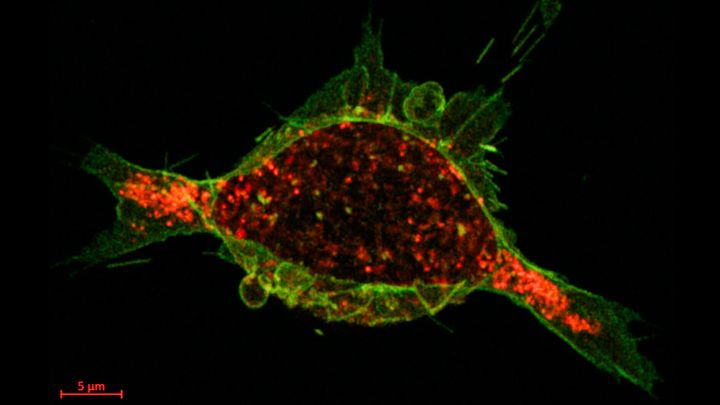
A research team led by Sophia Hober, professor at KTH Royal Institute of Technology, reported the development of a calcium activated delivery system they say could enable more precise treatment, with lower doses and less collateral damage to healthy tissue. In collaboration with Stanford University and Umeå University, the researchers reported their results in PNAS, the journal of the National Academy of Sciences.
The concept takes aim at a common challenge with targeted drugs, which tend to cling too tightly to receptors expressed by tumors. On the positive side, that strong bond blocks receptors’ tumor growth signals. But ADCs (Antibody–Drug Conjugates) are also meant to attack and kill, and too often the protein can become stuck without ever penetrating deeper into the cell’s real intended goal: an acidic compartment called the lysosome. There, in the kill zone, the targeting protein can be broken down, thus unleashing toxin that causes cell death.
To avoid that problem, the researchers developed a calcium-sensitive switch that binds strongly to the cancer cell receptor on the outside of the cell where relatively high calcium concentrations are found, in the blood and the extracellular fluid.
Once bound together, the drug-loaded protein (or calcium-regulated affinity, CaRA) and epidermal growth factor receptor (EGFR) are pulled inside the cell, into compartments with gradually lower levels of calcium. And because their bond is calcium dependent, the receptor and CaRA eventually go their separate ways: the receptor can recycle back to the membrane, while CaRA continues carrying its payload toward the lysosome.
“The calcium switch is built into the drug design,” Hober says. “It senses calcium levels and changes its grip automatically.”
Co-authors Malin Jönsson and Marit Möller, both postdoctoral researchers at KTH, say the study was performed on living human cancer cell lines, using a payload of the cytotoxin, mertansine DM1. In the tests, the concentration of the CaRA EGFR–DM1 conjugate needed to kill 50 percent of high EGFR-expressing cancer cells was extremely low, which Jönsson says indicates very high potency. It had no effect on low EGFR-expressing cells:
“The drug conjugate is highly selective—it only kills cells that overexpress EGFR, leaving healthy or low-EGFR cells unharmed,” Jönsson says. “This shows specific targeting and a strong therapeutic window, which is critical for reducing side effects.”
Contacts
Sophia HoberProfessorKTH Royal Institute of Technology
sophia@kth.seImages
Subscribe to releases from KTH Royal Institute of Technology
Subscribe to all the latest releases from KTH Royal Institute of Technology by registering your e-mail address below. You can unsubscribe at any time.
Latest releases from KTH Royal Institute of Technology
Simulations suggest a breakthrough in understanding how turbulence develops12.3.2026 09:43:46 CET | Press Release
A new study revisits a century-old question about how turbulence starts. The findings could potentially influence not only aircraft engineering but even design of mechanical heart valves, and treatment of heart disease. Computer simulations at Stockholm’s KTH Royal Institute of Technology indicate that very small vortices may create increasingly larger swirls of flow—the opposite of the traditional view of how energy is transferred in turbulence.
Method to extract Baltic phosphorus may ease Europe's reliance on fertilizer imports18.2.2026 14:28:50 CET | Press Release
The Baltic Sea is one of the world's most oxygen-depleted major bodies of water. The reason is excessive concentrations of phosphorus, an element essential for life—and an important ingredient in fertilizer. New research shows a way to possibly convert this problem into a resource that reduces Europe's dependency on phosphate mining while revitalizing the Baltic ecosystem.
Data from a Swedish rail switch may reduce train delays in cold climates11.2.2026 15:08:36 CET | Press Release
Rail commuters in cold climates like Sweden’s are all too familiar with winter train delays and cancellations. The culprit is usually rail switches that freeze up or clog with snow even though they’re heated. A new study offers a more affordable and sustainable solution to keep these crucial, track-moving components in working order.
Researchers removed all plastic from a family's home, and here's what they found5.2.2026 12:12:32 CET | Press Release
What would happen if all the plastic in your home disappeared overnight? A Swedish family found out by volunteering for one month of near-total plastic withdrawal, in an experiment conducted by researchers at KTH Royal Institute of Technology.
New research enables safe reuse of concrete29.1.2026 10:06:38 CET | Press Release
Recent research in Sweden and Finland shows how used concrete’s lifespan can be extended another 50 to 100 years when incorporated into new construction.
In our pressroom you can read all our latest releases, find our press contacts, images, documents and other relevant information about us.
Visit our pressroom