
DNA floating in air reveals the hidden past of ecosystems
18.12.2025 14:48:01 CET | Umeå University | Press Release
DNA captured on air filters and stored since the 1960s acts as an ecological time capsule, according to a recent publication in Nature Communications. The findings show that tiny fragments of genetic material can paint a detailed picture of life across the landscape. They also reveal a distinct decline in biodiversity over three decades.
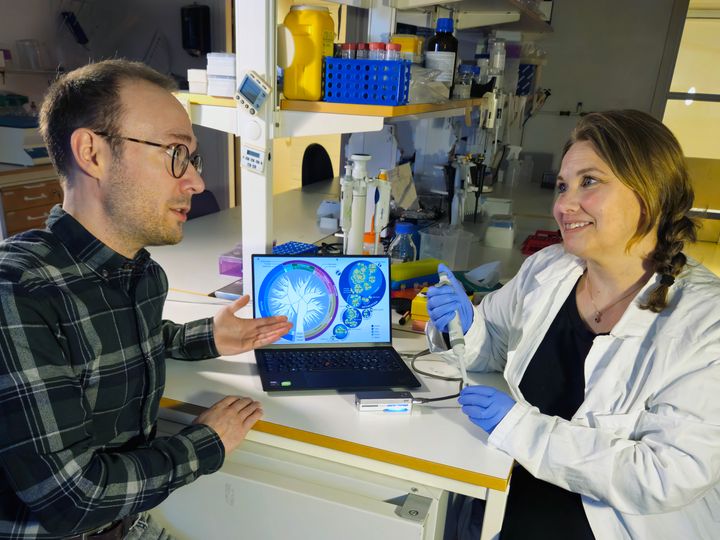
All organisms shed cell fragments with DNA to the environment. Now, researchers have performed the largest and most detailed analysis to date of airborne DNA using filters originally used to monitor radioactive fallout.
Air monitoring filters are found at hundreds of sites worldwide. These particular filters come from a station outside Kiruna, in northern Sweden, and have been archived in a basement at the Swedish Defence Research Agency, FOI, since the 1960s. When researcher Per Stenberg learned about the archive about a decade ago, he and his colleague Mats Forsman realised what a goldmine it was.
Shows ecosystems week by week
Week after week, the filters collected DNA from all living things: plants, fungi, insects, microbes, birds, fish, and even large mammals like moose and reindeer. By sequencing the DNA, the research team was, on a weekly basis, able to identify the presence of 2,700 organism groups within several miles of the station, and track how their populations increased or decreased over 34 years.
“It was a stroke of luck that the filters had been kept – and that they were made of a material that preserves DNA. The archive turned out to be a time machine, allowing us to revisit the past and watch an ecosystem changing in almost real time,” says Per Stenberg, lead author of the study conducted by researchers from Umeå University, the Swedish University of Agricultural Sciences, and the Swedish Defence Research Agency.
When the researchers looked at long-term patterns, they saw a clear decline in biodiversity in the area, from the 1970s to the early 2000s. Examples of declining organisms include birch together with wood-associated lichens and fungi. The overall decline cannot be explained by changes in the climate, but rather seems to be linked to human activities such as forest management.
Entirely new method for airborne DNA
Analyses of airborne DNA have been done before, but this is an entirely new and far more comprehensive approach that spans several decades. The research team used extensive DNA sequencing, machine-learning-based identification of organisms, and air-flow modelling to track the sources of the DNA. Comparisons with traditional field surveys show that the method is reliable both for identifying organisms and for detecting changes in their abundance.
“This work is the result of nine years of intense research and development. I look forward to applying these data, together with ongoing sequencing of additional filters, to a wide range of questions,” says Daniel Svensson, a co-author of the study.
The study shows that existing networks of air-filter stations can be used to monitor biodiversity trends and reconstruct ecosystems in places where baseline data are missing. This is essential for predicting future changes and adapting management and restoration strategies.
“The method can also detect and track genetic variation as well as the presence of invasive species and pathogens,” says Per Stenberg.
About the scientific study
Sullivan, A. R., Karlsson, E., Svensson, D., … Forsman, M., Stenberg, P. (2025). Airborne eDNA captures three decades of ecosystem biodiversity. Nature Communications. DOI: 10.1038/s41467-025-67676-7
Contacts
Per StenbergAssociate professorDepartment of Ecology, Environment and Geoscience
Tel:+46 90 786 96 46per.stenberg@umu.seSara-Lena BrännströmCommunications officerFaculty of Science & Technology
Tel:+46 90 786 72 24sara-lena.brannstrom@umu.seGeneral Press InquiriesPress Officer
Tel:+46 90 786 50 89press@umu.seImages

About us
Umeå University is a comprehensive university and one of Sweden’s largest higher education institutions with around 38,000 students and 4,600 staff. We have a diverse range of high-quality educational programmes and research within all disciplinary domains and the arts. The University offers world-class educational and research environments and helps expand knowledge of global significance. This is where the groundbreaking discovery was made of the CRISPR-Cas9 gene-editing tool, which was awarded the Nobel Prize in Chemistry. At Umeå University, everything is just around the corner. Our tightly knit campus makes it easy to meet, collaborate and share knowledge, something that encourages a dynamic and open culture.
Subscribe to releases from Umeå University
Subscribe to all the latest releases from Umeå University by registering your e-mail address below. You can unsubscribe at any time.
Latest releases from Umeå University
New findings on drug treatment for Compulsive Sexual Behaviour Disorder8.10.2026 07:45:00 CEST | Press Release
Medication used to treat addiction is no more effective than antidepressants in treating Compulsive Sexual Behaviour Disorder (CSBD). This is shown in a new study from Umeå University and Karolinska Institutet. However, the medications differ in terms of side effects and the way symptoms improve over time.
First country to turn around type 2 diabetes trend7.10.2026 14:13:59 CEST | Press Release
Mauritius is the first country in the world to have successfully reduced the prevalence of type 2 diabetes after decades of rising rates, according to a new study involving researchers from Umeå University. The decline has been observed across all population groups and among both women and men.
3D printers can make advanced research more accessible5.10.2026 08:00:00 CEST | Press Release
Developing new research equipment is often expensive and time-consuming. In his doctoral thesis, Daniel Nilsson at Umeå University demonstrates how standard 3D printers can be used to rapidly manufacture advanced scientific instruments directly in the laboratory.
Researchers discover major ecological shift in the Gulf of Bothnia2.10.2026 10:00:00 CEST | Press Release
For decades, scientists have regarded phosphorus as the main nutrient limiting biological production in the Gulf of Bothnia. Now, a new study led by researchers at Umeå University shows that a fundamental change is underway. The Bothnian Sea has shifted to nitrogen limitation, while the Bothnian Bay is rapidly moving in the same direction.
Bildmuseet: Anneli Furmark / You Are the Centre of the Earth1.10.2026 15:29:11 CEST | Press Release
Anneli Furmark’s works, graphic novels as well as painting, often explore the ways people relate to one another, to the landscape, and to the place. Her narratives frequently unfold in northern settings, with particular attention to houses and built environments. Bildmuseet presents drawings, comics, paintings and sketchbooks from the past fifteen years. Also on view is a film created especially for the exhibition, in which actors give voice to short stories from Furmark’s graphic novels.
In our pressroom you can read all our latest releases, find our press contacts, images, documents and other relevant information about us.
Visit our pressroom