
Lysosomes in focus: New study reveals how cells keep them intact
9.1.2026 10:00:00 CET | Umeå University | Press Release
When the cell’s recycling stations, the lysosomes, start leaking, it can become dangerous. Toxic waste risks spreading and damaging the cell. Now, researchers at Umeå University have revealed the molecular sensors that detect tiny holes in lysosomal membranes so they can be quickly repaired – a process crucial for preventing inflammation, cell death, and diseases such as Alzheimer’s.
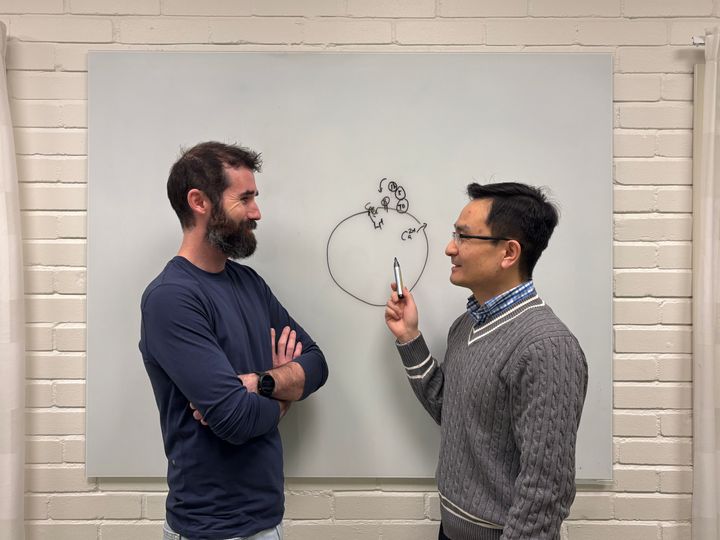
Lysosomes are the cell’s recycling stations, handling cellular waste and converting it into building blocks that can be reused. Lysosomal membranes are frequently exposed to stress from pathogens, proteins, and metabolic byproducts. Damage can lead to leakage of toxic contents into the cytoplasm, which in turn may cause inflammation and cell death. Until now, the mechanism by which cells detect these membrane injuries has remained unknown.
In a recently published study, professor Yaowen Wu and his research group at the Department of Chemistry at Umeå University, identified the signalling pathway that is activated in response to lysosomal damage. This discovery laid the foundation for understanding how the cell senses membrane injuries.
Sensors identified
In the new study, the researchers take it a step further and have discovered two autophagy protein complexes that serve as the long-sought sensors of lysosomal damage.
“They respond and quickly move to the damaged membranes when protons or calcium leak out, initiating the repair system that seals the hole. We observed that without these two key proteins, the cell fails to repair the damage, causing the lysosome to rupture,” says Yaowen Wu, lead author of the study.
Combination of techniques
The team used a combination of live-cell imaging, genetic knockout models, advanced microscopy, and functional repair assays to map the sequence of events following controlled lysosomal damage.
The results apply to several different types of cells and show the same underlying mechanism.
Next step in research
“The discovery provides a new understanding and opens the door to new treatment strategies for diseases where lysosomal damage plays a central role. In future studies, we will investigate links to neurodegeneration, infections, and inflammation,” says Yaowen Wu.
Dale Corkery, staff scientist and first author, adds:
“It is vital that lysosomal contents stay where they belong. If we understand why leaks sometimes go undetected, we can also understand why cells die in neurodegenerative diseases.”
The study is published in the scientific journal EMBO Journal.
About the scientific article
Corkery DP, Wijayatunga D, Feron BKL, Herzog LK, Knyazeva A, and Wu YW: The ATG8 E3-like ligases sense lysosomal damage and initiate ESCRT-mediated membrane repair. EMBO J. 2026. doi: 10.1038/s44318-025-00672-1.
Contacts
Yaowen WuProfessorDepartment of Chemistry
Tel:+46 90-786 55 31yaowen.wu@umu.seDale CorkeryStaff scientistDepartment of Chemistry
dale.corkery@umu.seSara-Lena BrännströmCommunications officerFaculty of Science & Technology
Tel:+46 90 786 72 24sara-lena.brannstrom@umu.seGeneral Press InquiriesPress Officer
Tel:+46 90 786 50 89press@umu.seImages

About us
Umeå University is a comprehensive university and one of Sweden’s largest higher education institutions with around 38,000 students and 4,600 staff. We have a diverse range of high-quality educational programmes and research within all disciplinary domains and the arts. The University offers world-class educational and research environments and helps expand knowledge of global significance. This is where the groundbreaking discovery was made of the CRISPR-Cas9 gene-editing tool, which was awarded the Nobel Prize in Chemistry. At Umeå University, everything is just around the corner. Our tightly knit campus makes it easy to meet, collaborate and share knowledge, something that encourages a dynamic and open culture.
Subscribe to releases from Umeå University
Subscribe to all the latest releases from Umeå University by registering your e-mail address below. You can unsubscribe at any time.
Latest releases from Umeå University
Thawing permafrost may trigger overlooked carbon sink in rivers17.6.2026 17:00:00 CEST | Press Release
A new study published in Nature study shows that rock weathering increasingly counteracts river CO₂ emissions as permafrost degrades. The study has been carried out by a collaborative team of researchers from Umeå University, Sweden, and East China Normal University.
Potatoes benefit when two soil bacteria team up16.6.2026 09:00:00 CEST | Press Release
Researchers at Umeå University have shown that two soil bacteria can work together to influence potato development. The bacterial partnership triggered distinct responses in potato plants and was associated with earlier tuber initiation and improved yield under greenhouse conditions. The findings suggest that combinations of beneficial soil bacteria could become a valuable tool for potato growers in the future.
Using agricultural waste to clean wastewater8.6.2026 08:00:00 CEST | Press Release
Water pollution caused by pharmaceuticals, pesticides, and other organic contaminants is an increasing global issue, especially in regions with limited wastewater treatment infrastructure. A new doctoral thesis from Umeå University, Sweden, offers an innovative and sustainable solution by demonstrating how agricultural waste can be converted into effective materials for water purification.
After the war, Mostar is shaped by struggles over memory and the future2.6.2026 13:02:00 CEST | Press Release
What should be preserved, rebuilt or forgotten after a war? A new study from Umeå University shows how conflicts over history, identity and the future continue to shape the Bosnian city of Mostar, three decades after the Bosnian War.
Continuous cover forestry favour hair lichens1.6.2026 08:00:00 CEST | Press Release
Industrial forestry has through clearcutting caused a large-scale decline of hair lichens in Sweden’s forests. Researchers in Umeå University, University of Northern British Columbia, Canada, and Norwegian University of Life Sciences have in a large-scaled field-experiment shown that partial cutting can increase abundance of hair lichens. The study is published in Forest Ecology and Management which publishes original research in forest ecology.
In our pressroom you can read all our latest releases, find our press contacts, images, documents and other relevant information about us.
Visit our pressroom