
Researchers removed all plastic from a family's home, and here's what they found
5.2.2026 12:12:32 CET | KTH Royal Institute of Technology | Press Release
What would happen if all the plastic in your home disappeared overnight? A Swedish family found out by volunteering for one month of near-total plastic withdrawal, in an experiment conducted by researchers at KTH Royal Institute of Technology.
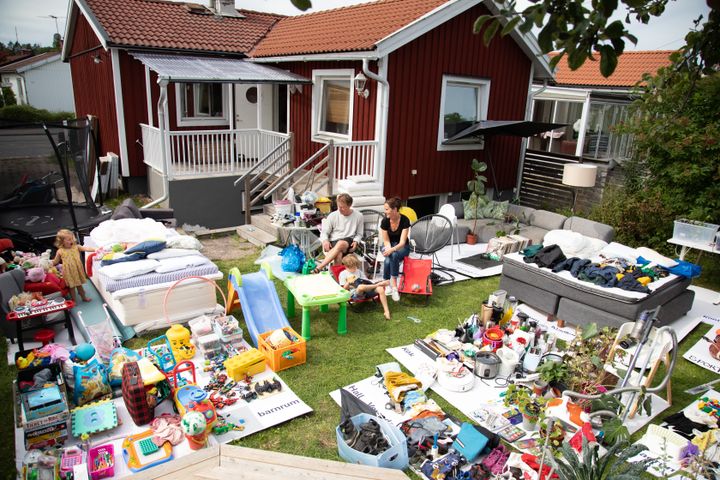
Toys, kitchen utensils, furniture, bedding and more were removed from the suburban house where Emelie and Walter Hesse and their two children live outside of Stockholm. Though they were allowed to keep 10 plastic items each – in addition to computers, phones and major appliances like the refrigerator and washer – the Hesse family faced up to life without plastic, if only for a few weeks.
For the course of the month, the family turned to alternatives made of wood, metal, wool and ceramics, says the project’s leader Sara Ilstedt, a professor of product and service design at KTH.
"We were surprised by how many plastic-free alternatives actually exist,” Ilstedt says.
Emelie Hesse says the family participated in the study out of curiosity, and to learn more about how to live more sustainably in everyday life. The hardest items to replace were hygiene products and kitchen appliances, but overall she found it refreshing to live without their usual things.
“We realized how much we had accumulated over time — things that weren’t being used. Changing habits was often easier than we thought,” she says.
New mattresses and furniture made from natural fibers replaced the old, and the researchers sourced second-hand shops for non-plastic things like lamps, toys and baskets.
The parents initially worried that the children would miss the things they got rid of, and that the replacement items wouldn’t suit the family in terms of function or design. "But it turned out really well," Hesse says. "Especially the toys, which genuinely stimulated the children’s creativity,” Hesse says.
Though the researchers offered to return everything they removed, the family declined a number of things they hadn't missed, and kept all the non-plastic replacements. Those items will be displayed at an upcoming exhibition in Stockholm.
Ilstedt says the experiment's aim was to visualize and document the amount of plastic in a typical household, and to investigate what can be replaced with alternatives. But they also wanted to understand how a plastic-free lifestyle works in practice –and where improvements could be made.
The researchers are mapping the climate impact of the family’s plastic items. All plastic objects were photographed and a total of about 400 kilos was weighed. Climate calculations are now being carried out to estimate the carbon emissions linked to each product, and the results will then be compared with the climate impact of the plastic-free replacement products.
“The experiment shows that plastic is deeply embedded in our lives, but also that change is possible,” Ilstedt says.
She says the Hesse family’s experiences provide insights into "what we can actually live without — and what cannot yet be replaced, where innovation is needed.”
The experiment is part of the international Reduce project, an interdisciplinary investigation into how plastic use can be reduced. The Swedish part is led by KTH.
Keywords
Contacts
Sara IlstedtProfessor/researcherKTH Royal Institute of Technology
sarai@kth.seDavid CallahanInternational Public Information OfficerKTH Royal Institute of Technology
press@kth.seImages

Subscribe to releases from KTH Royal Institute of Technology
Subscribe to all the latest releases from KTH Royal Institute of Technology by registering your e-mail address below. You can unsubscribe at any time.
Latest releases from KTH Royal Institute of Technology
Now multiple optical devices' stabilizing properties can be identified with a single reprogrammable chip14.10.2026 13:03:08 CEST | Press Release
In optical fibers, chips and other light-guiding devices, minor defects can scatter photons and disrupt their path. A new study demonstrates a way to reveal properties which, in certain systems, help light wave behavior withstand such flaws. The method could help speed up the search for new kinds of electronics and optical technologies, and contribute to more reliable quantum devices.
Researchers identify aggressive molecular features in low-risk prostate cancer7.10.2026 13:41:39 CEST | Press Release
A new study revealed molecular features linked to more aggressive prostate cancer in a subset of patients who had been classified as low risk, highlighting biological differences that may not be apparent from clinical measures alone. The results could lead to new therapeutic strategies.
Why do spruce take decades to reproduce? A genetic study offers new clues14.9.2026 17:41:41 CEST | Press Release
New techniques have enabled researchers in Sweden to begin decoding how one of Northern Europe's most important coniferous tree species switches from growing branches to producing cones – their seed-bearing reproductive organs.
KTH builds Swedish expertise in nitrocellulose2.9.2026 12:54:32 CEST | Press Release
Sweden wants to reduce its dependence on foreign suppliers for nitrocellulose, a raw material central to the production of conventional propellants. KTH is now launching a new competence centre to build up expertise across the entire chain – from forest-based raw materials and manufacturing to safe storage.
'Like uprooting tree stumps' – a simpler method to manufacture biosensors27.8.2026 15:42:00 CEST | Press Release
A new manufacturing method could help move the production of nanoscale sensors from specialized fabrication facilities to conventional semiconductor manufacturing plants.
In our pressroom you can read all our latest releases, find our press contacts, images, documents and other relevant information about us.
Visit our pressroom