
Simulations suggest a breakthrough in understanding how turbulence develops
12.3.2026 09:43:46 CET | KTH Royal Institute of Technology | Press Release
A new study revisits a century-old question about how turbulence starts. The findings could potentially influence not only aircraft engineering but even design of mechanical heart valves, and treatment of heart disease.
Computer simulations at Stockholm’s KTH Royal Institute of Technology indicate that very small vortices may create increasingly larger swirls of flow—the opposite of the traditional view of how energy is transferred in turbulence.
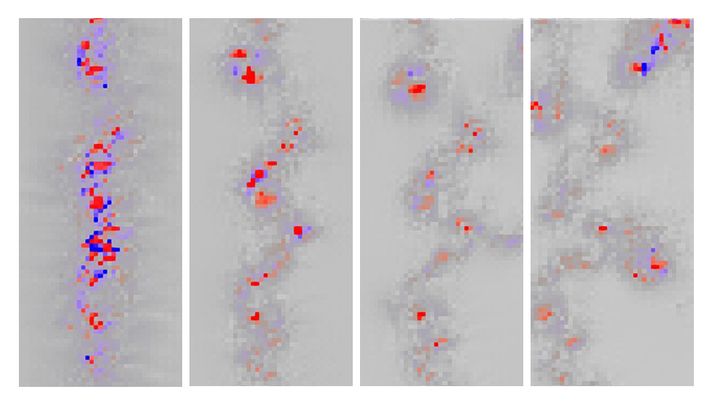
Often seen in nature, from whirlpools to the shape of galaxies, vortices are one of the main flow structures that drive turbulence. The dominant idea over the last 100 years is that large swirling motions in a fluid break apart into smaller and smaller swirls, passing energy down the chain until it finally disappears – a process known as the forward cascade.
Johan Hoffman, professor of numerical analysis at KTH Royal Institute of Technology, says there is no reason to abandon that explanation, but now science has to make room for the possibility of another.
The study was published in Scientific Reports.
Hoffman and co-author Joel Kronborg, a PhD student at KTH, began the simulation with two large, counter‑rotating vortices. These big vortices created a very strong strain field — a region where the fluid is stretched in one direction and squeezed in another. That strain field generated the small vortices.
These small-scale vortices then reorganized themselves into patterns whose combined motion produces flow on larger scales. Hoffman says the team used advanced math to break down the flow into basic parts and to explain why the tiny vortices appeared and how they behaved.
Hoffman says the finding doesn’t rule out that energy is transferred also in the forward direction, from big to small vortices.
“Sometimes both can happen together,” he says.
“In fact, this is also the first step in the new mechanism, where energy is transferred from big vortices to vortices on the finest possible scale, before the transfer of energy is reversed to flow from small to larger scales,” he says.
The result could eventually impact a number of industries and applications where turbulence and vortex dynamics are important, he says.
“The aerodynamic performance of airplanes and vehicles is one such example, with potential gains in safety and fuel efficiency,” Hoffman says.
“Another example from our own research is the design of mechanical heart valves, and planning of clinical interventions to treat heart valve disease.”
Contacts
David CallahanInternational Public Information OfficerKTH Royal Institute of Technology
press@kth.seJohan HoffmanresearcherKTH Royal Institute of Technology
Tel:+46 708 46 45 86jhoffman@kth.seSubscribe to releases from KTH Royal Institute of Technology
Subscribe to all the latest releases from KTH Royal Institute of Technology by registering your e-mail address below. You can unsubscribe at any time.
Latest releases from KTH Royal Institute of Technology
Now multiple optical devices' stabilizing properties can be identified with a single reprogrammable chip14.10.2026 13:03:08 CEST | Press Release
In optical fibers, chips and other light-guiding devices, minor defects can scatter photons and disrupt their path. A new study demonstrates a way to reveal properties which, in certain systems, help light wave behavior withstand such flaws. The method could help speed up the search for new kinds of electronics and optical technologies, and contribute to more reliable quantum devices.
Researchers identify aggressive molecular features in low-risk prostate cancer7.10.2026 13:41:39 CEST | Press Release
A new study revealed molecular features linked to more aggressive prostate cancer in a subset of patients who had been classified as low risk, highlighting biological differences that may not be apparent from clinical measures alone. The results could lead to new therapeutic strategies.
Why do spruce take decades to reproduce? A genetic study offers new clues14.9.2026 17:41:41 CEST | Press Release
New techniques have enabled researchers in Sweden to begin decoding how one of Northern Europe's most important coniferous tree species switches from growing branches to producing cones – their seed-bearing reproductive organs.
KTH builds Swedish expertise in nitrocellulose2.9.2026 12:54:32 CEST | Press Release
Sweden wants to reduce its dependence on foreign suppliers for nitrocellulose, a raw material central to the production of conventional propellants. KTH is now launching a new competence centre to build up expertise across the entire chain – from forest-based raw materials and manufacturing to safe storage.
'Like uprooting tree stumps' – a simpler method to manufacture biosensors27.8.2026 15:42:00 CEST | Press Release
A new manufacturing method could help move the production of nanoscale sensors from specialized fabrication facilities to conventional semiconductor manufacturing plants.
In our pressroom you can read all our latest releases, find our press contacts, images, documents and other relevant information about us.
Visit our pressroom