
Study reveals unseen changes in motor control after spinal cord injury
14.4.2026 12:09:09 CEST | KTH Royal Institute of Technology | Press Release
Even when people with incomplete spinal cord injuries can walk, everyday functions like standing, balancing or producing steady force may remain difficult. A new study shows why.
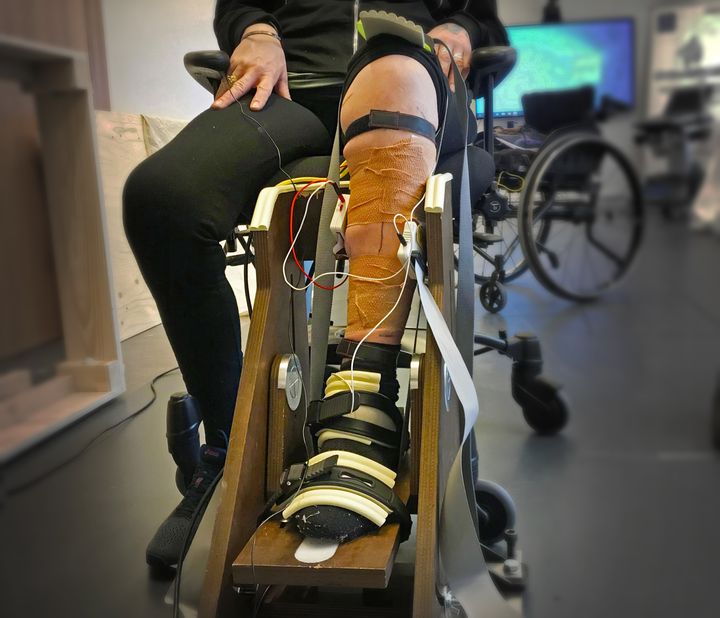
Using surface skin electrical sensors, a research team in Sweden identified previously unseen changes in motor coordination that result from incomplete spinal cord injuries (SCI). The study is the first to examine how individual motor units—that is, nerve-to-muscle connections that create movement—work together in people with SCI.
"Our study reveals, at the cellular level, how the central nervous system adapts to the injury to control movement," says Ruoli Wang, associate professor in biomechanics at Promobilia MoveAbility lab, KTH Royal Institute of Technology. She says the researchers' approach was completely non-invasive.
The results were published in the Journal of NeuroEngineering and Rehabilitation.
The study's lead author, PhD student Zhihao Duan, says the researchers found the nervous system struggles to spread signals smoothly across muscles at low levels of exertion after the injury. And it appears to overcompensate at higher levels of exertion, sending "louder", less refined signals.
A single muscle moves through hundreds of motor units, each turning on and off precisely to create smooth force. Composed of a single motor neuron and its connecting muscle fibers, these motor units respond to shared signals from the nervous system, much like different sections of musicians led by an orchestra conductor. That shared input is what allows them to act in coordinated patterns.
To explore how well these units coordinate under the control of the central nervous system, the team examined 25 people (including 10 control participants). They used high density electromyography (HD-EMG) to measure electrical activity in the functionally similar calf muscles—soleus and gastrocnemius—while volunteers pushed lightly or moderately against a force measurement device.
Duan says that at 20 percent effort, fewer of the motor units in the two calf muscles were working in a shared, coordinated way compared with people without injury. Their movements as a result were shaky and unstable. "They were much less being driven by the same coordinated signal from the nervous system." he says.
At a higher level of effort—50 percent—the SCI group showed stronger low-frequency synchronization between the two muscles. The body loses flexibility and precision in control of the movement. "This could be a sign of the nervous system compensating by sending louder, less refined signals," Duan says.
"One interesting finding is that after spinal cord injury the nervous system becomes more rigid and less able to change its approach as the muscles work harder. A healthy nervous system on the other hand is able to adapt its strategy as force demands, to adjust the shared neural drive level," Wang says.
Although the study was limited by a small sample size and challenges in identifying enough motor units per muscle from the skin surface, Wang says the results offer unique insight into how SCI reshapes motor control.
"This finding may open the door to a new rehabilitation biomarker, helping clinicians and researchers design new neurorehabilitation strategies to re-tune the spinal cord control and to restore coordinated neural input," she says.
The study was a collaboration with Aleris Rehab Station and was funded by the Swedish Research Council and Promobilia Foundation.
Contacts
David CallahanInternational Public Information OfficerKTH Royal Institute of Technology
press@kth.seRuoli WangKTH Royal Institute of Technology
Ruoli@kth.seImages
Links
Subscribe to releases from KTH Royal Institute of Technology
Subscribe to all the latest releases from KTH Royal Institute of Technology by registering your e-mail address below. You can unsubscribe at any time.
Latest releases from KTH Royal Institute of Technology
Study offers single explanation for two major symptoms of schizophrenia19.3.2026 11:00:02 CET | Press Release
Scientists have long known that dopamine helps the brain learn from rewards, but a new computational model shows how for people with schizophrenia this learning system can break down and simultaneously produce two very different symptoms — delusions and a loss of motivation.
Wheat bran research shows fiber- and protein-rich food gels can be entirely plant-based18.3.2026 12:56:57 CET | Press Release
Scientists in Sweden have for the first time created a fully wheat-based gel made entirely from wheat bran fiber and wheat gluten protein—an advance that could turn one of the grain industry’s least valued by products into a nutritious, sustainable ingredient in food products.
Simulations suggest a breakthrough in understanding how turbulence develops12.3.2026 09:43:46 CET | Press Release
A new study revisits a century-old question about how turbulence starts. The findings could potentially influence not only aircraft engineering but even design of mechanical heart valves, and treatment of heart disease. Computer simulations at Stockholm’s KTH Royal Institute of Technology indicate that very small vortices may create increasingly larger swirls of flow—the opposite of the traditional view of how energy is transferred in turbulence.
Method to extract Baltic phosphorus may ease Europe's reliance on fertilizer imports18.2.2026 14:28:50 CET | Press Release
The Baltic Sea is one of the world's most oxygen-depleted major bodies of water. The reason is excessive concentrations of phosphorus, an element essential for life—and an important ingredient in fertilizer. New research shows a way to possibly convert this problem into a resource that reduces Europe's dependency on phosphate mining while revitalizing the Baltic ecosystem.
Data from a Swedish rail switch may reduce train delays in cold climates11.2.2026 15:08:36 CET | Press Release
Rail commuters in cold climates like Sweden’s are all too familiar with winter train delays and cancellations. The culprit is usually rail switches that freeze up or clog with snow even though they’re heated. A new study offers a more affordable and sustainable solution to keep these crucial, track-moving components in working order.
In our pressroom you can read all our latest releases, find our press contacts, images, documents and other relevant information about us.
Visit our pressroom