
New chip offers way to make use of quantum system ‘imperfections’
19.5.2026 14:30:22 CEST | KTH Royal Institute of Technology | Press Release
Quantum technologies promise powerful new kinds of computers, giving scientists new tools to mimic and explore nature at its tiniest scales. At those levels, everything in nature—from atoms and electrons to light itself—follows the strange rules of quantum mechanics. But the real world is never perfectly clean: signals fade, energy leaks away and systems pick up noise from their surroundings.
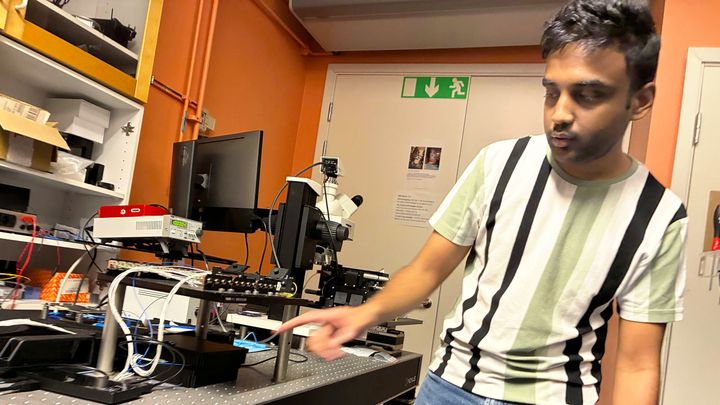
“Understanding how quantum systems behave under this messiness is crucial if we want our experiments to say something about nature as it really is, not just idealized setups,” says Govind Krishna, PhD student at KTH Royal Institute of Technology.
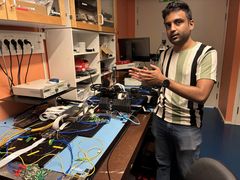
In a recent study at KTH, Kishna led the development of a chip that enables researchers to simulate the way many quantum systems behave when they lose energy or information to their surroundings. The results were published in Nature Communications.
Krishna says the research strengthens the role of quantum computers as simulators of quantum systems and quantum processes in nature.
“Our research presents a method that lets us safely test how ‘imperfection’ in quantum systems behave,” he says, “and even explore ideas where ‘imperfection’ itself becomes an asset we can use, instead of only a problem we try to get rid of.”
Krishna says the study uses light particles, or photons, on the chip as stand‑ins for the particles in whatever system is being modelled. Using this tightly‑controlled quantum system enables replaying and studying the photon behavior in other kinds of systems.
The device is an integrated photonic circuit: light travels through microscopic tracks, or waveguides, on a silicon chip, much like electricity moves through wires on a computer chip. In its experiments, the team added an extra “side track” that plays the role of a loss channel. Using electrical signals, they could tune how strongly the main tracks connected to this side track.
“In many quantum experiments, anything that does not fit the ideal textbook picture is simply treated as loss and ignored,” Krishna says. “The chip enables us to simulate those non‑ideal processes in a controlled way.”
Part of the quantum light is redirected into a separate output that plays the role of the environment or loss channel. This channel is measured in order to track the fate of photons.
“The chip works a bit like a programmable railway junction for quantum light,” says Ali Elshaari, associate professor at KTH and senior author of the study. “By changing the control signals, we can decide whether the photons mostly stay on the main track, are mostly diverted to the loss channel, or end up in superpositions that depend on their quantum interference.”
Although the study was focused on basic physics and proof‑of‑principle demonstrations, the researchers say that understanding these effects is important for future quantum technologies.
“Real quantum devices will always have leaks and noise,” says co‑author Jun Gao, associate professor at Huazhong University of Science and Technology in Wuhan, China. “Our chip gives us a controlled way to study how quantum information flows under those conditions, and when elements that used to be seen only as problems - like loss, might be turned into useful resources instead.
Images
Subscribe to releases from KTH Royal Institute of Technology
Subscribe to all the latest releases from KTH Royal Institute of Technology by registering your e-mail address below. You can unsubscribe at any time.
Latest releases from KTH Royal Institute of Technology
Why do spruce take decades to reproduce? A genetic study offers new clues14.9.2026 17:41:41 CEST | Press Release
New techniques have enabled researchers in Sweden to begin decoding how one of Northern Europe's most important coniferous tree species switches from growing branches to producing cones – their seed-bearing reproductive organs.
KTH builds Swedish expertise in nitrocellulose2.9.2026 12:54:32 CEST | Press Release
Sweden wants to reduce its dependence on foreign suppliers for nitrocellulose, a raw material central to the production of conventional propellants. KTH is now launching a new competence centre to build up expertise across the entire chain – from forest-based raw materials and manufacturing to safe storage.
'Like uprooting tree stumps' – a simpler method to manufacture biosensors27.8.2026 15:42:00 CEST | Press Release
A new manufacturing method could help move the production of nanoscale sensors from specialized fabrication facilities to conventional semiconductor manufacturing plants.
Technique could make flat optic fiber 1,000 times more sensitive than standard fiber13.8.2026 10:57:20 CEST | Press Release
Optical fiber has already transformed the modern world. New research now suggests it could do even more. A new flat fiber fabrication technique produces a high fidelity sensor for a wide range of applications, from batteries to bridges, according to a recently-published study.
Why your building is often too hot, or cold — and the simple fix3.6.2026 13:28:26 CEST | Press Release
Not happy with the heating in your office, or your apartment building? A new study shows that complicated “smart building” technology isn’t the only answer for spaces that feel too hot after lunch, or too cold in the morning.
In our pressroom you can read all our latest releases, find our press contacts, images, documents and other relevant information about us.
Visit our pressroom