
Continuous cover forestry favour hair lichens
1.6.2026 08:00:00 CEST | Umeå University | Press Release
Industrial forestry has through clearcutting caused a large-scale decline of hair lichens in Sweden’s forests. Researchers in Umeå University, University of Northern British Columbia, Canada, and Norwegian University of Life Sciences have in a large-scaled field-experiment shown that partial cutting can increase abundance of hair lichens. The study is published in Forest Ecology and Management which publishes original research in forest ecology.
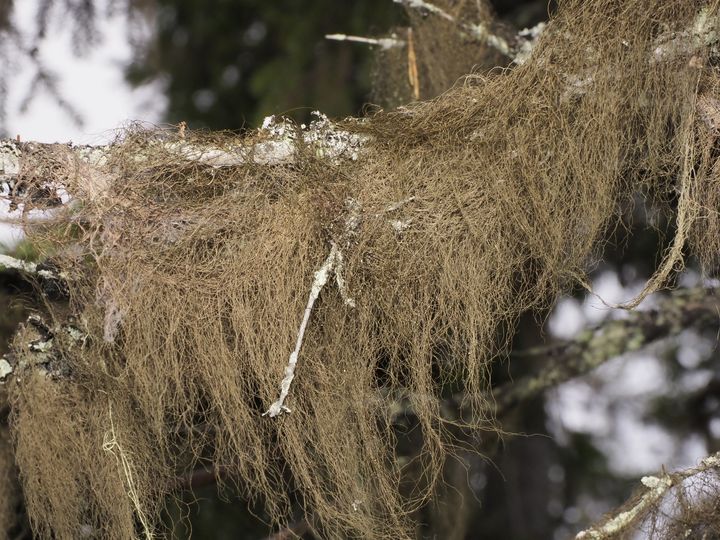
“Hair lichens have important functions in coniferous forest ecosystems and provide forage, habitat and nest material for mammals, birds, insects, and spiders. These lichens are particularly important for reindeer husbandry and can be decisive for the survival of reindeer in winter when ground lichens are unavailable. Knowledge of how environmental factors regulate abundance of hair lichens is important to develop forest management methods that can maintain hair lichens, and to understand how lichens are affected by climate change” says Per-Anders Esseen, professor emeritus at the Department of Ecology, Environment and Geoscience at Umeå University.
About the study
The unique study long-term study (2008–2019) was led by Per-Anders Esseen, together by Matthias Siewert, Umeå University, Darwyn Coxson, University of Northern British Columbia, Prince George, Canada, and Yngvar Gauslaa, Norwegian University of Life Sciences, Ås, Norway.
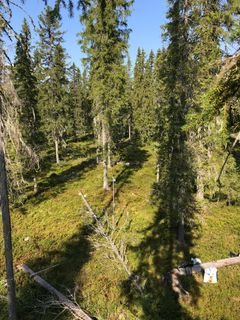
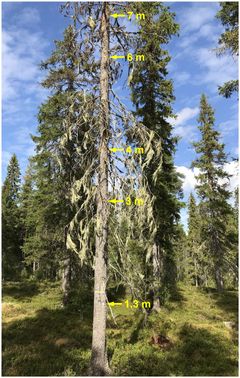
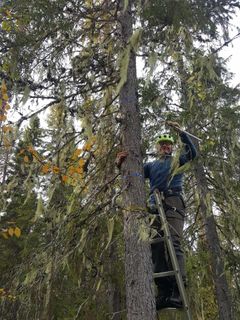
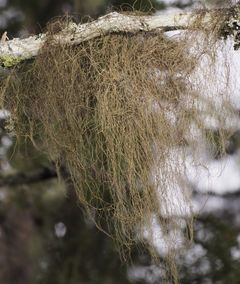
Fifteen sample plots (80 m × 80 m) were laid out in an old spruce-dominated forest in Vindeln Experimental Forests, Swedish University of Agricultural Science, northeastern Sweden. Partial cutting treatments where one-third and two-thirds of the trees were logged were compared with unlogged control plots. Forest data, temperature and light were measured over eleven years. The researchers measured the biomass of hair lichens up to a height of seven meters by using ladders. The objective was to analyze how forest structure and microclimate influence hair lichens with different functions traits by comparing the pale lichen witch’s hair (Alectoria sarmentosa) with dark horsehair lichens (Bryoria).
Strong thinning decreased hair lichens
“The lichen mass in a forest depends on the balance between colonization, growth and losses, and is regulated by the amount of available substrate, microclimate, the lichen’s colour and dispersal capacity” says Per-Anders Esseen.
The lichen mass per tree decreased shortly after logging but thereafter decreased up to four times in partial cuts, with largest increase in the lower part of the trees. The stand-level lichen mass increased after moderate thinning, but decreased after strong thinning, due to fewer host trees and loss of lichens by strong wind.
“Increased light is the most important factor promoting hair lichen accumulation after partial cutting” says Per-Anders Esseen.
Dark hair lichens increased faster
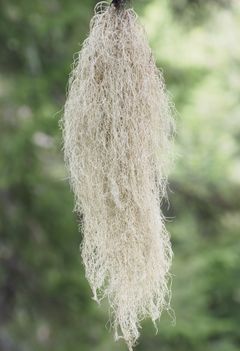
Lichens are complex partnerships between fungi and photobionts (an alga, or a cyanobacterium), which passively take up water. The researchers found that dark hair lichens with melanin pigments increased faster with increased thinning level than pale lichens. The algae in dark lichens receive less light than algae in pale lichens. Dark lichens have lower photosynthesis in dense forests than pale lichens but have higher photosynthesis and growth in thinned forest with high availability of light.
“Our results show that continuous cover forestry can significantly increase the amount of hair lichens in managed forests, which is particularly important in important winter grazing areas for reindeer” says Per-Anders Esseen.
Original article:
Esseen, P.-A., Siewert, M.B., Coxson, D.S., & Gauslaa, Y. (2026). Canopy structure and microclimate drive long-term dynamics of hair lichens after partial cutting. Forest Ecology and Management, Volume 617, 123891. https://doi.org/10.1016/j.foreco.2026.123891
Contacts
Per-Anders Esseenprofessor emeritusDepartment of Ecology, Environment and Geoscience
Tel:+46 70 556 3330per-anders.esseen@umu.seAnna-Lena LindskogCommunication officerFaculty of Science & Technology
Tel:+46706422956anna-lena.lindskog@umu.seImages

About us
Umeå University is a comprehensive university and one of Sweden’s largest higher education institutions with around 38,000 students and 4,600 staff. We have a diverse range of high-quality educational programmes and research within all disciplinary domains and the arts. The University offers world-class educational and research environments and helps expand knowledge of global significance. This is where the groundbreaking discovery was made of the CRISPR-Cas9 gene-editing tool, which was awarded the Nobel Prize in Chemistry. At Umeå University, everything is just around the corner. Our tightly knit campus makes it easy to meet, collaborate and share knowledge, something that encourages a dynamic and open culture.
Subscribe to releases from Umeå University
Subscribe to all the latest releases from Umeå University by registering your e-mail address below. You can unsubscribe at any time.
Latest releases from Umeå University
Thawing permafrost may trigger overlooked carbon sink in rivers17.6.2026 17:00:00 CEST | Press Release
A new study published in Nature study shows that rock weathering increasingly counteracts river CO₂ emissions as permafrost degrades. The study has been carried out by a collaborative team of researchers from Umeå University, Sweden, and East China Normal University.
Potatoes benefit when two soil bacteria team up16.6.2026 09:00:00 CEST | Press Release
Researchers at Umeå University have shown that two soil bacteria can work together to influence potato development. The bacterial partnership triggered distinct responses in potato plants and was associated with earlier tuber initiation and improved yield under greenhouse conditions. The findings suggest that combinations of beneficial soil bacteria could become a valuable tool for potato growers in the future.
Using agricultural waste to clean wastewater8.6.2026 08:00:00 CEST | Press Release
Water pollution caused by pharmaceuticals, pesticides, and other organic contaminants is an increasing global issue, especially in regions with limited wastewater treatment infrastructure. A new doctoral thesis from Umeå University, Sweden, offers an innovative and sustainable solution by demonstrating how agricultural waste can be converted into effective materials for water purification.
After the war, Mostar is shaped by struggles over memory and the future2.6.2026 13:02:00 CEST | Press Release
What should be preserved, rebuilt or forgotten after a war? A new study from Umeå University shows how conflicts over history, identity and the future continue to shape the Bosnian city of Mostar, three decades after the Bosnian War.
Whole organ 3D imaging reveals remaining insulin producing cells in type 1 diabetes26.5.2026 21:21:47 CEST | Press Release
Researchers at Umeå University have conducted a unique three-dimensional mapping of an entire human pancreas. The study shows that insulin-producing cells can remain long after the onset of type 1 diabetes – a finding that suggests the disease progression is more complex than previously assumed.
In our pressroom you can read all our latest releases, find our press contacts, images, documents and other relevant information about us.
Visit our pressroom