
Technique could make flat optic fiber 1,000 times more sensitive than standard fiber
13.8.2026 10:57:20 CEST | KTH Royal Institute of Technology | Press Release
Optical fiber has already transformed the modern world. New research now suggests it could do even more. A new flat fiber fabrication technique produces a high fidelity sensor for a wide range of applications, from batteries to bridges, according to a recently-published study.
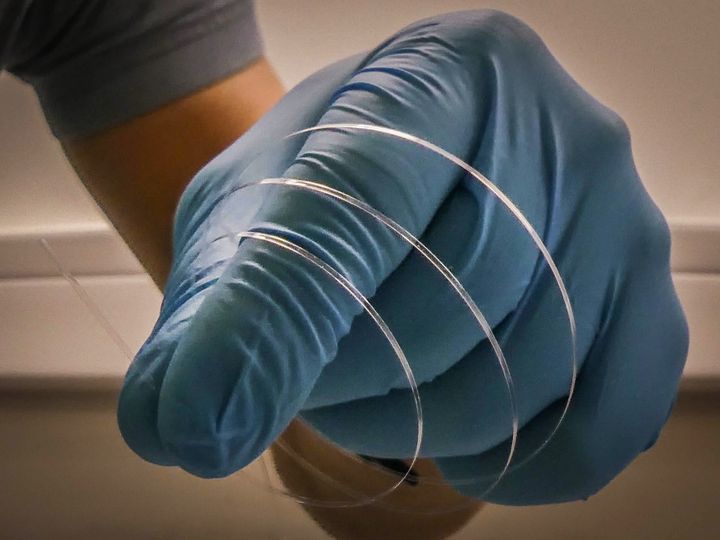
Researchers from KTH Royal Institute of Technology in Stockholm and the University of Southampton in the UK have developed a new type of flat silica optical fiber that performs differently from conventional round fiber. The work, published in Nature Communications, introduces a high-aspect-ratio platform that can be engineered to respond strongly to pressure, temperature and other physical changes.
By creating a ribbon-like geometry with controlled internal microstructure, the team showed that the shape of fiber can be used as a functional part of a sensor. Instead of the widely-used technique of flattening a round fiber, the researchers created a method to preform it from the beginning, and they used laser-based glass processing to add internal features like air channels or metal fillings.
In laboratory demonstrations, the flat fiber showed pressure sensitivity up to 1,000 times higher than standard circular fiber designs. The team also demonstrated an enhanced temperature sensing version by filling part of the internal microstructure with a tin-based alloy.
“This is not just a different looking fiber,” KTH researcher Pawel Maniewski says. “It is a new design space for optical fiber.”
“By changing the geometry, we can make the glass itself much more responsive to the physical world around it.”
The breakthrough builds on collaboration between KTH and Southampton in laser-based glass processing, speciality fiber manufacture and optical sensing. The result is a fiber that remains compatible with existing optical systems while offering new mechanical and sensing capabilities.
The potential applications are wide ranging. Flat fibers could be embedded into composite materials to give aircraft, drones and infrastructure a better sense of internal strain and pressure. The same platform could also support smarter battery technology, where pressure and temperature changes inside cells can provide early signs of abnormal behaviour.
Unlike electronic sensors, optical fibers are immune to electromagnetic interference, lightweight, compact and capable of operating in harsh environments. These features make them attractive for aerospace, energy systems, biomedical devices and advanced manufacturing.
The researchers believe the work points towards a broader shift in fiber technology. Rather than using optical fiber only to transmit light, future systems could use the fiber geometry itself to shape how materials sense, respond and communicate.
“This gives optical fiber a new dimension,” says Chris Holmes, professor at Southampton University. “The next step is to take this platform from proof-of-concept sensing towards real systems, including intelligent drones, advanced composites and safer energy technologies.”
Contacts
Pawel ManiewskiKTH Royal Institute of Technology
Pawel Maniewski is a researcher working at the intersection of laser-material processing, glass science, and specialty optical fibre fabrication, currently based at KTH Royal Institute of Technology, alongside his role as a Visiting Fellow at the Optoelectronic Research Centre, University of Southampton, UK.
Images
Subscribe to releases from KTH Royal Institute of Technology
Subscribe to all the latest releases from KTH Royal Institute of Technology by registering your e-mail address below. You can unsubscribe at any time.
Latest releases from KTH Royal Institute of Technology
Why do spruce take decades to reproduce? A genetic study offers new clues14.9.2026 17:41:41 CEST | Press Release
New techniques have enabled researchers in Sweden to begin decoding how one of Northern Europe's most important coniferous tree species switches from growing branches to producing cones – their seed-bearing reproductive organs.
KTH builds Swedish expertise in nitrocellulose2.9.2026 12:54:32 CEST | Press Release
Sweden wants to reduce its dependence on foreign suppliers for nitrocellulose, a raw material central to the production of conventional propellants. KTH is now launching a new competence centre to build up expertise across the entire chain – from forest-based raw materials and manufacturing to safe storage.
'Like uprooting tree stumps' – a simpler method to manufacture biosensors27.8.2026 15:42:00 CEST | Press Release
A new manufacturing method could help move the production of nanoscale sensors from specialized fabrication facilities to conventional semiconductor manufacturing plants.
Why your building is often too hot, or cold — and the simple fix3.6.2026 13:28:26 CEST | Press Release
Not happy with the heating in your office, or your apartment building? A new study shows that complicated “smart building” technology isn’t the only answer for spaces that feel too hot after lunch, or too cold in the morning.
New chip offers way to make use of quantum system ‘imperfections’19.5.2026 14:30:22 CEST | Press Release
Quantum technologies promise powerful new kinds of computers, giving scientists new tools to mimic and explore nature at its tiniest scales. At those levels, everything in nature—from atoms and electrons to light itself—follows the strange rules of quantum mechanics. But the real world is never perfectly clean: signals fade, energy leaks away and systems pick up noise from their surroundings.
In our pressroom you can read all our latest releases, find our press contacts, images, documents and other relevant information about us.
Visit our pressroom