
Why do spruce take decades to reproduce? A genetic study offers new clues
14.9.2026 17:41:41 CEST | KTH Royal Institute of Technology | Press Release
New techniques have enabled researchers in Sweden to begin decoding how one of Northern Europe's most important coniferous tree species switches from growing branches to producing cones – their seed-bearing reproductive organs.
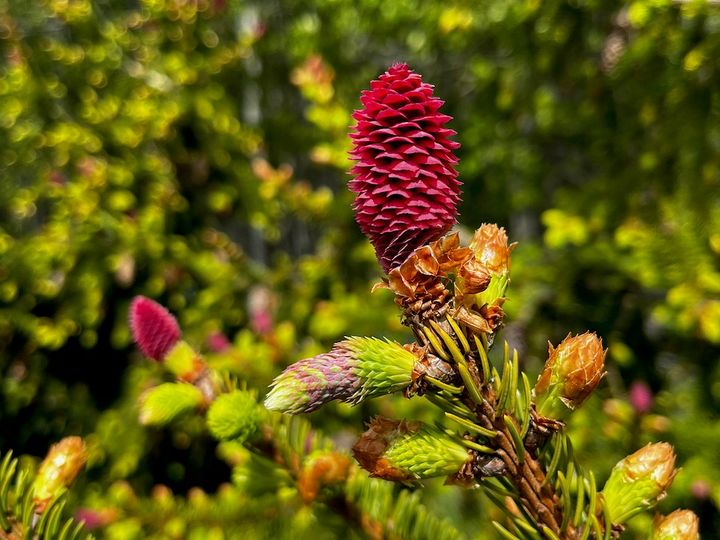
In a recent study that may have implications for the forestry industry, researchers from KTH Royal Institute of Technology report the creation of a genetic map that reveals new insight into the Norway spruce’s transition from vegetative to reproductive development. The resulting gene atlas, developed in collaboration with the Swedish University of Agricultural Sciences (SLU), shows when and where genes are active during cone development and identified key genes involved in the process.
In addition, the researchers discovered a previously unknown gene called DAL55.
With their enormous genomes and long life cycles, Norway spruce trees are notoriously difficult to study. Their juvenile period can last longer than 25 years, followed by infrequent cone production—once every three to five years. This poses obstacles for efficient forest tree breeding. These challenges leave important questions about cone development unanswered, despite the species' ecological and economic importance as a source of timber, construction materials, paper and other forest products.
In an unprecedented investigation, the researchers used a technology developed at KTH called spatial transcriptomics, which allows scientists to see which genes are active in a given tissue and exactly where that activity occurs.
“The technology enables us to study the expression patterns of all genes simultaneously,” says Stefania Giacomello, an associate professor at the Department of Gene Technology at KTH and researcher at SciLifeLab. Now commercialized as Visium by 10x Genomics, the technique was used to study gene expression in extremely thin sections of spruce cone tissue, measuring just 10 micrometers (0.01 millimeters) in thickness.
While the immediate goal was to better understand cone development in spruce, the work also touches on a broader evolutionary question: Are some of the genetic mechanisms that control reproduction in flowering plants (angiosperms, such as apple trees) inherited from a much older common ancestor that flowering plants share with cone-bearing trees (gymnosperms) like spruce?
Jens Sundström, a researcher in plant biotechnology at SLU, says: “The findings improve our understanding of the evolutionary processes that contributed to the development of all living seed plants, including both flowering plants and conifers.”
He says the research addresses questions relevant to forestry-dependent economies – such as in Sweden and Finland, where Norway spruce underpins the sector.
Giacomello says the findings could help breeders develop spruce varieties better suited to climate change.
“By learning more about the molecular mechanisms that regulate cone formation, we hope to accelerate breeding efforts and facilitate the production of climate-adapted spruce seedlings for forest owners across the country,” Giacomello says.
Contacts
Stefania Giacomelloassociate professor at the Department of Gene TechnologyKTH Royal Institute of Technology
stefania.giacomello@scilifelab.seDavid CallahanInternational Public Information OfficerKTH Royal Institute of Technology
press@kth.seJens SundströmSLU
Tel:+46 725737217Jens.Sundstrom@slu.seImages


Links
Subscribe to releases from KTH Royal Institute of Technology
Subscribe to all the latest releases from KTH Royal Institute of Technology by registering your e-mail address below. You can unsubscribe at any time.
Latest releases from KTH Royal Institute of Technology
KTH builds Swedish expertise in nitrocellulose2.9.2026 12:54:32 CEST | Press Release
Sweden wants to reduce its dependence on foreign suppliers for nitrocellulose, a raw material central to the production of conventional propellants. KTH is now launching a new competence centre to build up expertise across the entire chain – from forest-based raw materials and manufacturing to safe storage.
'Like uprooting tree stumps' – a simpler method to manufacture biosensors27.8.2026 15:42:00 CEST | Press Release
A new manufacturing method could help move the production of nanoscale sensors from specialized fabrication facilities to conventional semiconductor manufacturing plants.
Technique could make flat optic fiber 1,000 times more sensitive than standard fiber13.8.2026 10:57:20 CEST | Press Release
Optical fiber has already transformed the modern world. New research now suggests it could do even more. A new flat fiber fabrication technique produces a high fidelity sensor for a wide range of applications, from batteries to bridges, according to a recently-published study.
Why your building is often too hot, or cold — and the simple fix3.6.2026 13:28:26 CEST | Press Release
Not happy with the heating in your office, or your apartment building? A new study shows that complicated “smart building” technology isn’t the only answer for spaces that feel too hot after lunch, or too cold in the morning.
New chip offers way to make use of quantum system ‘imperfections’19.5.2026 14:30:22 CEST | Press Release
Quantum technologies promise powerful new kinds of computers, giving scientists new tools to mimic and explore nature at its tiniest scales. At those levels, everything in nature—from atoms and electrons to light itself—follows the strange rules of quantum mechanics. But the real world is never perfectly clean: signals fade, energy leaks away and systems pick up noise from their surroundings.
In our pressroom you can read all our latest releases, find our press contacts, images, documents and other relevant information about us.
Visit our pressroom