
Now multiple optical devices' stabilizing properties can be identified with a single reprogrammable chip
14.10.2026 13:03:08 CEST | KTH Royal Institute of Technology | Press Release
In optical fibers, chips and other light-guiding devices, minor defects can scatter photons and disrupt their path. A new study demonstrates a way to reveal properties which, in certain systems, help light wave behavior withstand such flaws. The method could help speed up the search for new kinds of electronics and optical technologies, and contribute to more reliable quantum devices.
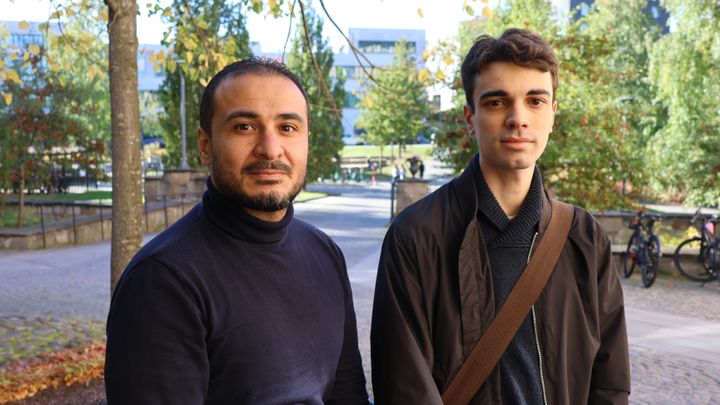
Reporting in an upcoming edition of the journal Physical Review Letters, researchers at KTH Royal Institute of Technology demonstrated a programmable chip that can detect and measure “topological properties,” or features of wave behavior that don’t change even when a system is altered. (An open access version of the research article is available to view on arxiv.org)
KTH Associate Professor Ali Elshaari says understanding these properties can help devices keep working despite imperfections.
Topological properties can make materials unusually stable, Elshaari says. “When I explain topology to students, I start with a knot in a rope,” he says. “You can stretch it, twist it or shake it, but the knot stays until you cut the rope.
“Physicists have found that some materials and devices carry similar knots in how waves move through them.”
KTH doctoral student Andrea Cataldo, the study’s lead author, says that kind of stability is attractive for technologies that must work despite noise and defects, such as future electronics and quantum devices.
“In the real world, every system loses some energy,” Cataldo says. “So we need ways to study these properties under realistic conditions.”
The light-based chip can imitate energy-losing systems and directly reveal their hidden stable properties, he says.
The chip reliably distinguished the "knotted" (topological) cases from ordinary ones, Cataldo says. It also detected a special point where energy-losing systems behave in unusual ways, called an exceptional point.
“We use a mathematical trick to run the lossy system on the chip without actually losing the signal,” he says. The researchers then compare the light against reference beams—an approach they compare to tuning an instrument against a reference note.
“This lets us read the hidden information even when energy loss would normally hide it,” he says.
Because the chip can be reprogrammed, many different scenarios can be tested on one device.
Contacts
Ali ElshaariAssociate ProfessorKTH Royal Institute of Technology
elshaari@kth.seImages

Links
Subscribe to releases from KTH Royal Institute of Technology
Subscribe to all the latest releases from KTH Royal Institute of Technology by registering your e-mail address below. You can unsubscribe at any time.
Latest releases from KTH Royal Institute of Technology
Researchers identify aggressive molecular features in low-risk prostate cancer7.10.2026 13:41:39 CEST | Press Release
A new study revealed molecular features linked to more aggressive prostate cancer in a subset of patients who had been classified as low risk, highlighting biological differences that may not be apparent from clinical measures alone. The results could lead to new therapeutic strategies.
Why do spruce take decades to reproduce? A genetic study offers new clues14.9.2026 17:41:41 CEST | Press Release
New techniques have enabled researchers in Sweden to begin decoding how one of Northern Europe's most important coniferous tree species switches from growing branches to producing cones – their seed-bearing reproductive organs.
KTH builds Swedish expertise in nitrocellulose2.9.2026 12:54:32 CEST | Press Release
Sweden wants to reduce its dependence on foreign suppliers for nitrocellulose, a raw material central to the production of conventional propellants. KTH is now launching a new competence centre to build up expertise across the entire chain – from forest-based raw materials and manufacturing to safe storage.
'Like uprooting tree stumps' – a simpler method to manufacture biosensors27.8.2026 15:42:00 CEST | Press Release
A new manufacturing method could help move the production of nanoscale sensors from specialized fabrication facilities to conventional semiconductor manufacturing plants.
Technique could make flat optic fiber 1,000 times more sensitive than standard fiber13.8.2026 10:57:20 CEST | Press Release
Optical fiber has already transformed the modern world. New research now suggests it could do even more. A new flat fiber fabrication technique produces a high fidelity sensor for a wide range of applications, from batteries to bridges, according to a recently-published study.
In our pressroom you can read all our latest releases, find our press contacts, images, documents and other relevant information about us.
Visit our pressroom