
As Scandinavian peninsula rises from sea, new satellite data shows gravity changes
6.2.2025 09:15:25 CET | KTH Royal Institute of Technology | Press Release
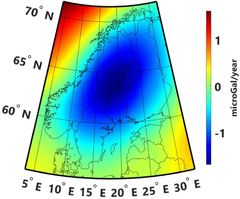
Bouncing back from under the weight of Ice Age glaciers which have long since vanished, the Nordic region land mass is slowly rising above sea level. Two scientists at Sweden’s KTH Royal Institute of Technology have a refined a method for measuring and predicting the small details of how this slow movement changes Earth’s gravitational pull over time. One thing they found is that the Fennoscandinavian peninsula's land mass is more dense than previously known.

For decades, KTH researchers Mohammad Bagherbandi and Lars Sjöberg have been examining what’s informally known as the post-glacial rebound effect in Fennoscandinavia, a peninsula that includes Sweden, Norway, Finland and part of Russia. Their latest study reports a refined measurement method that combines remote sensing by satellite and terrestrial gravity data, as well as 3D positioning from GPS and similar satellite positioning systems.
The KTH researchers found that the density of the upper mantle is about 3,546 kilograms per cubic meter—slightly more than reported in earlier studies. It is widely believed the land mass rises by as much as 1 cm per year.
Bagherbandi, a research her in geodesy and land surveying at KTH, says the new technique highlights the value of satellite data in the field of geodesy, the science of accurately measuring and understanding the Earth's geometric shape, orientation in space, and gravity field
“Beginning 60 years ago, scientists were using terrestrial gravimeters to establish gravity reference system and study temporal changes in gravity associated with glacial isostatic adjustment (GIA),” Bagherbandi says. “Our study is an alternative technique to study this phenomenon."
This means researchers can now create alternative and comparable models of how the land and gravity are changing over time in the region, he says.
“This discovery helps us understand the slow ‘bounce-back’ of land after the Ice Age,” Bagherbandi says. “It also shows how important the Global Geodetic Observing System (GGOS) are for learning about Earth’s movements and gravity changes.”
A similar study is underway in the U.S., where scientists are evaluating an even larger region of North America that is known to be rising.
Bagherbandi says understanding these changes is valuable beyond the field of geodesy. It helps scientists improve their tools for studying Earth's geodynamics. It can also help with other fields, like preparing for rising sea levels and learning about natural disasters.
Read the scientific article:
Bagherbandi, M., Sjöberg, L.E. A short note on GIA related surface gravity versus height changes in Fennoscandia. Journal of Geodesy
Images

Subscribe to releases from KTH Royal Institute of Technology
Subscribe to all the latest releases from KTH Royal Institute of Technology by registering your e-mail address below. You can unsubscribe at any time.
Latest releases from KTH Royal Institute of Technology
Why your building is often too hot, or cold — and the simple fix3.6.2026 13:28:26 CEST | Press Release
Not happy with the heating in your office, or your apartment building? A new study shows that complicated “smart building” technology isn’t the only answer for spaces that feel too hot after lunch, or too cold in the morning.
New chip offers way to make use of quantum system ‘imperfections’19.5.2026 14:30:22 CEST | Press Release
Quantum technologies promise powerful new kinds of computers, giving scientists new tools to mimic and explore nature at its tiniest scales. At those levels, everything in nature—from atoms and electrons to light itself—follows the strange rules of quantum mechanics. But the real world is never perfectly clean: signals fade, energy leaks away and systems pick up noise from their surroundings.
How to save computing energy? This study shows a way to engineer materials so magnetic signals can carry information6.5.2026 13:06:14 CEST | Press Release
A recent study shows a new and potentially more energy efficient way for information to be transmitted inside electronic systems, including computers and phones—without relying on electric currents or external magnetic fields.
Cause of common heart valve defect revealed in genetic study28.4.2026 11:18:02 CEST | Press Release
New clues from genetic research may help explain what causes the most common heart defect present at birth. Researchers in Sweden have identified rare DNA changes during fetal development that can lead to a condition known as bicuspid aortic valve (BAV).
Study offers new way to stop global potato pathogen once linked to Ireland’s Great Famine23.4.2026 11:46:21 CEST | Press Release
Scientists in Sweden have taken an important step toward fighting potato late blight, a plant disease that once triggered an historic famine in Ireland and now threatens to spread globally due to climate change.
In our pressroom you can read all our latest releases, find our press contacts, images, documents and other relevant information about us.
Visit our pressroom