
For graphene production, a potential green alternative to mining graphite
3.3.2025 14:14:40 CET | KTH Royal Institute of Technology | Press Release
Researchers in Sweden report a green alternative to reduce reliance on mining graphite, the raw source behind the "wonder material" graphene.
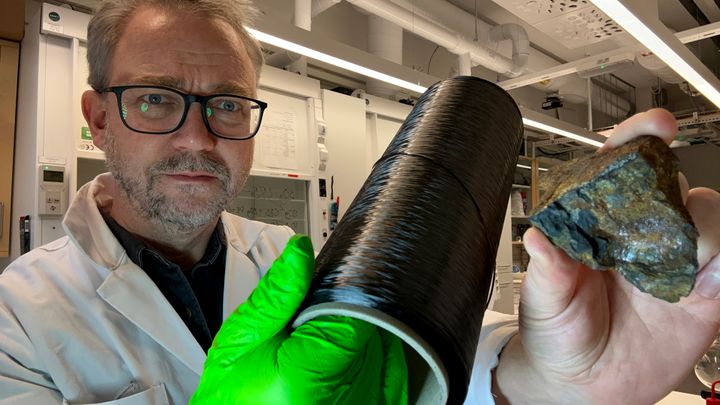
In the latest volume of the scientific journal Small, researchers at KTH Royal Institute of Technology say they have developed a reproducible and scalable method for producing graphene oxide (GO) nanosheets from commercial carbon fibers, marking a breakthrough in sustainable nanomaterial synthesis.
The process involves exfoliating carbon fibers with nitric acid, which provides high yields of one-atom-thick sheets of graphene oxide with characteristics comparable to commercial GO sourced from mined graphite.
Graphene oxide is a widely studied nanomaterial that can be used in car batteries when its thin sheets stack together, forming layers similar to graphite. It is also useful in high-performance composites, water purification and electronic devices. However, synthesis from mined graphite requires harsh chemicals and often results in material inconsistencies due to variations in graphite purity.
Biomass is possible source
Richard Olsson, professor in polymeric materials at KTH, says the proof of concept was carried out with carbon fibers derived from polyacrylonitrile (PAN), a widely available polymer that undergoes high-temperature oxidation and graphitization. He says the method could be duplicated with other raw sources, such as raw sources such as biomass or forest industry sidestreams.
Olsson points to the electric vehicle battery market as one that can benefit from the new technology. “The core of graphite battery functionality can be found in the layered graphene inside, which can be harvested from commercial carbon fibers using this method,” he says.
“The future of auto manufacturing will build on battery-based power, and the question is where the graphite will be sourced? They are going to need alternatives.”
Graphene sheets peel off
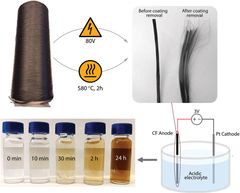
The method consists of transforming the carbon fibers using the process of electrochemical oxidation in a bath of water and nitric acid. The bath acts as a conductor and when an electric current is sent through carbon fiber, the material begins to lose electrons which transforms the surface much the same way that oxidization appears as rust on a car. In this case, the transformation causes layers of nanoscale graphene oxide to peel off from the carbon fibers' surface.
The study discovered a window in which just 5 percent nitric acid was perfect for creating these tiny nanosheets, ranging from 0.1 to 1 micrometer in size, with a uniform thickness of about 0.9 nanometers. Notably, the GO nanosheets synthesized this way emerged in circular and elliptical shapes, in contrast to the polygonal shapes typical of GO synthesized from natural, mined graphite.
High yield and quality
Compared to existing synthetic methods, the new approach delivers a high yield of 200 milligrams of GO per gram of carbon fiber. This efficient conversion rate makes it viable for large-scale production, addressing a key challenge in nanomaterial synthesis, he says.
To ensure the nanosheets met quality standards, the researchers examined and measured the properties and structure of the material with a number of advanced techniques.
The study also explored methods to remove protective polymer coatings from commercial carbon fibers before oxidation, heating at 580°C for two hours and shock-heating to 1200°C for three seconds—both proving effective. The research demonstrated that the nature of electrical conduction within the fibers plays a crucial role in the electrochemical exfoliation process.
Olsson says the next steps for the researchers include investigating biobased sources for carbon fibers, delving deeper into how the process works.
###
Making Synthetic 2D Graphene Oxide Nanosheets by Electrochemical Oxidation of Commercial Carbon Fibre, Small, DOI: 10.1002/smll.202408972
Images
Subscribe to releases from KTH Royal Institute of Technology
Subscribe to all the latest releases from KTH Royal Institute of Technology by registering your e-mail address below. You can unsubscribe at any time.
Latest releases from KTH Royal Institute of Technology
Cause of common heart valve defect revealed in genetic study28.4.2026 11:18:02 CEST | Press Release
New clues from genetic research may help explain what causes the most common heart defect present at birth. Researchers in Sweden have identified rare DNA changes during fetal development that can lead to a condition known as bicuspid aortic valve (BAV).
Study offers new way to stop global potato pathogen once linked to Ireland’s Great Famine23.4.2026 11:46:21 CEST | Press Release
Scientists in Sweden have taken an important step toward fighting potato late blight, a plant disease that once triggered an historic famine in Ireland and now threatens to spread globally due to climate change.
Study reveals unseen changes in motor control after spinal cord injury14.4.2026 12:09:09 CEST | Press Release
Even when people with incomplete spinal cord injuries can walk, everyday functions like standing, balancing or producing steady force may remain difficult. A new study shows why.
Study offers single explanation for two major symptoms of schizophrenia19.3.2026 11:00:02 CET | Press Release
Scientists have long known that dopamine helps the brain learn from rewards, but a new computational model shows how for people with schizophrenia this learning system can break down and simultaneously produce two very different symptoms — delusions and a loss of motivation.
Wheat bran research shows fiber- and protein-rich food gels can be entirely plant-based18.3.2026 12:56:57 CET | Press Release
Scientists in Sweden have for the first time created a fully wheat-based gel made entirely from wheat bran fiber and wheat gluten protein—an advance that could turn one of the grain industry’s least valued by products into a nutritious, sustainable ingredient in food products.
In our pressroom you can read all our latest releases, find our press contacts, images, documents and other relevant information about us.
Visit our pressroom