
AI helps decode horses' body language for better veterinary care
9.4.2025 12:20:55 CEST | KTH Royal Institute of Technology | Press Release
Researchers are using AI to bridge the communication gap between horse and human. Combining 3D motion capture and machine learning, a new modeling system would equip veterinarians with a powerful visual tool for interpreting equine body language—the key to detecting physical and even behavioral problems.
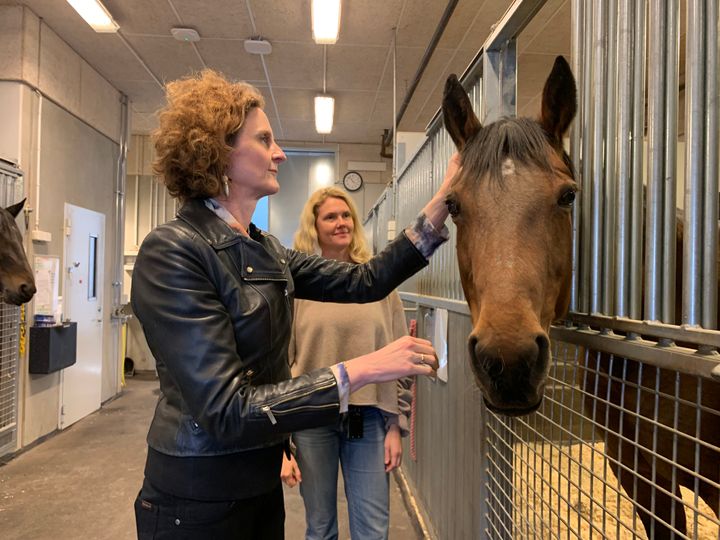
Based on new research from KTH Royal Institute of Technology and Swedish University of Agricultural Science (SLU), the platform can reconstruct the exact 3D motion of horses from videos, using an AI-based parametric model of the horse’s pose and shape. The model is precise enough to enable a veterinarian, for example, to spot telling changes which could otherwise be overlooked or misinterpreted in an examination, such as in a horse’s posture or their body weight.
The system—titled DESSIE—employs disentangled learning, which separates different important factors in an image and helps the AI avoid confusion with background details or lighting conditions, says Hedvig Kjellström, a Professor in computer vision and machine learning at KTH.
“DESSIE marks the first example of disentangled learning in non-human 3D motion models,” Kjellström says.
Elin Hernlund, Associate Professor in biomechanics at SLU and equine orthopedics clinician, says DESSIE would enable greater accuracy in observation and interpretation of horses’ movements and, as a result, earlier and more precise intervention than today. In a sense, it enables getting critical information “straight from the horse’s mouth.”
“Horses are powerful but fragile and they tell us how they are feeling by their body language,” Hernlund says. “By watching their gate we can see, for example, if they are offloading pain,” she says.
“We say we created a digital voice to help these animals break through the barrier of communication between animals and humans. To tell us what they are feeling,” Hernlund says. “It’s the smartest and highest resolution way to extract digital information from the horse’s body—even their faces, which can tell us a great deal.”
The research team are further training DESSIE with images of a wider variety of horse breeds and sizes, which would enable them to link genetics to phenotypes and gain a better understanding of the core biological structure of animals.
“To achieve this, we're asking breeders to send images of their breeds to capture as much variation as possible," Hernlund says.
Images
Subscribe to releases from KTH Royal Institute of Technology
Subscribe to all the latest releases from KTH Royal Institute of Technology by registering your e-mail address below. You can unsubscribe at any time.
Latest releases from KTH Royal Institute of Technology
Technique could make flat optic fiber 1,000 times more sensitive than standard fiber13.8.2026 10:57:20 CEST | Press Release
Optical fiber has already transformed the modern world. New research now suggests it could do even more. A new flat fiber fabrication technique produces a high fidelity sensor for a wide range of applications, from batteries to bridges, according to a recently-published study.
Why your building is often too hot, or cold — and the simple fix3.6.2026 13:28:26 CEST | Press Release
Not happy with the heating in your office, or your apartment building? A new study shows that complicated “smart building” technology isn’t the only answer for spaces that feel too hot after lunch, or too cold in the morning.
New chip offers way to make use of quantum system ‘imperfections’19.5.2026 14:30:22 CEST | Press Release
Quantum technologies promise powerful new kinds of computers, giving scientists new tools to mimic and explore nature at its tiniest scales. At those levels, everything in nature—from atoms and electrons to light itself—follows the strange rules of quantum mechanics. But the real world is never perfectly clean: signals fade, energy leaks away and systems pick up noise from their surroundings.
How to save computing energy? This study shows a way to engineer materials so magnetic signals can carry information6.5.2026 13:06:14 CEST | Press Release
A recent study shows a new and potentially more energy efficient way for information to be transmitted inside electronic systems, including computers and phones—without relying on electric currents or external magnetic fields.
Cause of common heart valve defect revealed in genetic study28.4.2026 11:18:02 CEST | Press Release
New clues from genetic research may help explain what causes the most common heart defect present at birth. Researchers in Sweden have identified rare DNA changes during fetal development that can lead to a condition known as bicuspid aortic valve (BAV).
In our pressroom you can read all our latest releases, find our press contacts, images, documents and other relevant information about us.
Visit our pressroom