
Why do incomplete spinal cord injuries cause unstable movements? New study reveals disrupted muscle coordination
14.4.2026 12:09:09 CEST | KTH Royal Institute of Technology | Press Release
Even when people with incomplete spinal cord injuries can walk, everyday functions like standing, balancing or producing steady force may remain difficult. A new study shows why.
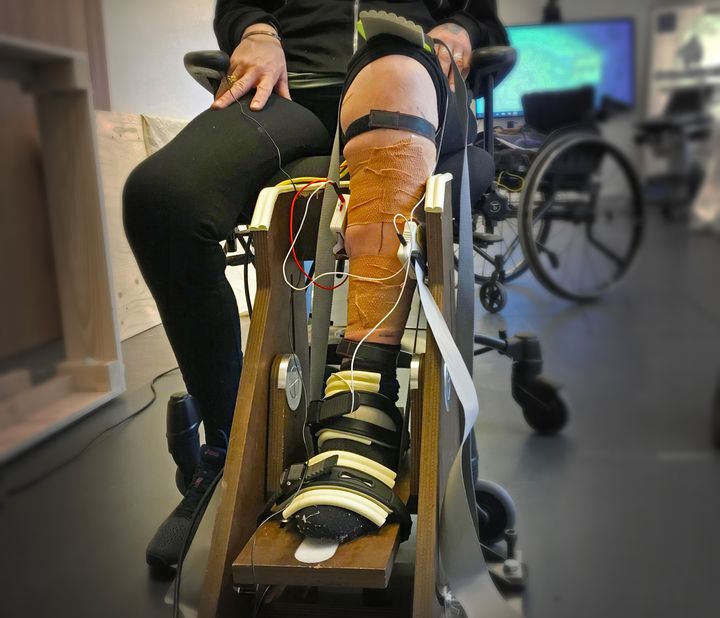
Researchers at KTH Royal Institute of Technology found that nerve-to-muscle signals become less coordinated, leading to instability at low effort and rigid, overcompensated movements at higher force levels.
Using surface skin electrical sensors, researchers identified previously unseen changes in motor coordination that result from incomplete spinal cord injuries (SCI). The study is the first to examine how individual motor units—that is, nerve-to-muscle connections that create movement—work together in people with SCI.
"Our study reveals, at the cellular level, how the central nervous system adapts to the injury to control movement," says Ruoli Wang, associate professor in biomechanics at Promobilia MoveAbility lab, KTH Royal Institute of Technology. She says the researchers' approach was completely non-invasive.
The results were published in the Journal of NeuroEngineering and Rehabilitation.
The study's lead author, PhD student Zhihao Duan, says the researchers found the nervous system struggles to spread signals smoothly across muscles at low levels of exertion after the injury. And it appears to overcompensate at higher levels of exertion, sending "louder", less refined signals.
A single muscle moves through hundreds of motor units, each turning on and off precisely to create smooth force. Composed of a single motor neuron and its connecting muscle fibers, these motor units respond to shared signals from the nervous system, much like different sections of musicians led by an orchestra conductor. That shared input is what allows them to act in coordinated patterns.
Weak coordination at low effort, overcompensation at higher effort
To explore how well these units coordinate under the control of the central nervous system, the team examined 25 people (including 10 control participants). They used high density electromyography (HD-EMG) to measure electrical activity in the functionally similar calf muscles—soleus and gastrocnemius—while volunteers pushed lightly or moderately against a force measurement device.
Duan says that at 20 percent effort, fewer of the motor units in the two calf muscles were working in a shared, coordinated way compared with people without injury. Their movements as a result were shaky and unstable. "They were much less being driven by the same coordinated signal from the nervous system." he says.
At a higher level of effort—50 percent—the SCI group showed stronger low-frequency synchronization between the two muscles. The body loses flexibility and precision in control of the movement. "This could be a sign of the nervous system compensating by sending louder, less refined signals," Duan says.
Implications for rehabilitation
One interesting finding is that after spinal cord injury the nervous system becomes more rigid and less able to change its approach as the muscles work harder. A healthy nervous system on the other hand is able to adapt its strategy as force demands, to adjust the shared neural drive level," Wang says.
Although the study was limited by a small sample size and challenges in identifying enough motor units per muscle from the skin surface, Wang says the results offer unique insight into how SCI reshapes motor control.
"This finding may open the door to a new rehabilitation biomarker, helping clinicians and researchers design new neurorehabilitation strategies to re-tune the spinal cord control and to restore coordinated neural input," she says.
The study was a collaboration with Aleris Rehab Station and was funded by the Swedish Research Council and Promobilia Foundation.
Q&A
Why can people with incomplete spinal cord injury still walk but struggle with balance?
Because walking requires basic muscle activation, which may recover after injury. However, fine coordination between muscles—needed for balance—is disrupted.
What are motor units and why are they important?
Motor units are single motor neurons and the muscle fibers they control. They must work in coordinated patterns to produce smooth, controlled movement.
What happens to muscle coordination after spinal cord injury?
At low effort, coordination weakens, causing instability. At higher effort, the system overcompensates, producing rigid and less precise movement.
How did researchers measure muscle coordination?
They used high-density electromyography (HD-EMG), a non-invasive method that detects electrical activity in muscles through sensors placed on the skin.
How could this research improve rehabilitation?
It may lead to new biomarkers and therapies that target neural coordination, helping patients regain smoother and more stable movement.
Key facts
- Study published: Journal of NeuroEngineering and Rehabilitation (2026)
- Lead institutions: KTH Royal Institute of Technology and Aleris Rehab Station
- Sample size: 25 participants
- Technology: High-density electromyography (HD-EMG)
- Muscles studied: Soleus and gastrocnemius
- Core finding: Reduced coordination at 20% effort, overcompensation at 50%
Contacts
David CallahanInternational Public Information OfficerKTH Royal Institute of Technology
press@kth.seRuoli WangKTH Royal Institute of Technology
Ruoli@kth.seImages
Links
Subscribe to releases from KTH Royal Institute of Technology
Subscribe to all the latest releases from KTH Royal Institute of Technology by registering your e-mail address below. You can unsubscribe at any time.
Latest releases from KTH Royal Institute of Technology
Now multiple optical devices' stabilizing properties can be identified with a single reprogrammable chip14.10.2026 13:03:08 CEST | Press Release
In optical fibers, chips and other light-guiding devices, minor defects can scatter photons and disrupt their path. A new study demonstrates a way to reveal properties which, in certain systems, help light wave behavior withstand such flaws. The method could help speed up the search for new kinds of electronics and optical technologies, and contribute to more reliable quantum devices.
Researchers identify aggressive molecular features in low-risk prostate cancer7.10.2026 13:41:39 CEST | Press Release
A new study revealed molecular features linked to more aggressive prostate cancer in a subset of patients who had been classified as low risk, highlighting biological differences that may not be apparent from clinical measures alone. The results could lead to new therapeutic strategies.
Why do spruce take decades to reproduce? A genetic study offers new clues14.9.2026 17:41:41 CEST | Press Release
New techniques have enabled researchers in Sweden to begin decoding how one of Northern Europe's most important coniferous tree species switches from growing branches to producing cones – their seed-bearing reproductive organs.
KTH builds Swedish expertise in nitrocellulose2.9.2026 12:54:32 CEST | Press Release
Sweden wants to reduce its dependence on foreign suppliers for nitrocellulose, a raw material central to the production of conventional propellants. KTH is now launching a new competence centre to build up expertise across the entire chain – from forest-based raw materials and manufacturing to safe storage.
'Like uprooting tree stumps' – a simpler method to manufacture biosensors27.8.2026 15:42:00 CEST | Press Release
A new manufacturing method could help move the production of nanoscale sensors from specialized fabrication facilities to conventional semiconductor manufacturing plants.
In our pressroom you can read all our latest releases, find our press contacts, images, documents and other relevant information about us.
Visit our pressroom