
Ice may release more iron than climate models predict
26.5.2026 10:00:00 CEST | Umeå University | Press Release
Most people think of ice as frozen and lifeless, but research at Umeå University shows the opposite. A new study published in PNAS demonstrates that ice actively speeds up the breakdown of iron minerals and may release more iron than current environmental models account for. This is crucial for predicting how nutrient cycles, carbon storage, and water quality will change in polar and mountain regions as the planet warms.
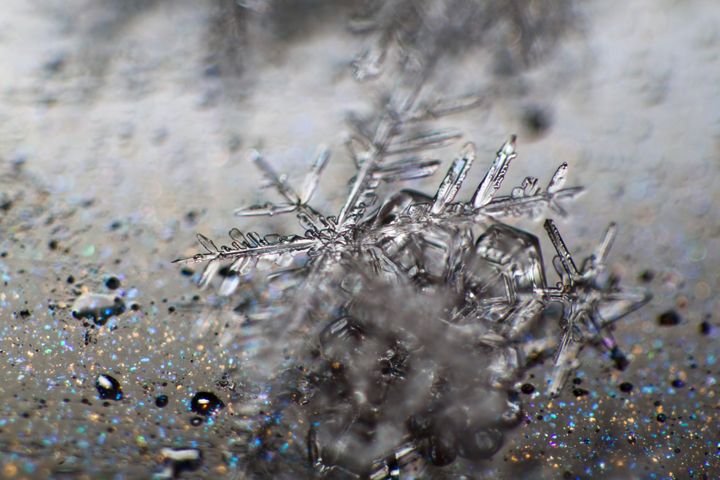
Roughly 17 percent of Earth's land surface sits on permafrost, and vast additional areas experience seasonal freezing. As climate change increases the frequency of freeze-thaw cycles and causes permafrost to degrade, ice-driven mechanisms could be releasing iron and other trace elements at rates that current environmental models do not account for.
“To understand how climate change affects natural systems, we also need to understand the chemistry inside ice,” says Jean-François Boily, Professor at the Department of Chemistry, who led the study.
Iron is a key nutrient that controls algae growth in lakes and oceans, binds carbon in soils, and affects water color and quality. Changes in iron release could therefore have cascading effects on ecosystems from mountain streams to Arctic coastlines.
The stronger the binding, the greater the boost
The research group looked at how different dissolved salts, found everywhere in nature, affect iron minerals. They specifically examined the dissolution of goethite, a rust-colored iron mineral abundant in soils, sediments, and dust.
“The result was remarkably clear. Ice boosted the dissolution rate for every salt that binds to iron, and the stronger the binding, the greater the boost,” says Jean-François Boily. “This reveals a simple rule: If you know how strongly a substance binds to iron, you can likely estimate how much ice will amplify its.”
Fluoride, the strongest binder tested, released more than four times as much iron in ice as in liquid water. Sulfate, a weaker binder, showed a smaller but still measurable boost. Perchlorate, which barely interacts with iron at all, produced no dissolution in either phase.
Valuable tool for modeling
The mechanism lies in what happens when water freezes. Substances that cannot be incorporated into the ice are concentrated into tiny pockets of remaining liquid trapped between ice crystals. In these environments, where salt concentrations can increase up to 500-fold, chemical reactions can proceed much faster, which helps explain the increased breakdown of minerals observed in the study.
"What surprised us most was how consistent this effect appeared across the compounds we tested. If the pattern holds more broadly, we could potentially predict ice-enhanced mineral breakdown based on a single chemical property. That would be a valuable tool for environmental modeling," says Jean-François Boily.
About the scientific study
Tao Chen, Tao Luo, Tra My Bui Thi, Hervé Colloc, Claire Roiland, Laurent Le Pollès, Khalil Hanna and Jean-François Boily. Ice amplifies ligand-controlled mineral dissolution in microscale hot spots. Proceedings of the National Academy of Sciences (PNAS), April 2026.
Contacts
Jean-François BoilyProfessorDepartment of Chemistry
Tel:+46 90 786 52 70jean-francois.boily@umu.seSara-Lena BrännströmCommunications officerFaculty of Science & Technology
Tel:+46 90 786 72 24sara-lena.brannstrom@umu.seGeneral Press InquiriesPress Officer
Tel:+46 90 786 50 89press@umu.seImages

About us
Umeå University is a comprehensive university and one of Sweden’s largest higher education institutions with around 38,000 students and 4,600 staff. We have a diverse range of high-quality educational programmes and research within all disciplinary domains and the arts. The University offers world-class educational and research environments and helps expand knowledge of global significance. This is where the groundbreaking discovery was made of the CRISPR-Cas9 gene-editing tool, which was awarded the Nobel Prize in Chemistry. At Umeå University, everything is just around the corner. Our tightly knit campus makes it easy to meet, collaborate and share knowledge, something that encourages a dynamic and open culture.
Subscribe to releases from Umeå University
Subscribe to all the latest releases from Umeå University by registering your e-mail address below. You can unsubscribe at any time.
Latest releases from Umeå University
Katarina Pierre steps down after 16 years as artistic director of Bildmuseet11.9.2026 13:23:51 CEST | Press Release
With an unfailing eye for artistic quality and a deep belief in the importance of art, Katarina Pierre has developed Bildmuseet into one of Sweden’s leading venues for international contemporary art. After 16 years as artistic director, she is now retiring.
A few minutes of freezing can change the fate of iron in nature27.8.2026 09:00:00 CEST | Press Release
Just a few minutes of freezing and thawing can have a decisive impact on how ferrihydrite, the most reactive iron mineral in cold soils, permafrost and glaciers, transforms, according to researchers at Umeå University in a paper published in the journal Science. As climate warming intensifies freeze-thaw cycles and extends them into new regions, ice is becoming an increasingly important driver of Earth's ecosystems.
New study maps how gut bacteria help and hinder each other's growth24.8.2026 09:00:00 CEST | Press Release
Researchers at Umeå University have mapped interactions between common gut bacteria, creating one of the most comprehensive datasets of its kind. Published in Nature Communications, the study reveals that most bacteria compete with one another, but also identifies mechanisms through which some bacteria promote the growth of others.
Thawing permafrost may trigger overlooked carbon sink in rivers17.6.2026 17:00:00 CEST | Press Release
A new study published in Nature study shows that rock weathering increasingly counteracts river CO₂ emissions as permafrost degrades. The study has been carried out by a collaborative team of researchers from Umeå University, Sweden, and East China Normal University.
Potatoes benefit when two soil bacteria team up16.6.2026 09:00:00 CEST | Press Release
Researchers at Umeå University have shown that two soil bacteria can work together to influence potato development. The bacterial partnership triggered distinct responses in potato plants and was associated with earlier tuber initiation and improved yield under greenhouse conditions. The findings suggest that combinations of beneficial soil bacteria could become a valuable tool for potato growers in the future.
In our pressroom you can read all our latest releases, find our press contacts, images, documents and other relevant information about us.
Visit our pressroom