
Whole organ 3D imaging reveals remaining insulin producing cells in type 1 diabetes
26.5.2026 21:21:47 CEST | Umeå University | Press Release
Researchers at Umeå University have conducted a unique three-dimensional mapping of an entire human pancreas. The study shows that insulin-producing cells can remain long after the onset of type 1 diabetes – a finding that suggests the disease progression is more complex than previously assumed.
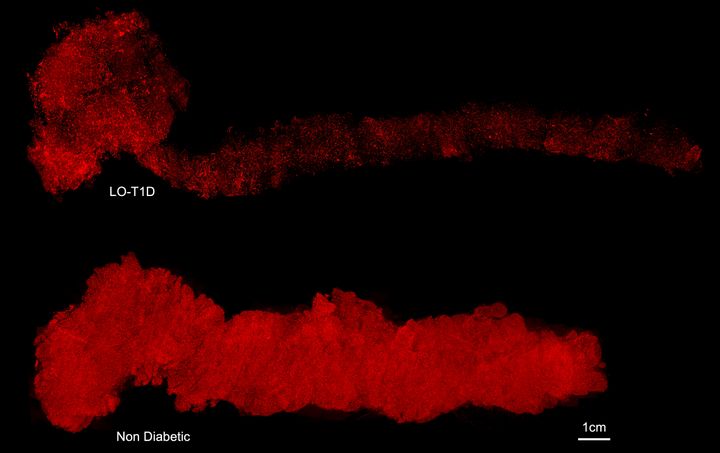
“Our results suggest the pancreas can retain β cells – those insulin‑producing cells that are typically destroyed in type 1 diabetes – in a way that has not previously been recognized,” says Ulf Ahlgren, Professor at the Department of Medical and Translational Biology at Umeå University.
Using advanced imaging technologies, researchers at Umeå University have created the first complete 3D map of an entire pancreas from a donor with late‑onset type 1 diabetes, at a microscopic resolution. The analysis revealed that while traditional islets of Langerhans were largely depleted of β-cells, a substantial number of insulin‑producing cells still remained outside the islet structures. These were primarily found as individual cells or as small clusters of b-cells, in which the cells were distanced from all other endocrine cell types. In total, the researchers identified hundreds of thousands of insulin‑positive objects.
“The fact that these cells are located outside the islets and are more numerous than the islet‑associated β-cells, i.e. in inversed proportions compared to non-diabetic subjects, suggests that they may either be more resistant to destruction or that new β-cells can be formed,” says Ulf Ahlgren.
The researchers argue that analyses traditional islet-focused analyses risk underestimating how many β-cells actually survive in type 1 diabetes. The new findings point to a previously overlooked cellular reservoir that could, in the long term, become a target for novel therapeutic strategies.
“The ability to study individual cells throughout an entire organ and from all angles has the potential to change how we think about β‑cell loss,” explains Ulf Ahlgren. “If certain regions of the pancreas promote β‑cell survival, understanding these microenvironments could help guide the development of therapies that stabilize, or even expand the remaining b-cells in type 1 diabetes.”
Doctoral student Joakim Lehrstrand also emphasizes the importance of broadening the perspective.
“This work shows that we must look beyond the islets when studying β‑cell biology in type 1 diabetes,” he says.
The research group believes that whole‑organ 3D imaging will become a key tool in future studies of type 1 diabetes and other pancreas related diseases, such as type 2 diabetes and pancreas cancer. The method makes it possible to identify specific regions or even individual cells throughout the entire organ, something that has previously been extremely difficult using conventional techniques. These regions can then be isolated for further molecular analyses.
“Hopefully, this will help us understand whether and how β-cells and their microenvironment differ within the pancreas in diabetes,” says Ulf Ahlgren.
The results have been published in Science Advances.
About the scientific article:
Joakim Lehrstrand et al.: 3D imaging of an entire pancreas shows inverse proportions of extra-islet versus islet-associated β cells in late-onset type 1 diabetes. Sci. Adv.12,eaed0496(2026).
DOI:10.1126/sciadv.aed0496
Keywords
Contacts
Ulf Ahlgren, Department of Department of Medical and Translational Biology at Umeå University
Mobile: +46 (0)70 220 92 28
Email: ulf.ahlgren@umu.se
Images

Links
About us
Umeå University is a comprehensive university and one of Sweden’s largest higher education institutions with around 38,000 students and 4,600 staff. We have a diverse range of high-quality educational programmes and research within all disciplinary domains and the arts. The University offers world-class educational and research environments and helps expand knowledge of global significance. This is where the groundbreaking discovery was made of the CRISPR-Cas9 gene-editing tool, which was awarded the Nobel Prize in Chemistry. At Umeå University, everything is just around the corner. Our tightly knit campus makes it easy to meet, collaborate and share knowledge, something that encourages a dynamic and open culture.
Subscribe to releases from Umeå University
Subscribe to all the latest releases from Umeå University by registering your e-mail address below. You can unsubscribe at any time.
Latest releases from Umeå University
Katarina Pierre steps down after 16 years as artistic director of Bildmuseet11.9.2026 13:23:51 CEST | Press Release
With an unfailing eye for artistic quality and a deep belief in the importance of art, Katarina Pierre has developed Bildmuseet into one of Sweden’s leading venues for international contemporary art. After 16 years as artistic director, she is now retiring.
A few minutes of freezing can change the fate of iron in nature27.8.2026 09:00:00 CEST | Press Release
Just a few minutes of freezing and thawing can have a decisive impact on how ferrihydrite, the most reactive iron mineral in cold soils, permafrost and glaciers, transforms, according to researchers at Umeå University in a paper published in the journal Science. As climate warming intensifies freeze-thaw cycles and extends them into new regions, ice is becoming an increasingly important driver of Earth's ecosystems.
New study maps how gut bacteria help and hinder each other's growth24.8.2026 09:00:00 CEST | Press Release
Researchers at Umeå University have mapped interactions between common gut bacteria, creating one of the most comprehensive datasets of its kind. Published in Nature Communications, the study reveals that most bacteria compete with one another, but also identifies mechanisms through which some bacteria promote the growth of others.
Thawing permafrost may trigger overlooked carbon sink in rivers17.6.2026 17:00:00 CEST | Press Release
A new study published in Nature study shows that rock weathering increasingly counteracts river CO₂ emissions as permafrost degrades. The study has been carried out by a collaborative team of researchers from Umeå University, Sweden, and East China Normal University.
Potatoes benefit when two soil bacteria team up16.6.2026 09:00:00 CEST | Press Release
Researchers at Umeå University have shown that two soil bacteria can work together to influence potato development. The bacterial partnership triggered distinct responses in potato plants and was associated with earlier tuber initiation and improved yield under greenhouse conditions. The findings suggest that combinations of beneficial soil bacteria could become a valuable tool for potato growers in the future.
In our pressroom you can read all our latest releases, find our press contacts, images, documents and other relevant information about us.
Visit our pressroom