
Why your building is often too hot, or cold — and the simple fix
3.6.2026 13:28:26 CEST | KTH Royal Institute of Technology | Press Release
Not happy with the heating in your office, or your apartment building? A new study shows that complicated “smart building” technology isn’t the only answer for spaces that feel too hot after lunch, or too cold in the morning.

Highlights:
- Heating based only on outdoor temperature misses key factors. Study shows accounting for sunlight, ventilation and occupancy increased comfort from 60% to 90%+.
- Simple adjustment to existing control logic — not new hardware or AI —cut heating use by 10–13% and trimmed costs by ~8.5% in real building test.
- In April–May, traditional systems can misjudge heating by 50–70%, wasting energy when sunlight takes over.
In many cases, heating can be significantly improved simply by adjusting existing controls to account for sunlight, ventilation and how many people are inside, according to researchers at KTH Royal Institute of Technology in Stockholm.
Heating systems in most buildings are regulated by a single factor: the outside temperature. But that ignores the factors that affect how warm a building feels inside – namely, solar radiation, occupancy and airflow.
Amirmohammad Behzadi, a researcher at KTH, says these three inputs form the core of a simple fix that made a significant difference when tested in a six-story building in Sweden. More development would be needed in order to commercialize the concept, but the onsite test showed that adding these three factors to regulate building temperature resulted in consistently comfortable temperatures and 13 percent lower energy use, without resorting to complex artificial intelligence or heavy computing.
The researchers report that the biggest energy savings of between 56 percent and 70 percent could be realized during the transitional months of spring.
In practice, this type of “adaptive” control works like a smarter version of the type of heating control most buildings use, Behzadi says. When sunshine warms a room, for example, the system automatically lowers the hot-water temperature entering the radiators rather than keeping it constant. When a space fills with people — who generate heat themselves — it adjusts again. And when ventilation brings in cooler outside air, it compensates for the resulting heat loss.
The research, which was published in the journal Energy Conversion and Management, shows that tackling climate emissions from buildings may not always require costly new technologies that rely on real-time optimization, weather forecasting or machine learning.
“Sometimes, it may just mean rethinking the rules we already use,” Behzadi says. Sensors already provide data for solar and ventilation in many buildings, and occupancy can be estimated by sensing CO2 and ventilation demand, as well as by feeding in data on occupants’ daily schedules.
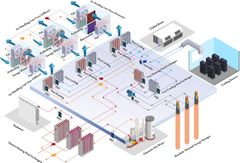
Behzadi says the concept could be adaptable to many types of buildings, even to those with analog systems. The researchers tested their approach over the course of a year in a 10,000-square-metre “green” commercial property with radiators supplied by a combination of district heating and underground heat storage.
Comparing the results with the building’s basic control model based solely on outdoor temperature, they found that the percentage of time in which indoor temperatures remained within the comfort range rose from 60 to more than 90 percent. Deviations from the ideal indoor temperature were reduced by 73 percent. At the same time, energy use decreased by around 10 to 13 percent. Carbon emissions fell by roughly 9 percent, and operating costs dropped by about 8.5 percent.
Because most large buildings already have some form of central control or building management system, this type of optimization can often be integrated with minimal disruption, whether in offices, apartment blocks or public buildings, according to Behzadi. Data on temperature, sunlight, occupancy and ventilation can be collected through relatively simple upgrades and fed into a control system that adjusts heating in real time, he says.
Contacts
Amirmohammad Behzadi
abehzadi@kth.seImages


Subscribe to releases from KTH Royal Institute of Technology
Subscribe to all the latest releases from KTH Royal Institute of Technology by registering your e-mail address below. You can unsubscribe at any time.
Latest releases from KTH Royal Institute of Technology
KTH builds Swedish expertise in nitrocellulose2.9.2026 12:54:32 CEST | Press Release
Sweden wants to reduce its dependence on foreign suppliers for nitrocellulose, a raw material central to the production of conventional propellants. KTH is now launching a new competence centre to build up expertise across the entire chain – from forest-based raw materials and manufacturing to safe storage.
'Like uprooting tree stumps' – a simpler method to manufacture biosensors27.8.2026 15:42:00 CEST | Press Release
A new manufacturing method could help move the production of nanoscale sensors from specialized fabrication facilities to conventional semiconductor manufacturing plants.
Technique could make flat optic fiber 1,000 times more sensitive than standard fiber13.8.2026 10:57:20 CEST | Press Release
Optical fiber has already transformed the modern world. New research now suggests it could do even more. A new flat fiber fabrication technique produces a high fidelity sensor for a wide range of applications, from batteries to bridges, according to a recently-published study.
New chip offers way to make use of quantum system ‘imperfections’19.5.2026 14:30:22 CEST | Press Release
Quantum technologies promise powerful new kinds of computers, giving scientists new tools to mimic and explore nature at its tiniest scales. At those levels, everything in nature—from atoms and electrons to light itself—follows the strange rules of quantum mechanics. But the real world is never perfectly clean: signals fade, energy leaks away and systems pick up noise from their surroundings.
How to save computing energy? This study shows a way to engineer materials so magnetic signals can carry information6.5.2026 13:06:14 CEST | Press Release
A recent study shows a new and potentially more energy efficient way for information to be transmitted inside electronic systems, including computers and phones—without relying on electric currents or external magnetic fields.
In our pressroom you can read all our latest releases, find our press contacts, images, documents and other relevant information about us.
Visit our pressroom