
After the war, Mostar is shaped by struggles over memory and the future
2.6.2026 13:02:00 CEST | Umeå University | Press Release
What should be preserved, rebuilt or forgotten after a war? A new study from Umeå University shows how conflicts over history, identity and the future continue to shape the Bosnian city of Mostar, three decades after the Bosnian War.
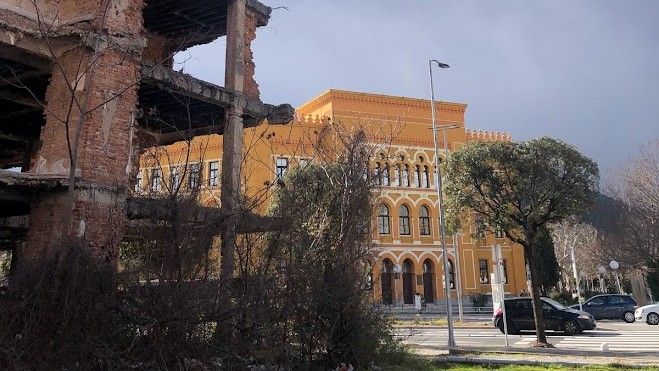
The war in Bosnia and Herzegovina between 1992 and 1995 left large parts of the city of Mostar in ruins. But rebuilding the city has involved far more than repairing houses and streets. This is highlighted in new research from Umeå University.
According to Matheus Souza, a doctoral student in political science, the city’s urban spaces still carry different narratives about the past and competing visions of the future.
Key findings of the research
• The city’s urban spaces are still shaped by conflicts over memory, identity and the future.
• For some people, the remaining war ruins symbolised stagnation and a need for modernisation, while others saw them as important for memory and continuity.
• Conflicts over the city’s future became visible in memorial sites, commercial projects and artistic initiatives.
• Peace after war is not only about political agreements or the absence of violence.
• Urban development after war is not only a technical or economic issue.
Quotes
“My research shows that places are never experienced solely as physical locations. They are also shaped by different memories of the past, experiences of the present and expectations for the future,” says Matheus Souza.
“Peace is also shaped through the organisation of urban space and time: through whether people are able to maintain continuity in everyday life, whether they can recognise themselves in the city around them and whether they can imagine sustainable futures after the war,” says Matheus Souza.
Read the full research
Space, Time and Peace in Post-War Mostar
More information
For more information or interview requests, please contact Matheus Souza
A longer article will be published on www.umu.se/en under Social Sciences
Keywords
Contacts
Matheus SouzaDoctoral student in political scienceUmeå University
Tel:+46 90 786 73 99matheus.souza@umu.sewww.umu.se/en/staff/matheus-souza/Charlotte StåhlCommunications Officer and press contactSocial Sciences
Tel:+4690 786 74 89charlotte.stahl@umu.sewww.umu.se/personal/charlotte-stahl/Images

About us
Umeå University is a comprehensive university and one of Sweden’s largest higher education institutions with around 38,000 students and 4,600 staff. We have a diverse range of high-quality educational programmes and research within all disciplinary domains and the arts. The University offers world-class educational and research environments and helps expand knowledge of global significance. This is where the groundbreaking discovery was made of the CRISPR-Cas9 gene-editing tool, which was awarded the Nobel Prize in Chemistry. At Umeå University, everything is just around the corner. Our tightly knit campus makes it easy to meet, collaborate and share knowledge, something that encourages a dynamic and open culture.
Subscribe to releases from Umeå University
Subscribe to all the latest releases from Umeå University by registering your e-mail address below. You can unsubscribe at any time.
Latest releases from Umeå University
Katarina Pierre steps down after 16 years as artistic director of Bildmuseet11.9.2026 13:23:51 CEST | Press Release
With an unfailing eye for artistic quality and a deep belief in the importance of art, Katarina Pierre has developed Bildmuseet into one of Sweden’s leading venues for international contemporary art. After 16 years as artistic director, she is now retiring.
A few minutes of freezing can change the fate of iron in nature27.8.2026 09:00:00 CEST | Press Release
Just a few minutes of freezing and thawing can have a decisive impact on how ferrihydrite, the most reactive iron mineral in cold soils, permafrost and glaciers, transforms, according to researchers at Umeå University in a paper published in the journal Science. As climate warming intensifies freeze-thaw cycles and extends them into new regions, ice is becoming an increasingly important driver of Earth's ecosystems.
New study maps how gut bacteria help and hinder each other's growth24.8.2026 09:00:00 CEST | Press Release
Researchers at Umeå University have mapped interactions between common gut bacteria, creating one of the most comprehensive datasets of its kind. Published in Nature Communications, the study reveals that most bacteria compete with one another, but also identifies mechanisms through which some bacteria promote the growth of others.
Thawing permafrost may trigger overlooked carbon sink in rivers17.6.2026 17:00:00 CEST | Press Release
A new study published in Nature study shows that rock weathering increasingly counteracts river CO₂ emissions as permafrost degrades. The study has been carried out by a collaborative team of researchers from Umeå University, Sweden, and East China Normal University.
Potatoes benefit when two soil bacteria team up16.6.2026 09:00:00 CEST | Press Release
Researchers at Umeå University have shown that two soil bacteria can work together to influence potato development. The bacterial partnership triggered distinct responses in potato plants and was associated with earlier tuber initiation and improved yield under greenhouse conditions. The findings suggest that combinations of beneficial soil bacteria could become a valuable tool for potato growers in the future.
In our pressroom you can read all our latest releases, find our press contacts, images, documents and other relevant information about us.
Visit our pressroom